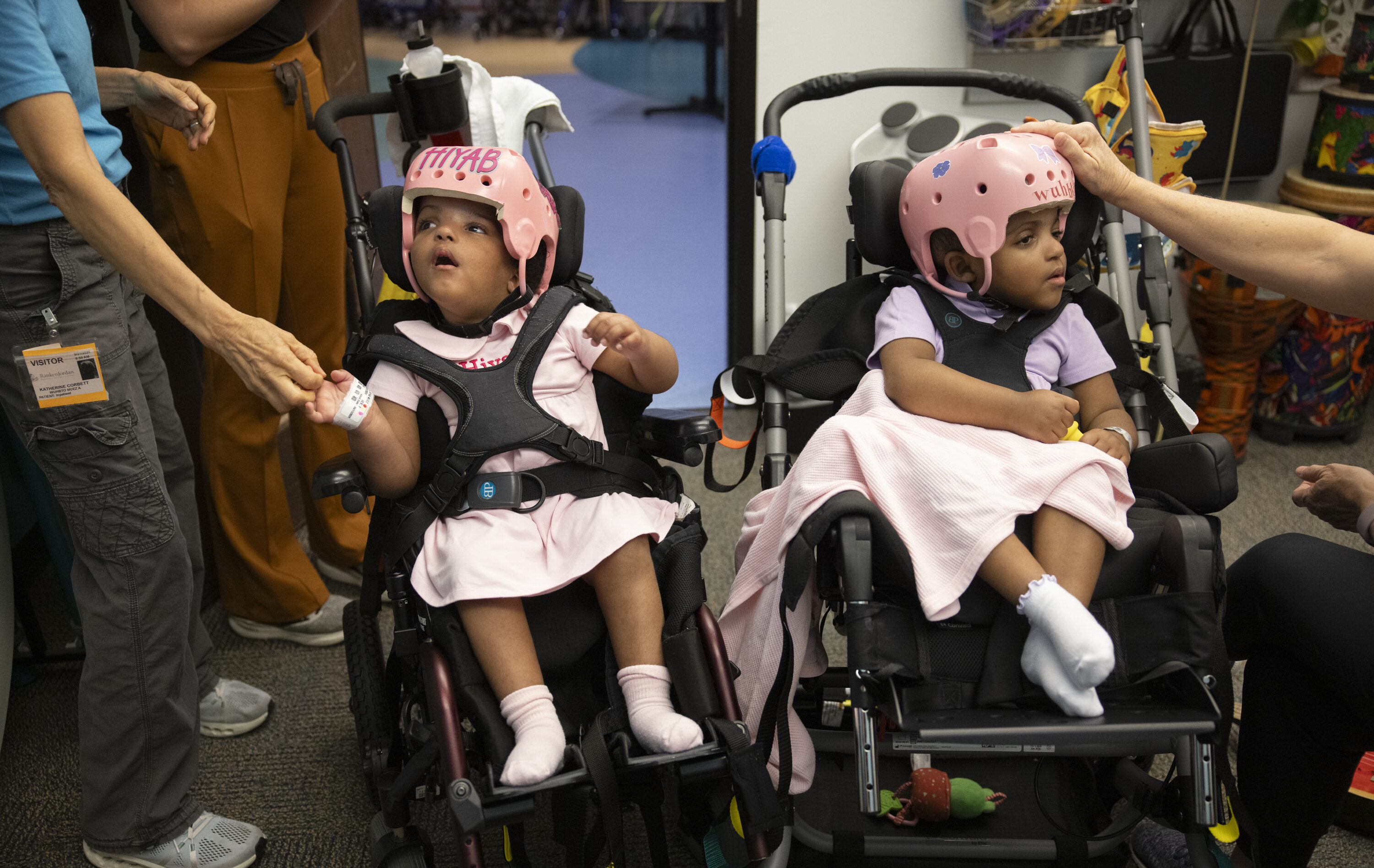
Cardinal Glennon Children’s Hospital succesfully separates twins conjoined at the head
The 2-year-old twin sisters lit up immediately as Kate Corbett leaned toward them with a wide smile, reciting the familiar lines of “Goodnight Moon.”
“A little old lady, whispering…” Corbett waited for the girls to fill in their favorite part.
“Hush,” the girls shushed, grinning side-by-side.
“Side by side” is still relatively new for Wuhbto and Hiyab. They were born craniopagus twins — conjoined at the head — and spent the first two years of their lives attached but facing opposite directions.
The girls were successfully separated in the spring after a series of six surgeries at SSM Health Cardinal Glennon Children’s Hospital. They are now receiving transitionary care at Ranken Jordan Pediatric Bridge Hospital.
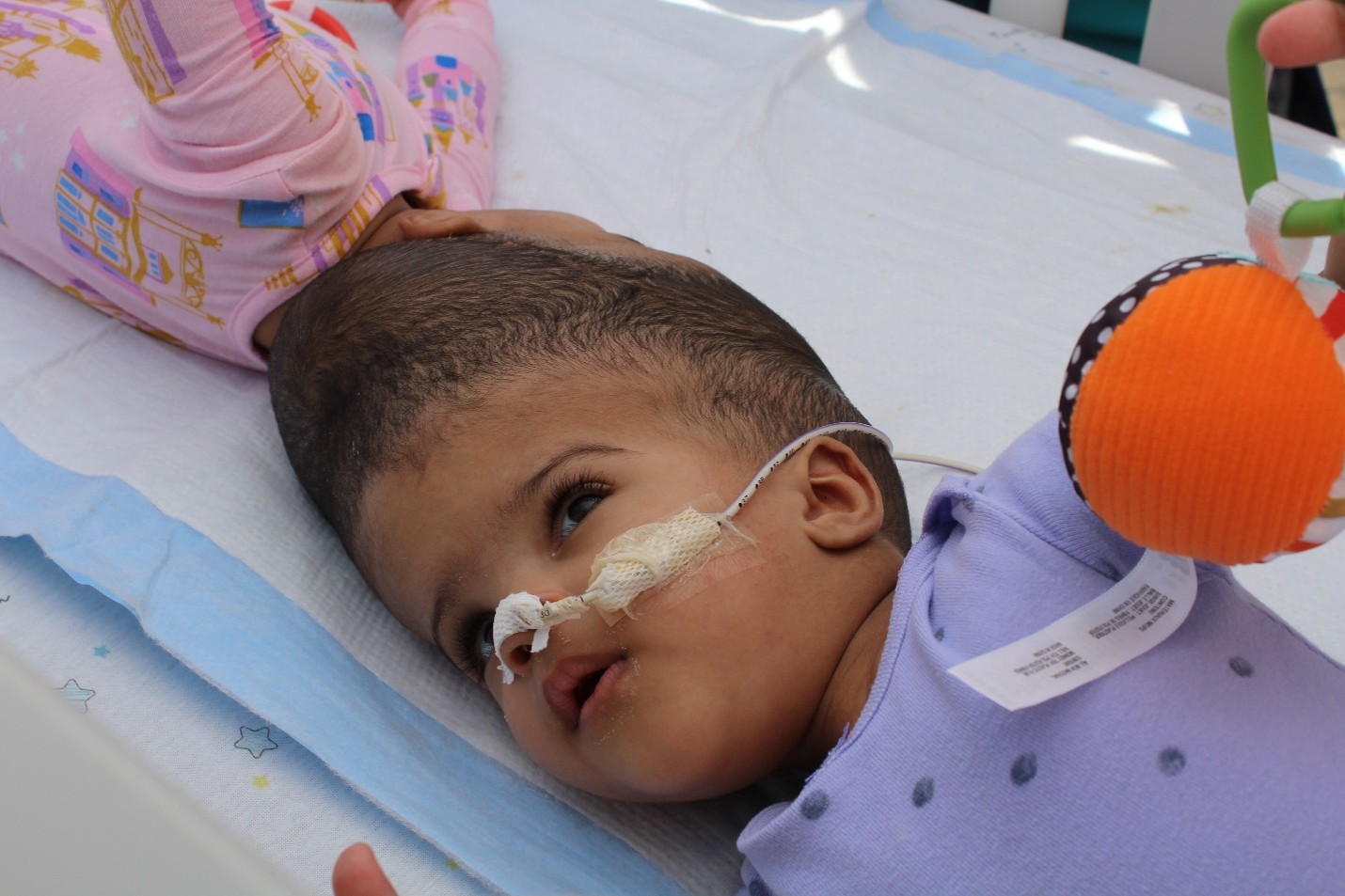
Twin sisters Hiyab and Wuhbto before surgery.
Wuhbto and Hiyab were born in the Tigray region of Ethiopia on March 31, 2024. Their journey to St. Louis began when Cardinal Glennon chief medical officer Dr. Andrew White received a call from a colleague with whom he had previously traveled to northern Ethiopia.
“When I heard about the twins’ condition, I knew Cardinal Glennon had both the expertise, capabilities and commitment to help,” White said at a Sept. 16 news conference.
The girls had been living at Lola Children’s Home in Ethiopia, which gave them better access to regular medical care than they would have had at home. Global nonprofit World Pediatrics coordinated their travel on Ethiopian Airlines, and Wuhbto and Hiyab arrived in St. Louis shortly before their first birthday.
Craniopagus twins are rare, occurring once in every 2.5 million live births and making up less than 6% of all conjoined twins. Just 32 craniopagus separations have been performed in the past 30 years, and 62 in the past 100 years, said Dr. Kevin Chen, a plastic surgeon at Cardinal Glennon. (One of those was performed at Cardinal Glennon in the 1980s by Dr. Richard Bucholz, who consulted with Wuhbto and Hiyab’s team.)
This case required expertise from “virtually every corner of pediatric medicine,” head pediatric neurosurgeon Dr. Joanna Kemp said. While the twins’ brains were mostly separate, fused in only a few small areas, they shared a large network of connected veins. Separating them meant assigning veins to one sister or the other, which was done gradually over the course of four surgeries and several months.
Their skulls were fused together at the widest part of the head, said Chen, who is also the head of Cardinal Glennon’s 3D Printing Center of Excellence. Prior to separation, doctors used balloon-type expanders to stretch the skin and increase the surface area available to dedicate to each twin.
“They were missing the most bone, the most skin possible, and we scraped and scrounged just to maximally get as much skin as we could so that the separation could be successful,” he said.
The 3D printing center’s technology was vital to the team’s planning, Chen said. The realistic models of the twins’ anatomy allowed them to rehearse different approaches to separation and reconstruction; virtual reality systems gave them a chance to move things around as they went through possible surgical options.
The final separation surgery, involving more than 60 medical team members, took place over 25 hours on Feb. 24-25. Two teams worked on the twins; after separation, the beds were rotated 180 degrees away from each other so each team could finish the surgery on the now-separate girls.
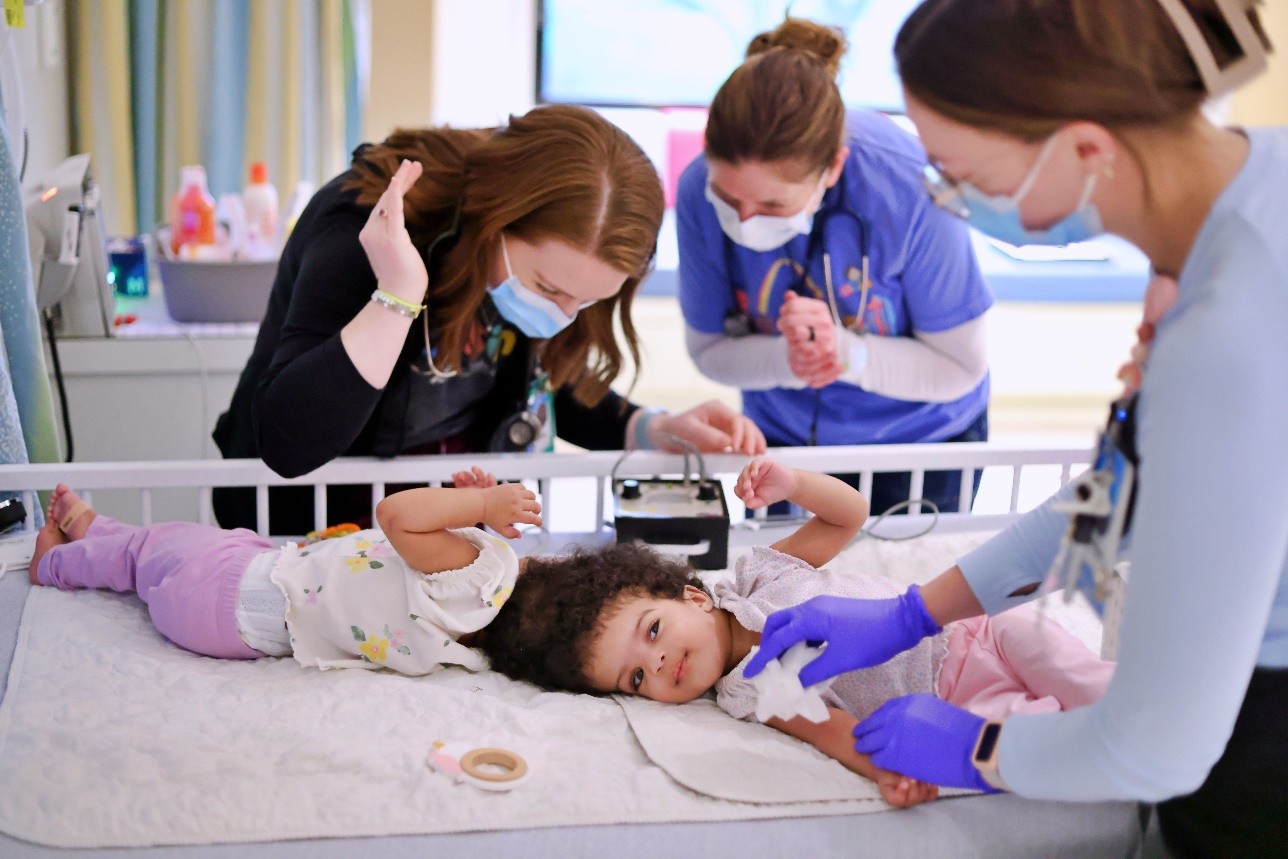
Twin sisters Hiyab and Wuhbto during a check up before their surgery.
Wuhbto has since undergone a successful cranioplasty to reconstruct her skull, and Hiyab is expected to undergo the same surgery later this fall. It’s too soon to know exactly what the girls’ long-term development will look like, but the medical team is encouraged by the progress they’ve made since separation, Kemp said.
“Our goal was never simply to just achieve a successful separation,” Kemp said. “Our goal was to create opportunities that they otherwise would not have had, while preserving their greatest potential for continued growth and development.”
‘Two joyful girls’
At Ranken Jordan Pediatric Bridge Hospital, Wuhbdo and Hiyab are taking full advantage of the hospital’s “care beyond the bedside” model of transitionary care, engaging in activities around the hospital that mimic children’s daily living in addition to a range of therapies.
The twins had previously stayed at Ranken Jordan for about a month prior to their surgeries.
“They are now able to participate in individually focused therapies, to do the activities of daily living they could not do while conjoined, such as simple things like sitting upright, and they can eventually learn to stand and walk. They’re already working on eating and speaking and socializing and playing with other kids, including each other,” said Dr. Nick Holekamp, chief health transformation officer at Ranken Jordan.
Corbett, a St. Louis native and one of the founders of the St. Louis chapter of World Pediatrics, has been one of the girls’ main caregivers for the past year and a half. Because the twins’ parents were unable to travel with the girls to the U.S. due to a variety of social and visa reasons, Corbett and others are in close contact with them, sharing thorough updates, photos, videos and FaceTime calls.
She was in the room when the girls were able to lay next to each other for the first time following their separation.
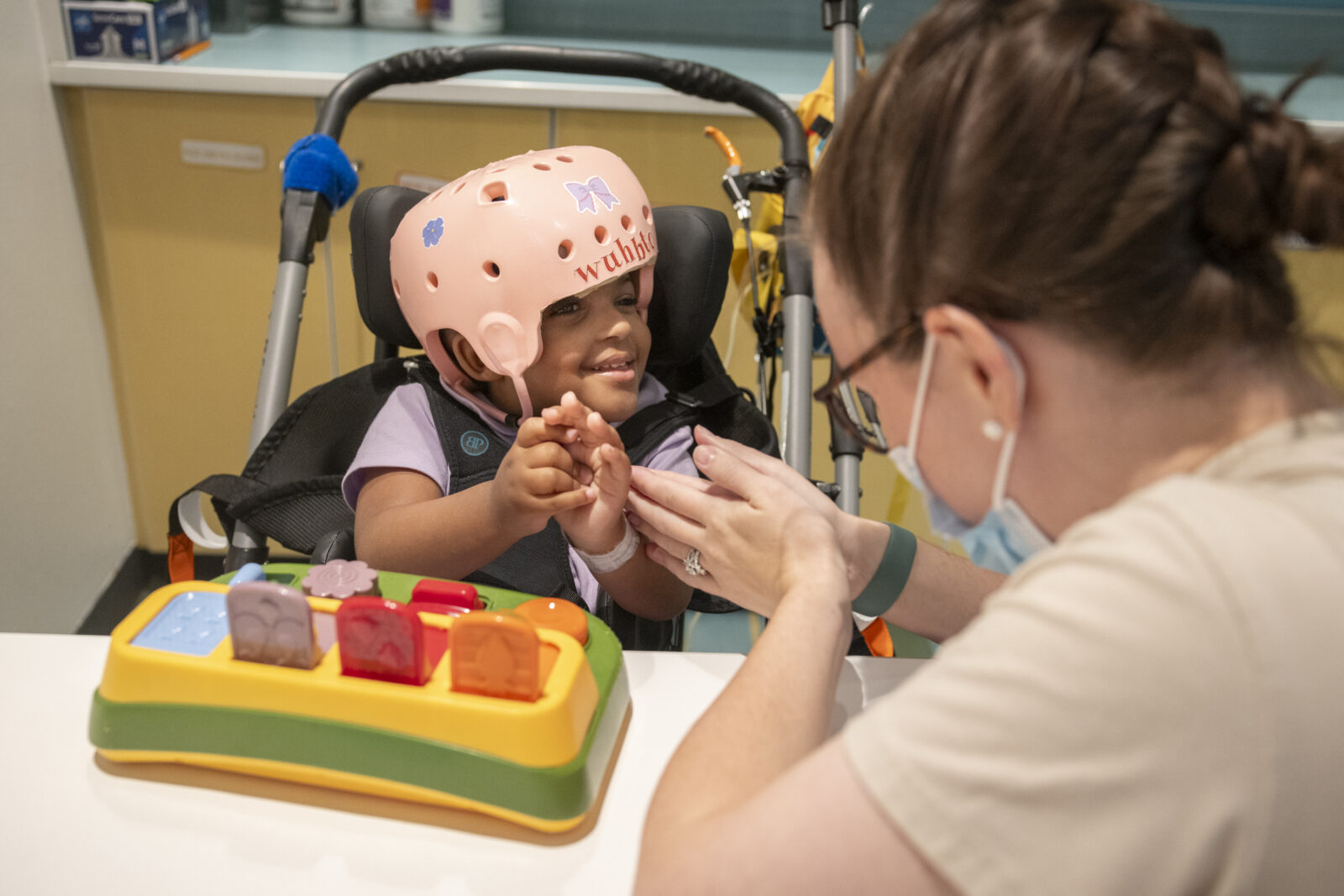
“They had banged each other and reached each other and pulled each other’s hair, but never before had they been able to snuggle up to each other and to reach for each other and be together in that special, sisterly way,” she said.
It’s been beautiful to watch their personalities emerge as they grow into toddlerhood, Corbett said. Wuhbto has found her voice and “is always moving, always wanting to be on the go. She’s also very discerning — if you sing the wrong song, she will let you know. If you give her the wrong toy, she will let you know,” she said.
Hiyab is the social butterfly, Corbett said. Before surgery, “if anyone walked in the room, if she was facing the other direction, she would flip her sister over and just want that undivided attention. She just loves people, and she just welcomes you in so sweetly,” she said. “You’ll see that she gives everyone
a sweet smile, and when she gets the giggles, she can’t stop.”
Families from the St. Louis Tigray community have also stepped in to be part of the twins’ lives, visiting them to speak and sing to them in their native language. After Wuhbto and Hiyab have recovered enough to return to Ethiopia, they will likely live at Lola Children’s Home for a time as another “bridge” of care before going home to their mother, father and two older brothers.
Abebe Fantahum, founder of Lola Children’s Home, thanked everyone involved in the girls’ care in a pre-recorded video message at the Sept. 16 news conference.
“When I think about Hiyab and Wuhbto’s future, I see two joyful girls continue to grow, learn and discover who they are as individuals,” he said. “My hope is that they will return home knowing how deeply they are loved, both in Ethiopia and St. Louis. Dear, beloved community in St. Louis, these girls are here because you chose to care.”