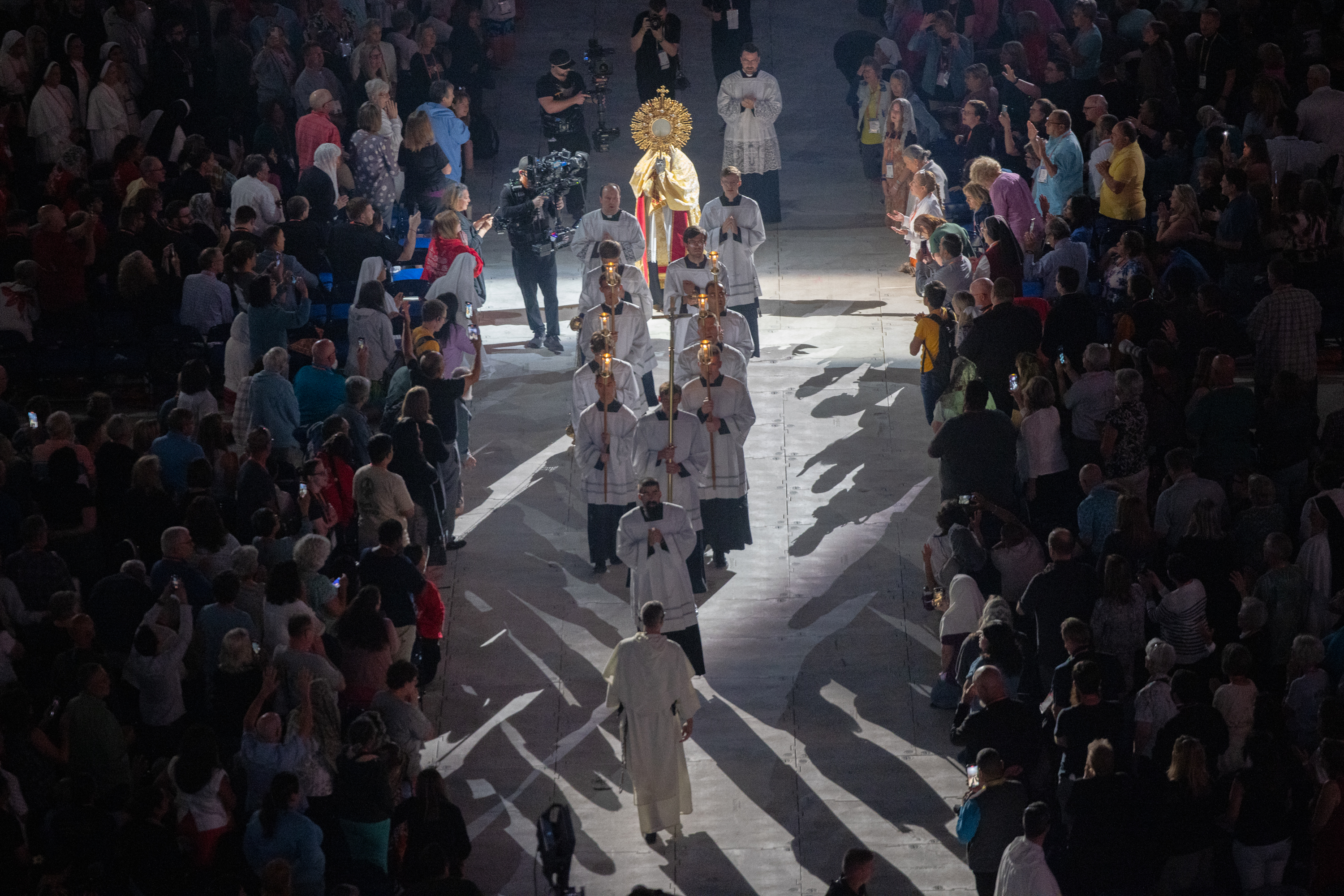
One challenge that was identified was reaching Catholics who were not already engaged with the Church
The National Eucharistic Revival — a three-year initiative to renew belief in the real presence of Jesus Christ in the Eucharist, following a marked decline in belief among U.S. Catholics — has rekindled both faith and outreach, according to a new study, although several challenges remain in extending those results to those not already in the pews.
The findings were released Jan. 15 in “Share Your Perspective” (“Comparte tu perspectiva”), a national survey of the impact of the National Eucharistic Revival conducted by the Catholic market research firm Vinea Research, which had been engaged by revival organizers and the U.S. Conference of Catholic Bishops.
“The bishops decided to take time to hear from Catholics in the United States about their experiences of the fruits of the Eucharistic Revival, to recognize ongoing needs within the Church, and to identify areas for potential growth in the future,” wrote Archbishop Charles C. Thompson of Indianapolis, chair of the USCCB’s Committee on Evangelization and Catechesis, in a Jan. 15 letter announcing the data’s release.
He explained the survey had been developed in two phases, with one-on-one interviews shaping the questions ultimately provided to just under 2,500 respondents.
The second phase’s online data collection took place during the summer and fall of 2025 — one year after the 10th National Eucharistic Congress, held in July 2024 in Indianapolis and preceded by the first National Eucharistic Pilgrimage, the four routes of which converged at the congress.
Of the online sample, 2,058 were lay Catholics who had not been involved in the revival’s organization. Lay Catholics were classified in the survey as national participants (50%), meaning they participated in either the National Eucharistic Congress or National Eucharistic Pilgrimage; as local participants (24%), meaning they joined in a local Eucharistic Revival activity but not in a national event; or were nonparticipants (26%) in revival activities.
The remaining sample, which the report described as “ecclesial,” represented 414 respondents who were priests, deacons or revival point persons.
On balance, the survey data showed both the “lay” and “ecclesial” groups benefited from the National Eucharistic Revival, reporting enhanced faith and spirituality as well as community outreach.
However, the report also discovered several challenges to be addressed, including reaching beyond already engaged Catholics, while providing more parish-level support for such initiatives.
Specifically, the survey measured the frequency of participation in various faith activities, the personal importance of such activities, the level of conviction in Catholic beliefs as well as comfort in evangelizing, and the extent of respondents’ understanding of beliefs.
According to Vinea, “the greatest growth in importance” for the lay segment “was observed in volunteering and spending time in eucharistic adoration,” with faith-related activities — especially volunteering — all showing “significant increases since 2021.”
Notably, belief in the Real Presence among all three segments edged to 90% and above, with the greatest increase detected among national participants (92%, up from 73% in 2021). Local participants saw an 11-point jump (93%, up from 82%), while belief among the general Catholic segment rose by 12 points (90%, up from 78%).
National participants (60%) reported a 17-point increase in eucharistic adoration since 2021 (up from 43%), with local participants (64%, up from 49%) and Vinea’s general Catholic population segment (43%, up from 37%) also spending more time before the Blessed Sacrament over the same four-year timeframe.
Community volunteer work rose among the three measured Catholic segments, with national participants (52%), local participants (64%) and the general Catholic population (40%) up 16, 17 and 13 points respectively since 2021.
Other increases among the survey’s national, local and general segments over this timeframe included:
• Scripture or spiritual reading, with national at 83% (up from 66%), local at 88% (up from 78%) and general at 80% (up from 71%).
• Attending Mass beyond the Sunday obligation, with national and local both at 74% (up from 55% and 64% respectively) and the general segment at 50% (up from 46%).
• Going to confession, with national at 61% (up from 43%), local at 58% (up from 41%) and the general group at 43% (up from 30%).
Among the ecclesial segment, the survey found that “leadership enthusiasm for the Revival was strong at every level, with 92% of bishops and 92% of pastors described as supportive.”
Just under half (49%) of 249 clergy polled perceived clergy morale in themselves or peers to be somewhat (38%) or significantly (11%) more encouraged by the revival. Another 40% reported their morale remained about the same.
Vinea found the revival overall “refocused clergy on the Eucharist, with a majority reporting substantive changes to their pastoral approach since 2021.”
Topping the list of those changes was a “somewhat” (44%) or “significantly stronger” (28%) level of encouraging parishioners in eucharistic devotion, with an enhanced attention to the Eucharist in teaching and ministry (70%), as well as a greater emphasis on evangelization and outreach (69%).
Clergy also reported their time spent in personal eucharistic adoration was “somewhat” (36%) or “significantly stronger” (15%). Both collaboration with, and training or support for, other leaders also improved by 45% and 43% respectively, clergy respondents said.
Ordained point persons for the revival found the initiative most successful — inclusive of “slightly successful,” “moderately successful” and “very/extremely successful” — at engaging regular Mass-attending Catholics (98%), followed by parish volunteers and ministry leaders (88%), senior parishioners (88%), families with children (85%) and youth and young adults (74%).
A total of 70% of ordained revival point persons said the initiative had been able to reach less engaged or lapsed Catholics. But most of that success was categorized as “slightly successful.”
Read the full report at stlreview.com/3Nv9J2O