Matthew Hoeckelman is one of seven teachers in Catholic schools to receive Emerson Excellence in Teaching Award
In Matthew Hoeckelman’s classroom, history isn’t a thing of the past. It’s something students can touch, try on and experience firsthand — from the weight of chain mail to the skull-hugging feel of a medieval helmet.
“History is not a dry subject,” he said. “There’s life behind it, and it’s real people.”
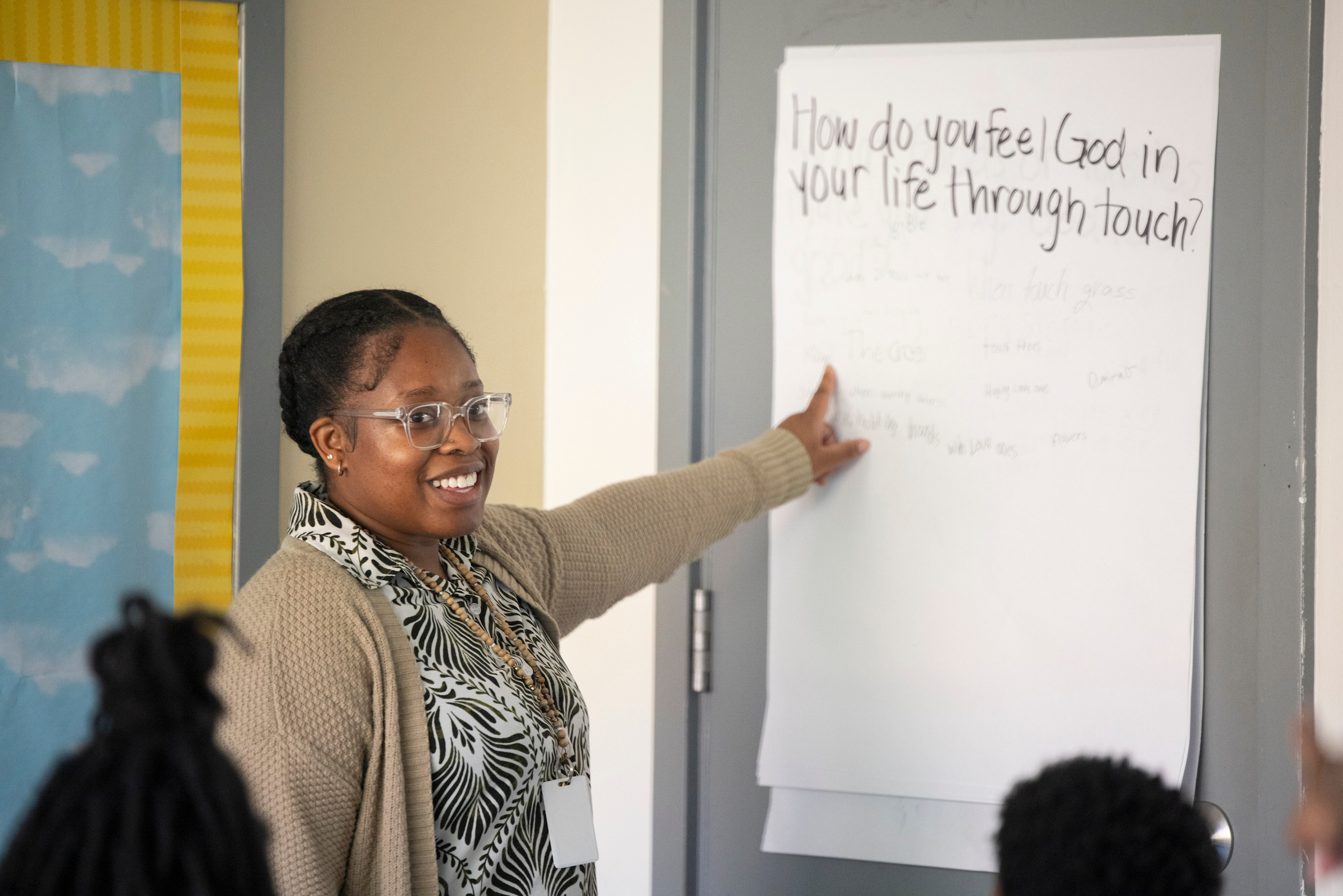
On a recent morning in November, seventh graders at St. Alban Roe School in Wildwood were immersed in a lesson on the Middle Ages. Hoeckelman entered his classroom and greeted students as Sir Thomas, a knight living in Cornwall, England, in the 13th century.
Hoeckelman invited one of his students to suit up for battle, layering on a surcoat, belt, gauntlets, chain mail and helmet, explaining how each piece would have helped protect a knight in the 1200s. Sir Thomas, he explained, is a fictional character inspired by his family’s genealogy — his maternal family traces its roots to Cornwall.
Hoeckelman is one of seven Catholic elementary and high school teachers in the metropolitan St. Louis area who are among more than 100 educators honored with an Emerson Excellence in Teaching Award this year. The annual award recognizes classroom instructors, selected by their schools’ administrators, for their accomplishments and dedication to their students and the teaching profession.
The Excellence in Teaching Awards program began in St. Louis in 1989 and is sponsored annually by Emerson, the St. Louis-headquartered global technology and engineering company.
Hoeckelman has taught in Catholic schools for nearly three decades, including 20 at St. Francis Borgia Grade School in Washington. He came to St. Alban Roe nine years ago as a middle school social studies and religion teacher and teaches grammar and writing to seventh graders. He also facilitates the Young Scholars Program for gifted students in grades two through five and leads an after-school scale model club, where students build models from two-dimensional instructions.
His love of teaching and history goes back to his childhood, when he would sit in his father’s parish school of religion class and listen to lessons about Scripture, including figures from the Old Testament.
“He would talk about the Hittites and the Phoenicians and the Romans and the Greeks and all that kind of stuff, and it was like, I want to know more,” he said. “I was one of those kids who would go down a rabbit hole because my parents bought my family (a set of) encyclopedias. I’d be sitting in their office and there would be a pile of encyclopedias all around me because I’d go from one to the other.”
Teaching in a Catholic school gives him the opportunity to make faith part of daily classroom life. He begins each class with prayer, prays for students and their families and looks for ways to connect religion with what he teaches.
“I love it that I can inject religion into anything I teach,” he said.
Mark Bratkowski, English, St. Dominic High School
Bratkowski, who teaches English II, AP Language and AP Literature, challenges students to think deeply, communicate thoughtfully and engage with complex literature and ideas, principal Stacy Stewart wrote in her nomination. He initiates one-on-one student conferences to understand individual strengths, challenges and needs, then provides personalized guidance while maintaining high expectations.
As a department leader and member of St. Dominic’s teacher leadership team, Bratkowski strengthens academic practices while continually pursuing professional development, Stewart wrote. His passion for teaching is rooted in a Catholic mission to form disciples of Jesus Christ. Through his classroom, Writers Guild, House System mentorship and daily interactions, he forms the whole person, she said.
Julie Bingham, learning specialist, St. Francis of Assisi School
As a learning specialist, Bingham brings executive experience, instructional expertise and heart to the classroom, principal Tim McInnis wrote in his nomination. She spent years as a parish school principal before choosing to return to teaching, turning down administrative roles to work directly with students.
Bingham uses evidence-based practices to help students facing the greatest academic challenges reach mastery of standards. She also uses technology to create custom modifications and designs spirit wear and other initiatives that build a joyful school culture. “Rooted in the Franciscan mission of uplifting those most in need, Julie is a fierce advocate for equity,” McInnis wrote. “She works tirelessly to remove academic, social and emotional barriers so that every child feels valued, supported and capable of success. Watching her students grow is her life’s calling.”
Layne Cramer, special education, St. Gabriel the Archangel School
A special education teacher for grades kindergarten through fifth, Cramer embodies the belief that every child can succeed, principal Tonya McEnery wrote in her nomination. Cramer seamlessly applies learning to target instruction, eliminates barriers for struggling learners and implements best practices on campus. She is seen as a “go-to” staff member for our faculty, who seek her assistance with ideas on how to help students.
The true measure of her work shines through her students’ breakthroughs, McEnery wrote. She does what others have thought to be too challenging or impossible. “It is her dedication that helps each student succeed and makes her deserving of the honor,” she wrote. “There is much to celebrate each and every day due to Ms. Cramer’s passion for what she does and the legacy she is leaving in the future of each student.”
John Kelly, science, Chaminade College Preparatory School
Kelly embodies Chaminade’s mission of forming young men the world needs, principal Brett Desnoyer wrote in his nomination. Kelly, who teaches middle and high school biology, engages students and places their best interests first. “His teaching plans and disposition are well adapted to a variety of learners, and his way of communicating with students, parents and colleagues is full of genuine goodwill,” Desnoyer wrote.
Outside of the classroom, Kelly is head coach of the cross country team, a track coach and serves on the school’s sustainability committee. “Mr. Kelly is not only an excellent teacher and content master, he is a good and kind man who shows students how to become trusted and kind adults,” Desnoyer wrote.
Colleen Rankowski, math, Cor Jesu Academy
Rankowski teaches math courses ranging from accelerated algebra to calculus. She challenges students to reach beyond what they believe is possible, dean of academics Meghan Bohac wrote in her nomination. Rankowski spends hours preparing learning experiences and finding ways to make difficult concepts accessible and engaging. “She does not simply want students to master content; she wants them to recognize their own potential and have the courage to pursue it,” Bohac wrote.
Rankowski contributes to students’ formation outside the classroom, encouraging them to become confident, thoughtful and capable young women. She models the qualities she hopes to instill, continually seeking ways to grow in her own practice. “She understands that a passion for learning is contagious and works intentionally to cultivate that same curiosity, perseverance and desire for growth in those around her,” Bohac wrote.
Dennis Toscano, classics, Saint Louis Priory School
Toscano, a classics teacher and chair of the Modern and Classical Languages Department, is described as a conscientious teacher who goes above and beyond to place the success of his students first, Tim Malacek, assistant head of school for intellectual formation, wrote in his nomination.
In the classroom, he is patient and kind, believing that all students can find success in a difficult subject, Malacek wrote. As a department chair, Toscano is humble and generous with his time, support and expertise. As a speaker of English, Spanish, Latin and Greek, Toscano “brings an extraordinary range of experience and expertise, benefiting both teachers and students in our modern and classical languages department,” Malacek wrote.