It is a sacrament at the service of communion, directed toward the salvation of others
Every baptized Catholic is marked as priest, prophet and king.
In the service of this common priesthood, there’s another path to participate in the mission of Christ in a particular way: the ministry conferred by the sacrament of holy orders.
“Holy Orders is the sacrament through which the mission entrusted by Christ to His apostles continues to be exercised in the Church until the end of time: thus it is the sacrament of apostolic ministry” (Catechism of the Catholic Church 1536).
Holy orders, along with matrimony, is one of the sacraments at the service of communion, directed toward the salvation of others. There are three degrees of holy orders: episcopate (bishop), presbyterate (priests) and diaconate, which includes both transitional deacons ordained on the path to priesthood and permanent deacons.
Understanding holy orders starts with understanding baptism, said Father Mark Wedig, OP, a sacramental theologian and president of Aquinas Institute of Theology in St. Louis. Like baptism and confirmation, the sacrament of holy orders imparts an indelible — permanent — spiritual character on the man.
“There’s a radical change in the person themselves, and that has to do with them being configured to Christ in a particular way,” Father Wedig said.
The ministerial priesthood adds a sacred power for the service of the faithful, which is exercised through teaching, divine worship and pastoral governance.
Through the ordained minister, then, “it is Christ Himself who is present to His Church as Head of His Body, shepherd of His flock, high priest of the redemptive sacrifice, Teacher of Truth,” (CCC 1548).
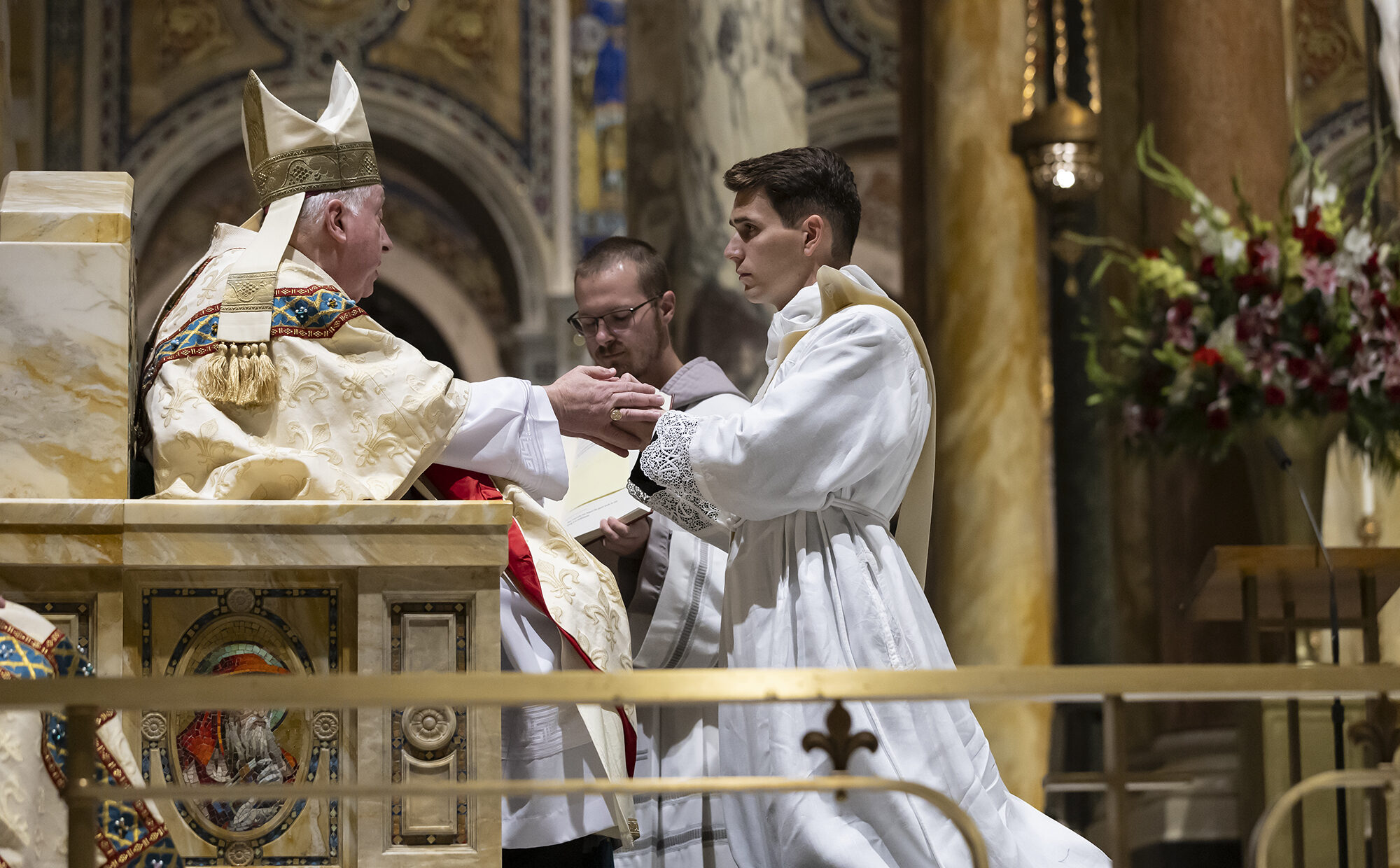
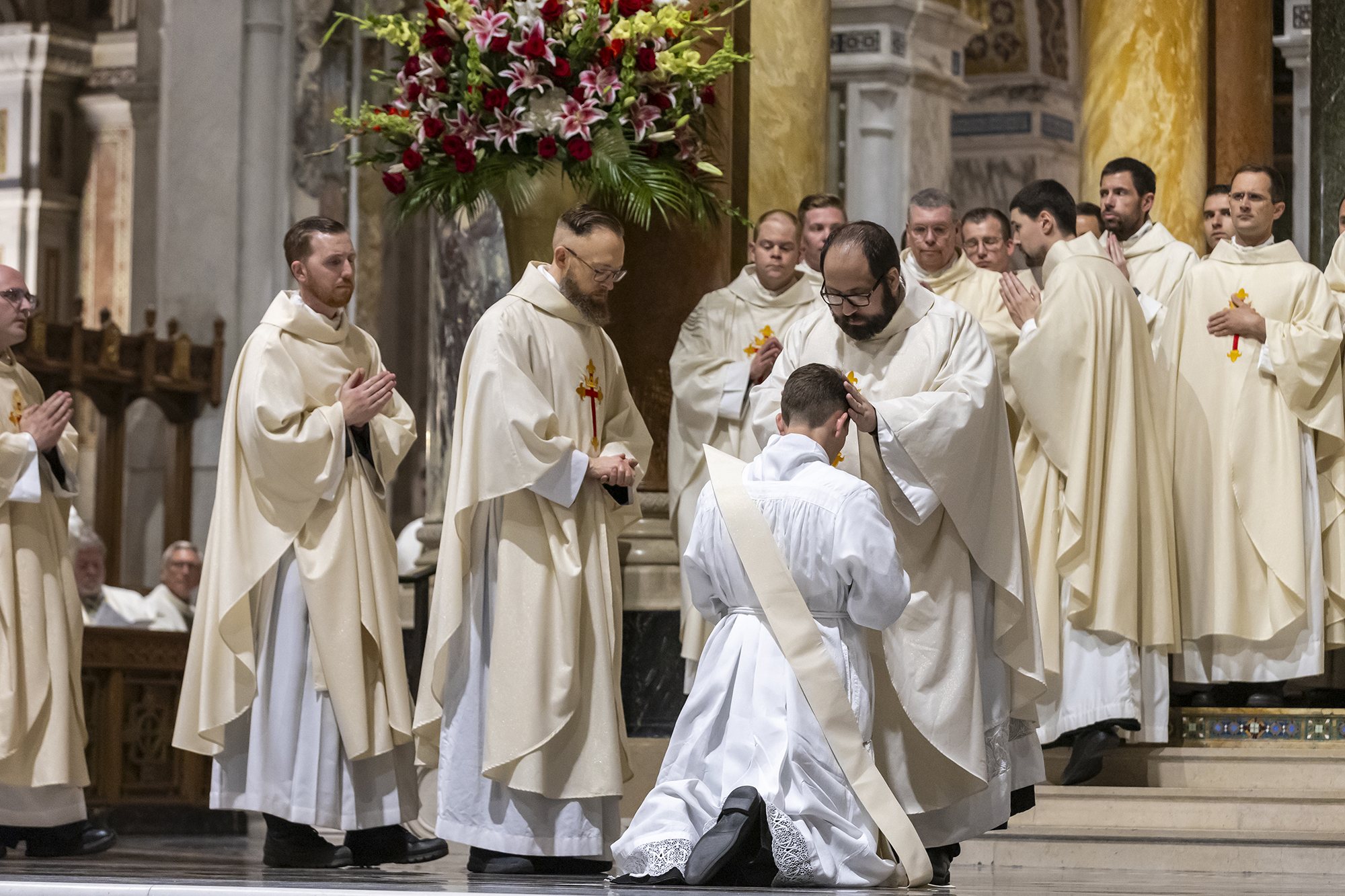
During the ordination Mass of a deacon, priest or bishop, the ordaining bishop lays his hands on the head of each ordinand, conferring the power of the Holy Spirit. The practice of laying on of hands goes back through Jewish tradition as well as the earliest days of the Church, a physical sign of identifying and calling forth a person to a sacred role, Father Wedig said.
The orders of bishop, priest and deacon are “irreplaceable for the organic structure of the Church,” the catechism says (CCC 1593). The fullness of holy orders resides in the bishop, who is the head of the particular Church entrusted to Him. As successors to the apostles, bishops share in the apostolic responsibility and mission of the entire Church, under the authority of the pope. Only bishops have the ability to ordain.
Priests are coworkers in mission with the bishop, sharing in the authority to preach the Gospel, shepherd the faithful and offer the sacraments, especially the Eucharist in the sacrifice of the Mass.
Deacons do not receive the ministerial priesthood, but they share in Christ’s mission and grace in a special way, exercising a ministry of liturgy, word and charity.
Each degree of holy orders builds on the prior ones, Father Wedig said. Deacons are particularly called to service, and that charge stays with the man even as he is ordained a priest and bishop.
Church tradition holds that the spiritual authority and mission of Jesus’ apostles have been passed in a continuous line of bishops through the generations to the present day. “The apostles were endowed by Christ with a special outpouring of the Holy Spirit coming upon them, and by the imposition of hands they passed on to their auxiliaries the gift of the Spirit, which is transmitted down to our day through episcopal consecration” (Lumen Gentium 21).
The tradition of apostolic succession points to the mission of bishops and priests that started with Jesus and continues in our own leaders today, Father Wedig said.
“The role is apostolic. The role really does have to do with handing on the faith and presiding over the community of faith in a particular way,” he said. “It’s not only apostolic in that the apostles’ hands were laid on a group of men, who laid on hands, who laid on hands — it is in a sense, but it’s really more important in the sense that it’s handing on the apostolic charge and the apostolic faith.”
Father Wedig recently marked the 40th anniversary of his ordination to the priesthood. As he looks back on those four decades, he sees the real grace of the sacrament at work: first, through the opportunities for preaching and teaching, in tandem with the Dominican order’s charism.
He’s also grateful for the charge to care for his people’s souls, offering Christ’s love and mercy.
“It’s the ability to pastorally care for people,” he said. “It might be hearing their confessions, but resonating with their lives, their concerns, their struggles, their challenges, and having people present that to you, being vulnerable and trusting in the Church’s care is very, very significant.”
The sacrament of holy orders
The Church confers the sacrament of holy orders only on baptized men “who suitability for the exercise of the ministry has been duly recognized” (CCC 1598).
Matter: The laying on of hands by the bishop
Form: The prayer of ordination said by the bishop, specific to the ordination of a deacon, priest or bishop.
Holy orders in Scripture
The beginnings of the priesthood can be found in the Old Testament. Melchizedek was a priest of God who offered bread and wine (Genesis 14:18). Then, the Levite tribe was set apart for priestly service, presiding over the Temple and offering sacrifices (Numbers 3:5-10).
The prefigurements of the Old Covenant are fulfilled in Jesus Christ. Jesus instituted the ministerial priesthood by asking His apostles to continue His ministries, including the celebration of the Eucharist.
“Then He took the bread, said the blessing, broke it, and gave it to them, saying, ‘This is my body, which will be given for you; do this in memory of me’” (Luke 22:19).
“[Jesus] said to them again, ‘Peace be with you. As the Father has sent me, so I send you.’ And when He had said this, He breathed on them and said to them, ‘Receive the holy Spirit. Whose sins you forgive are forgiven them, and whose sins you retain are retained’” (John 20:21-23).
“You will receive power when the holy Spirit comes upon you, and you will be my witnesses in Jerusalem, throughout Judea and Samaria, and to the ends of the earth” (Acts 1:8).
“The Twelve called together the community of the disciples and said, ‘It is not right for us to neglect the word of God to serve at table. Brothers, select from among you seven reputable men, filled with the Spirit and wisdom, whom we shall appoint to this task, whereas we shall devote ourselves to prayer and to the ministry of the word’…They presented these men to the apostles who prayed and laid hands on them. The word of God continued to spread, and the number of the disciples in Jerusalem increased greatly; even a large group of priests were becoming obedient to the faith” (Acts 6:2-4, 6-7).
“Do not neglect the gift you have, which was conferred on you through the prophetic word with the imposition of hands of the presbyterate” (1 Timothy 4:14).