The Archdiocese of St. Louis celebrates the past 200 years and looks forward to a future of carrying forward the Church’s mission
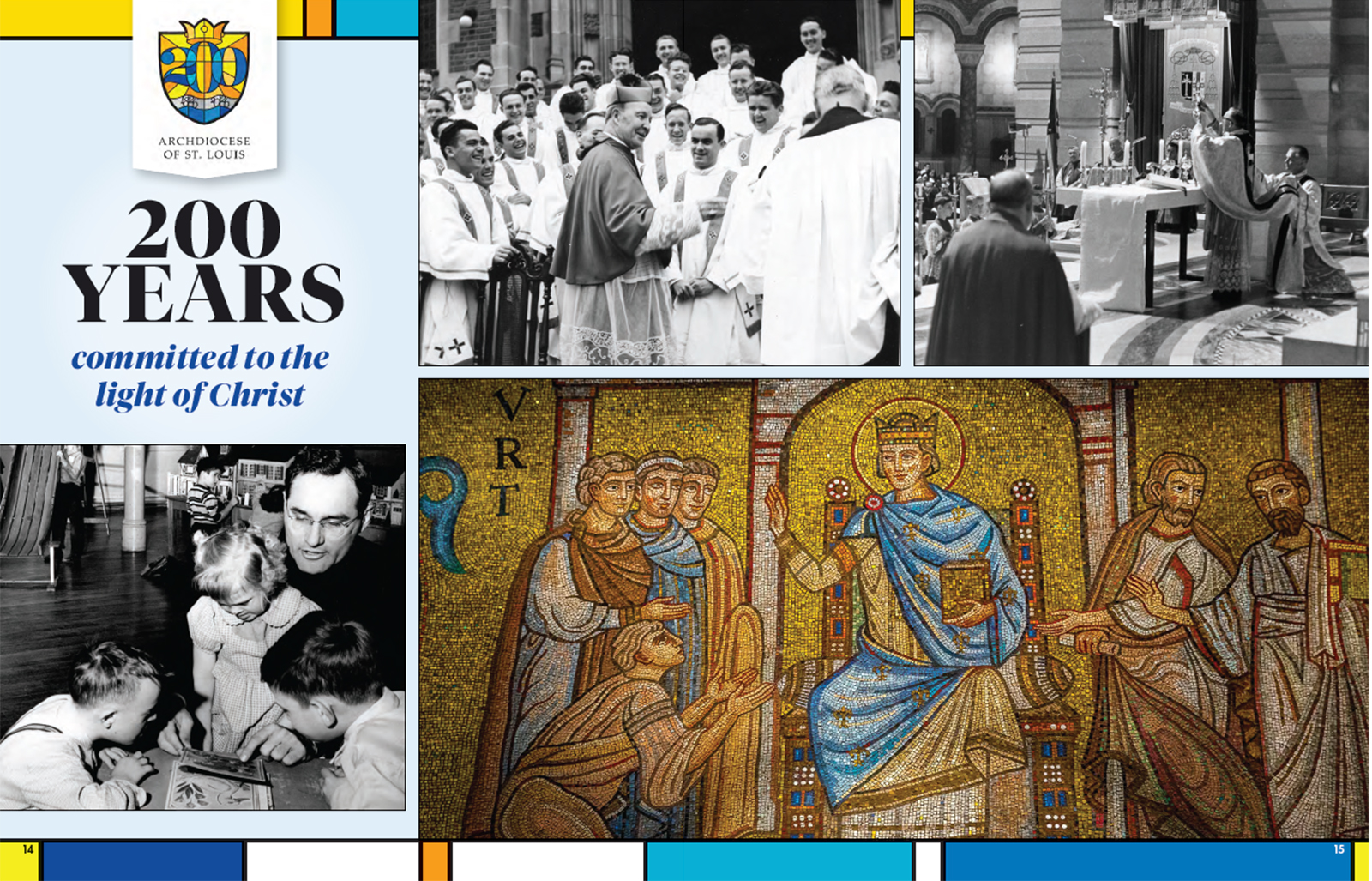
The archdiocese’s Bicentennial Jubilee Year is a sacred moment of reflection, celebration and renewal — a celebration of the past and carrying the Church’s mission forward.
Over the past 200 years, the Church in St. Louis has grown from a small frontier mission into a thriving Catholic community whose influence expands across 10 counties and the city of St. Louis and far beyond Missouri.
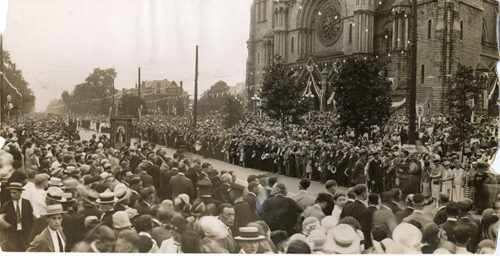
Consecration of the New Cathedral, 1926
“This Jubilee Year invites us to honor the past, celebrate the present and commit ourselves anew to the mission of Christ,” Archbishop Rozanski wrote in a letter to the faithful announcing the Jubilee Year.
The region’s Catholic roots reach back more than 350 years to the earliest missionary encounters in the Mississippi Valley, beginning with the first Mass offered in the settlement of St. Louis in 1764 on the site where the Basilica of St. Louis, King of France (Old Cathedral) stands. By 1818, St. Louis was established as the episcopal seat of a growing frontier Church.
In 1826, Pope Leo XII established the Diocese of St. Louis and entrusted Bishop Joseph Rosati with a vast missionary territory that extended from the Louisiana border to the Rocky Mountains. (Pope Pius IX elevated St. Louis to an archdiocese in 1847.)
“We are heirs to this missionary legacy,” Archbishop Rozanski said. “Our parishes, schools, charitable ministries, religious communities and lay leaders all bear witness to the enduring light of Christ passed down through generations. Now, in our own time, we are called to carry that light forward with courage, joy and faith.”
The Bicentennial Jubilee Year of celebration kicked off in January and will continue through Dec. 31. Parishes and school leaders received resources to celebrate in ways that best fit each community, and Masses were celebrated in each of the three vicariates earlier this year. Archbishop Rozanski will celebrate a Mass for the bicentennial on July 18.
Bicentennial Mass of celebration
Archbishop Mitchell T. Rozanski will celebrate a Mass for the Bicentennial Jubilee Year at 10 a.m. Saturday, July 18, at the Cathedral Basilica of Saint Louis. A reception will follow.
Plenary indulgence and pilgrimage sites
The Vatican’s Apostolic Penitentiary has granted a plenary indulgence for the Jubilee Year. To receive an indulgence, faithful must undertake a pious pilgrimage to any of the 15 designated pilgrimage sites in the archdiocese through July 26, while fulfilling the usual conditions. To learn more about the pilgrimage sites and the bicentennial, visit archstl200.org.
Archdiocesan “firsts”
First cathedral west of the Mississippi
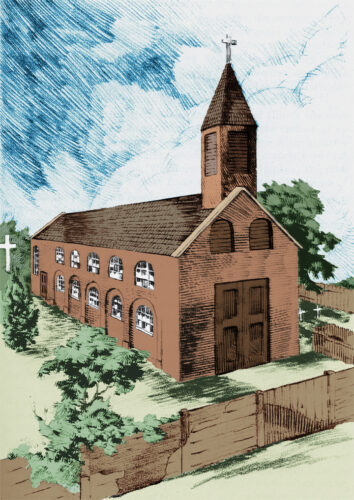
Colorized drawing of how the brick cathedral may have looked. The cornerstone was laid in 1818.
When Bishop William Louis Valentine DuBourg arrived in St. Louis in 1818, the seat of the Diocese of Louisiana and the Two Floridas, his first church was in a 44-year-old log building so dilapidated that during the winter months, the wine would freeze on the altar. He laid the cornerstone of a new brick cathedral on March 29, 1818.
The church was an important community landmark, and both Catholic and non-Catholic St. Louisans pledged money for its construction. Architect Gabriel Paul drew up grand plans for the building, but due to financial issues brought on by an economic recession, the church was never actually completed. Even so, Bishop DuBourg blessed the incomplete cathedral on Jan. 9, 1820.
The church was 134 feet by 40 feet and 40 feet tall. To offset its modest appearance, Bishop DuBourg decorated the interior with expensive objects donated by French patrons, and paintings by master artists gifted to him by King Louis XVIII. Some of these paintings still hang inside the Old Cathedral today.
Bishop Joseph Rosati built the current Old Cathedral church in 1834. A fire destroyed the old brick church the following year.
First college west of the Mississippi
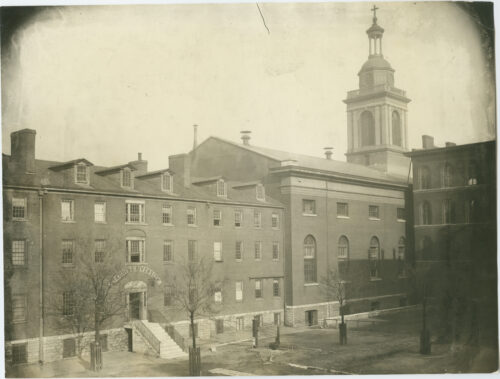
St. Louis College was begun by Bishop DuBourg in 1818, and was taken over by the Jesuits in 1829 on Washington Avenue.
As early as Jan. 8, 1818, Bishop DuBourg noted, “the people are most anxious that I should erect a college.” To expedite its creation, DuBourg donated his personal library and received permission to use the home of Madame Eugunie Alvarez for the school. DuBourg named Rev. Francois Niel, curate of his cathedral, as headmaster of the new school. Known as Saint Louis Academy, the first classes began Nov. 16, 1818. This was the first college west of the Mississippi River.
As early as 1823, Bishop DuBourg reached out to representatives of the Society of Jesus to gauge their interest in taking over operation of the local school. The Jesuits responded eagerly and began making the necessary plans for operating a school in St. Louis. Bishop DuBourg helped them purchase land on Washington Avenue between 9th and 10th Streets. Saint Louis College reopened on Nov. 2, 1829, and received its charter as Saint Louis University from the State Legislature on Dec. 28, 1832.
Saint Louis University moved to its current location at Grand and Lindell Boulevards in 1889, where the Jesuits also built St. Francis Xavier Parish, known locally as the College Church.
First seminary west of the Mississippi
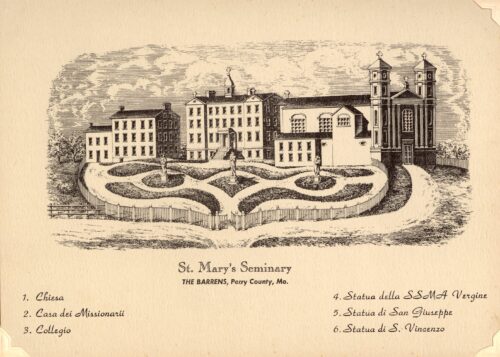
The Vincentians established St. Mary of the Barrens Seminary near Perryville in 1818. Then-Father Joseph Rosati was one of the the founders.
Bishop DuBourg knew he would need priests to help him direct the spiritual growth and evangelization of Catholics in his vast diocese. At his direction, Father Joseph Rosati, Father Felix De Andreis and the Vincentians established St. Mary of the Barrens Seminary near Perryville in October 1818, the first seminary west of the Mississippi.
In 1842, Bishop Peter Kenrick started a new seminary, separate from the Vincentians, in a home donated by the Soulard family. The archdiocesan seminary moved through several locations before settling in what is now Shrewsbury.
First hospital west of the Mississippi
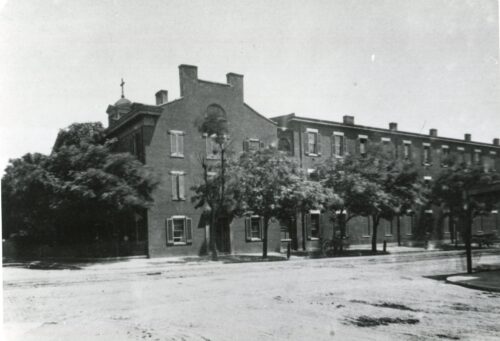
Mullanphy Hospital was the first hospital established west of the Mississippi River, in 1828. The original log cabin was replaced with a new building begun in 1831.
Founded in 1828, Mullanphy Hospital was the first hospital established west of the Mississippi River. Its namesake was John Mullanphy, a prominent Irish Catholic businessman and philanthropist. Mullanphy approached Bishop Joseph Rosati in 1826 with plans for the hospital. Mullanphy supplied the property and the funds for a building and its furnishings. At Bishop Joseph Rosati’s request, the Sisters of Charity (known today as the Daughters of Charity) came to St. Louis to operate the hospital.
In the deed, John Mullanphy specified that the hospital care for “all such indigent sick free persons without regard to color, country or religion.” The hospital was located on Spruce Street between Third and Fourth Streets. The first hospital was a three-room log cabin, and the number of patients quickly overwhelmed the small quarters.
A new hospital was built in 1831 to accommodate the growing city’s needs. It was erected in the nick of time just before the first cholera epidemics plagued the city. One of the first waves in 1832 killed more than 400 people in St. Louis, including two of the sisters working at the hospital. The sisters saved the lives of over 800 patients.
The hospital developed into DePaul Hospital, now under the care of the SSM Health system.
John Mullanphy also donated property and funds for an orphanage next to the hospital, the first in the state of Missouri. In 1834, the St. Louis Male Orphan Asylum was established next to the Old Cathedral and put in the hands of the Sisters of Charity. It was later taken over by the Sisters of St. Joseph of Carondelet and became the St. Joseph Home for Boys, which cared for young men in need until its closure in 2001.
First St. Vincent de Paul Society council in the U.S.
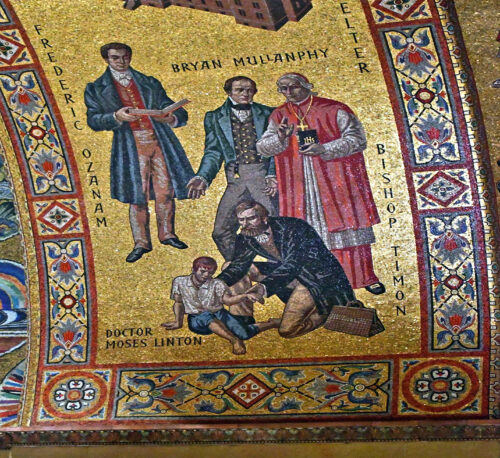
A mosaic in the Cathedral Basilica of Saint Louis depicts the work of the Society of St. Vincent de Paul.
Antoine Frederic Ozanam founded the Society of St. Vincent de Paul in France in 1833 for Catholic laypeople to serve those in need. In 1845, Father John Timon, CM, witnessed the organization’s good works in Paris, which he described to several prominent Catholics when he returned to St. Louis. On November 20, 1845, Catholic St. Louisans established the first U.S. conference at a meeting in the schoolhouse next to the Old Cathedral. There were 62 founding members. In the first meeting, members elected the officers and donated $17.70 to begin funding services for the poor. The officers assigned two “visitors” to each of the four parishes in the city. The visitors reported potential charitable cases to the conference, and the group would decide who would receive assistance.
First English Mass in the U.S.
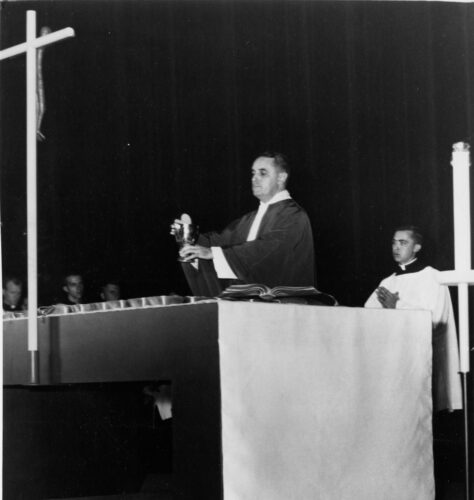
Father Frederic McManus celebrated the first Mass in the United States in which English was used. The Mass was celebrated Aug. 24, 1964, at Kiel Auditorium.
During the Second Vatican Council, the English translation of the Mass was introduced through the Constitution on the Sacred Liturgy, adopted by the bishops at the council in 1963 and promulgated officially by Pope Paul VI.
The first English text was approved in spring 1964. The U.S. bishops set Nov. 29, 1964, the first Sunday of Advent, as the official date for the introduction of English in the Mass around the country.
The first Mass celebrated in English in the U.S. took place on Aug. 24, 1964, in the Kiel Auditorium in St. Louis during the 25th annual Liturgical Week. An estimated 12,000 people attended Mass, celebrated by Father Frederic McManus.
First special education office
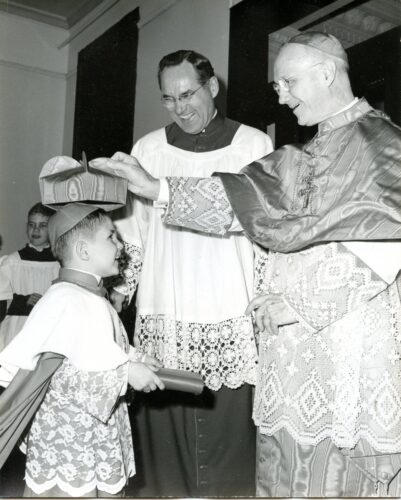
Cardinal Joseph Ritter and Msgr. Elmer Behrmann visited with a boy at St. Mary’s Special School for Exceptional Children, part of the first Department of Special Education in the United States.
Father Elmer H. Behrmann founded the archdiocese’s Department of Special Education in 1950, the first of its kind in the United States. In its early years, the department established special classes in several elementary schools around the archdiocese, as well as St. Mary’s Special School for Exceptional Children. The department also offered testing for diagnosis or placement, as well as the Catholic Guidance Center, which included reading and speech clinics.
First diocesan pro-life office
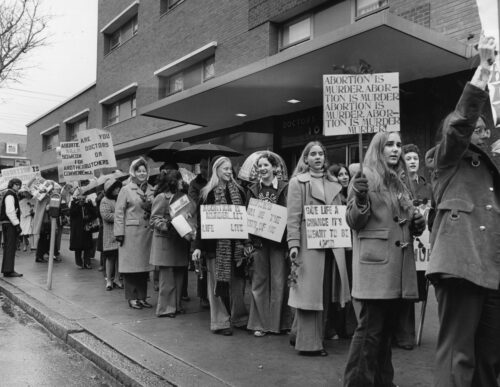
People participated in a pro-life demonstration in St. Louis on Jan. 22, 1974. The Archdiocese of St. Louis founded the Archdiocesan Pro-Life Committee in 1973.
The Respect Life Apostolate was founded by Cardinal John Carberry in 1973 within weeks of the tragic Roe v. Wade and Doe v. Bolton decisions which legalized abortions throughout the United States. Cardinal Carberry opened the first diocesan office in the nation dedicated to protecting and advocating for the preborn child and helping pregnant mothers. Known originally as the Archdiocesan Pro-Life Committee, the ministry became the blueprint for similar ones in dioceses through the nation, as well as the national pro-life pastoral plan and vision of the United States Conference of Catholic Bishops.
First diocesan foreign mission
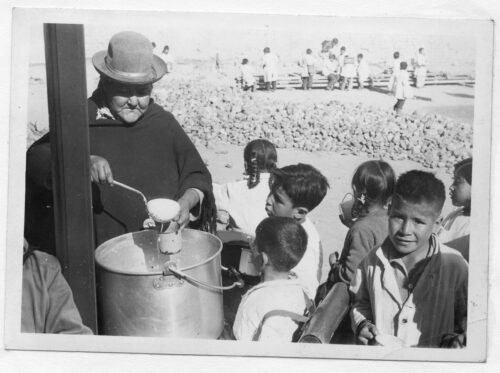
A woman served lunch at San Agustin School in Viacha, Bolivia. The archdiocese served in Bolivia for 64 years.
In a sign of support to the continued spiritual needs of the Latino community in St. Louis and Central and South America, Archbishop Joseph Ritter established a mission to Bolivia in 1956. The mission was the first of its kind by any diocese in the U.S. Operating in the Archdiocese of La Paz, archdiocesan priests served rural and impoverished areas for the next 64 years.
Continued growth in the archdiocese
The many firsts achieved in St. Louis were just the beginning. Over the next two centuries, Catholics contributed to the growth in several areas, including:
Education
Numerous religious communities established schools, including the Jesuits, Christian Brothers, Marianists, Society of the Sacred Heart, Visitation Sisters, Ursulines, Sisters of Charity of the Incarnate Word, the Loretto Sisters, Sisters of St. Joseph and the School Sisters of Notre Dame.
Over the years, many parishes chose to open parochial schools, which were primarily run and taught by religious sisters and clergy. During his tenure, Archbishop John J. Kain established the first archdiocesan school commission to regulate uniforms and curriculum, and he required every parish to maintain a parochial school as suggested by the Third Plenary Council of Baltimore in 1884.
Archbishop John J. Glennon in 1910 appointed a superintendent of Catholic Schools and created the high school development committee. A few Catholic high schools already existed through parishes or religious orders. In 1911, the first three archdiocesan schools were established: Kenrick High School for boys at Sts. Peter and Paul, Kain for girls at St. Theresa, and Rosati for girls at St. Francis de Sales. The schools did not charge tuition, and Archbishop Glennon set up the Catholic High School Association to finance the schools through donor contributions. Rosati and Kain High Schools for girls were combined a couple years later into Rosati‐Kain High School.
Under Archbishops Joseph F. Ritter and John J. Carberry, the high school education system was expanded through the 1960s, experiencing peak enrollment. The 1970s saw an increase of lay faculty and staff in schools and a decrease in student enrollment.
In 1991, Archbishop John L. May founded the Today and Tomorrow Educational Foundation to provide tuition‐assistance scholarships to families for parochial elementary school education. The foundation has expanded educational access, awarding more than 5,700 scholarships annually totaling more than $10 million to schools throughout the St. Louis metro area.
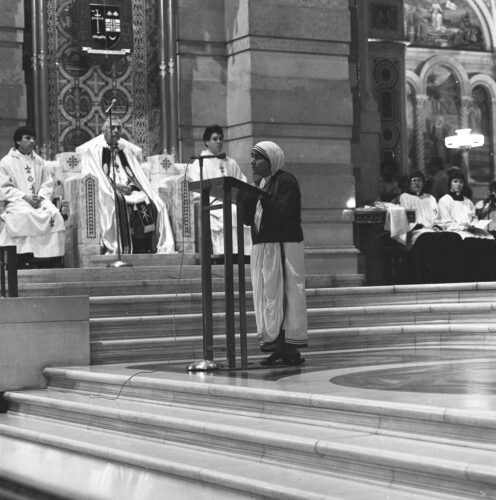
St. Teresa of Kolkata (Mother Teresa) visited St. Louis in 1979 and brought three Missionaries of Charity to establish a community here.
Charitable works
Father Peter Dunne began a ministry helping “street children,” and Father Tim Dempsey established residences for the homeless. Father John J. Butler, with the help of Cardinal Glennon, organized these and other services offered by the archdiocese in its orphanages, employment agencies, homeless shelters and residences in 1912, a collaboration that formally became Catholic Charities of St. Louis in 1932. Catholic Charities today serves the archdiocese’s 11 counties, providing housing, food support, mental health counseling, workforce training and resources for families, seniors and veterans.
In 1979, Mother Teresa of Kolkata personally visited St. Louis and brought three Missionaries of Charity to establish a community here — the second such community in the United States. The Sisters have remained in the Jeff-Vander-Lou neighborhood of north St. Louis ever since, operating a soup kitchen and serving the poorest residents of the city.
Health care
The Alexian Brothers, a healing order of Catholic men tracing their origins to medieval Europe, established Alexian Brothers Hospital in St. Louis in 1869, specializing in the care of the mentally ill and those with nervous diseases. Over the following century and a half, they expanded their ministry to include nursing homes, senior care programs and outreach to the homeless, serving the St. Louis community for more than 150 years.
The Sisters of Mercy, founded in 1831 by Catherine McAuley in Dublin, Ireland, to serve the poor and sick, arrived in St. Louis in 1856 to help and educate the poor. In 1871, the health care needs of the city required more help, so the sisters turned their school building into a 25-bed hospital for women and children known as St. John’s Hospital. By 1874, the facility became a general hospital with wards for the poor and private rooms for men, women and children. Under the leadership of Mother Magdalen de Pazzi Bentley, the hospital reached out to the community by affiliating with local universities and established a school of nursing. The sisters’ health care ministry grew over the decades to become a regional network, now known as Mercy health system.
In 1872, Mother Mary Odilia Berger and five companions arrived from Germany and set to work among St. Louis’ immigrant poor, nursing victims of smallpox, typhoid, diphtheria and cholera in their homes. By 1877, the Sisters of St. Mary opened St. Mary’s Infirmary, recording nearly 60 percent of its first patients as unable to pay. When yellow fever struck Mississippi and Tennessee in 1878, Mother Odilia sent sisters to nurse the afflicted; five of them died, all under the age of 30. Their congregation, later known as the Franciscan Sisters of Mary, grew their hospital ministry across the Midwest, eventually forming SSM Health — today one of the largest Catholic health care systems in the nation. The sisters also partnered with Saint Louis University, welcoming its medical students into their hospitals as early as 1903, collaborating to establish SLU’s School of Nursing in 1928 and jointly opening what is now SSM Health Saint Louis University Hospital in 1933. In 1956, Cardinal Glennon Children’s Hospital was opened as the nation’s first free-standing, nonprofit Catholic children’s hospital, providing care for children regardless of ability to pay.
Vocations/formation
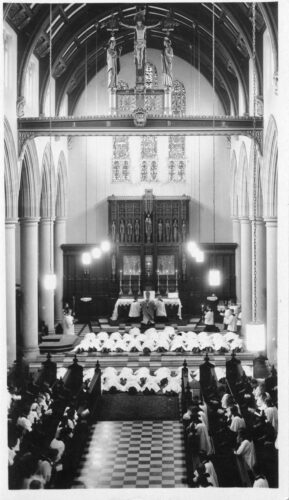
Men were ordained to the priesthood at Kenrick Seminary. The building is now called the Cardinal Rigali Center and serves as the archdiocesan curia offices.
The Civil War caused a steep drop in enrollment and scattered seminarians to institutions in other cities. Archbishop Kain reestablished the archdiocesan seminary in St. Louis in 1893, entrusting it once again to the Vincentian community and naming it Kenrick Seminary. Archbishop Glennon opened a second, larger Kenrick Seminary in Shrewsbury in 1916. In 1931, Saint Louis Preparatory Seminary opened on the same grounds, eventually establishing a full pipeline from high school through theology.
The postwar era brought a surge in vocations. By 1964, more than five hundred students crowded the high school seminary facility in Shrewsbury, prompting Archbishop Ritter to open a second preparatory seminary in north St. Louis County in 1965. Declining enrollment in subsequent decades led to a consolidation — in 1987, Archbishop May merged Cardinal Glennon College and Kenrick Seminary into a single institution, Kenrick-Glennon Seminary, and in 1991 closed the high school seminary program entirely. In 1995, after 177 years of Vincentian collaboration, the archdiocese assumed full responsibility for the seminary.
The institution has since experienced a renewal. Today, Kenrick-Glennon Seminary continues to form priests not only for St. Louis but for dioceses throughout the Midwest and elsewhere, carrying forward a tradition of formation that stretches back more than two centuries.
Oldest parish by vicariate
Northern Vicariate: St. Ferdinand
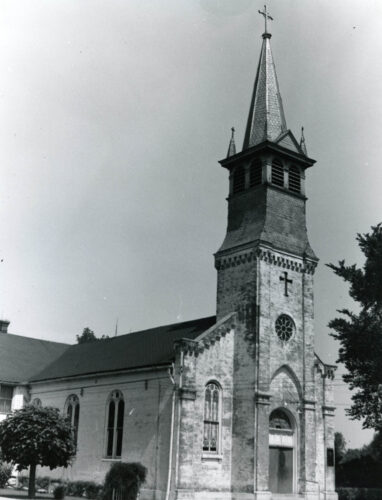
Note: St. Ferdinand is the oldest parish in the Northern Vicariate with the exception of the Basilica of St. Louis, King of France (Old Cathedral), which is explored elsewhere in this story.
St. Ferdinand Parish was established in 1789 in a log church in Florissant. Bishop William DuBourg invited Mother Rose Philippine Duchesne to the diocese, and in 1819, she and her sisters moved from St. Charles to Florissant. They established a brick convent and a new brick church at the St. Ferdinand site and opened a school for girls, which was the first Catholic school for Native American girls in the U.S. and the first free school for girls west of the Mississippi.
Father Pierre De Smet was ordained at St. Ferdinand in 1827.
In 1847, the Sisters of Loretto took over the property and added five large buildings. Archbishop Joseph Ritter changed the boundaries of St. Ferdinand Parish, and a new church and convent were built.
St. Ferdinand Parish and School were relocated to the current location at Charbonier Road in 1955 to accommodate the growing population.
The former site was maintained and restored by the Friends of Old St. Ferdinand’s, and after St. Rose Philippine Duchesne’s canonization in 1988, it was designated the Old St. Ferdinand Shrine, where it continues to host tours and events.
Southern Vicariate: Ste. Genevieve
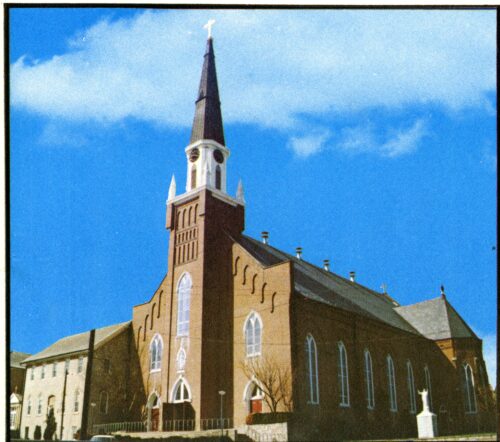
The first people of the parish were French Catholics from Canada who built a log church. Jesuit Father P.F. Watrin became its first pastor in 1759. Life in the village of Ste. Genevieve centered around the church; meetings were held after Sunday Mass and ordinances posted on the church door.
In 1794, the log church was moved to a higher ground due to flooding. Then, in 1831, work was begun on a stone church, which was consecrated on Nov. 12, 1837, by Bishop Joseph Rosati. Around that time, a wave of German immigrants were settling in the area, so homilies were preached in English, French and German.
As the parish continued to grow, work began on a new church in 1876, build around and above the stone structure. While the building of the brick church was ongoing, Mass was held as usual in the rock church. After its completion, the stone church was dismantled and carried out of the doors of the new church. The church was dedicated on Sept. 29, 1880. In 1911, a hexagonal apse and two transepts were added.
Western Vicariate: St. Charles Borromeo
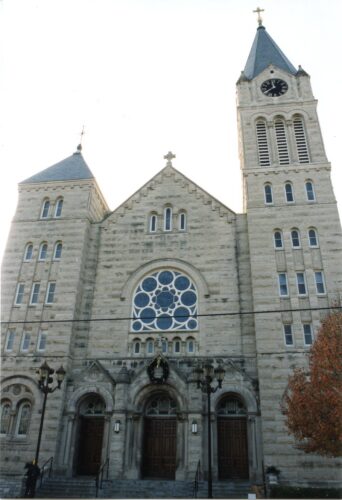
St. Charles Borromeo Parish in St. Charles was officially founded in 1792, but it traces its history back to the trading post established on the Missouri River banks in 1769 by Louis Blanchette and his fellow French Canadians. In 1789, the Spanish Lieutenant Governor of Upper Louisiana gave permission to build a permanent church, which was dedicated (along with the town) to St. Charles Borromeo, the patron of the Spanish King Charles.
For several years, visiting priests from local missions along the river stopped at St. Charles to celebrate sacraments. In 1823, the Jesuits began 134 years of ministry at the parish. A new stone church was built at Second and Decatur streets and dedicated in 1828. St. Rose Philippine Duchesne’s funeral was celebrated at the church in 1852.
To accommodate the growing population of immigrants settling in the area — German, French, English and Irish — a brick church was built in 1869 at Fifth and Decatur streets. The main body of that church was destroyed in a windstorm in 1915 and the current church was rebuilt at the same site in 1916. In 1957, the Jesuits passed responsibility for the parish to the archdiocese.
Black Catholics in the Archdiocese of St. Louis (1826–present)
The practice of racial segregation was embedded throughout St. Louis society, and the early Church was no exception. Members of the Catholic faithful and clergy in St. Louis, including Bishops William DuBourg, Joseph Rosati and Peter Kenrick, participated in the slave trade and held people in slavery. Their participation in the slave trade was supported by laws and social codes that preserved slavery by limiting and monitoring the activities of enslaved and free persons of color.
The sacramental records of the Old Cathedral reflect this reality — containing baptismal and other records of enslaved people owned by prominent St. Louisans and Catholic clergy alike. Early practice was shaped by the Code Noir of 1724, which mandated that all enslaved persons receive baptism and religious instruction, embedding people of color into Catholic life while simultaneously subjugating them.
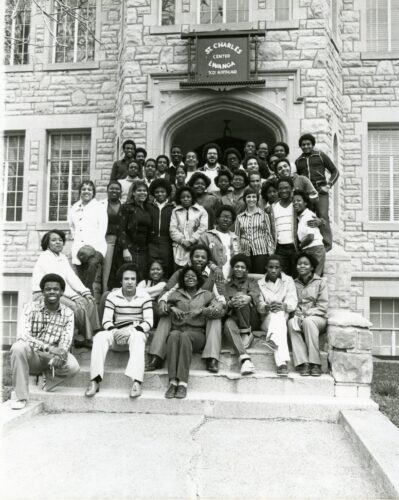
The St. Charles Lwanga Center was founded in 1978 by Father Ed Feuerbacher and other pastors at north St. Louis parishes to minister to support Black Catholic spirituality and culture.
Ministry to Black Catholics was undertaken separately from mainstream parish life. In 1832, Bishop Rosati repurposed a building as St. Mary’s Chapel for free and enslaved people of color. When the Old Cathedral was built in 1834, segregated galleries were designated for Black worshippers. In 1845, the Sisters of St. Joseph of Carondelet opened a school for daughters of free people of color, but a violent mob forced its closure. Missouri’s 1847 ban on educating African Americans further curtailed these efforts, limiting Catholic religious orders largely to sacramental instruction.
Segregation remained the norm for decades. In 1858, a segregated chapel was established at St. Francis Xavier Church, serving as the primary worship site for Black Catholics until the Jesuits opened St. Elizabeth Parish in 1873 — the fourth Black national parish in the country.
Integration came slowly and unevenly. Saint Louis University admitted its first Black students in 1944. Archbishop Joseph Ritter’s 1947 directive desegregating Catholic schools drew international attention, and his 1951 closure of Black-only institutions accelerated integration — though de facto segregation and white flight continued to shape parish life for years afterward.
In 1978, Father Ed Feuerbacher, other pastors and lay Catholics at several north St. Louis parishes formed the St. Charles Lwanga Center, a ministry to support Black Catholic spirituality and culture. The ministry has remained a mainstay in the archdiocese, evolving its activities to the needs of the present.
Bishops and archbishops of St. Louis
Bishop Louis William Valentine DuBourg (1815-1826)
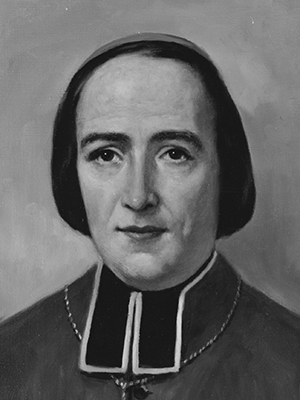
The first bishop to use St. Louis as his see city was Bishop DuBourg, a native of the French island of Saint Domingue (now Haiti) who had moved to France at age 2. As Bishop of Louisiana and the Floridas, he made St. Louis his episcopal headquarters from 1817 to 1820. On New Year’s Day 1818, he offered the first pontifical Mass in the vast area of Ste. Genevieve on his way upriver to St. Louis. Bishop DuBourg brought the Vincentians, the Jesuits and the Religious of the Sacred Heart to St. Louis. When the Louisiana Territory was split into two dioceses in 1826 — St. Louis and New Orleans — Bishop DuBourg resigned and returned to France. He died in 1833.
Bishop Joseph Rosati, CM (1827-1843)
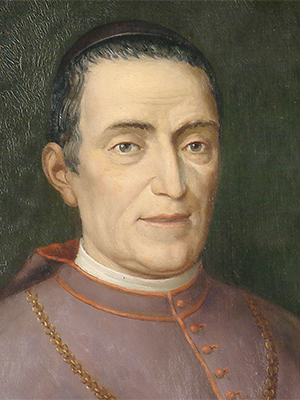
Bishop Rosati, founder of St. Mary’s College and seminary in Perryville and superior of the Congregation of the Mission (Vincentians) in the New World, became the first bishop of the Diocese of St. Louis in 1827 after having served as the first administrator of both the St. Louis and New Orleans dioceses. The St. Louis Diocese then covered an area nearly that of continental Europe. Bishop Rosati remained the administrator of New Orleans until June 1830 while leading the Diocese of St. Louis. The Cathedral of St. Louis, now called the Basilica of St. Louis, King of France (Old Cathedral), was built in 1831, during Bishop Rosati’s tenure. A native of the province of Lazio, Italy, Bishop Rosati died in Rome in 1843.
Archbishop Peter Richard Kenrick (1843-1895)
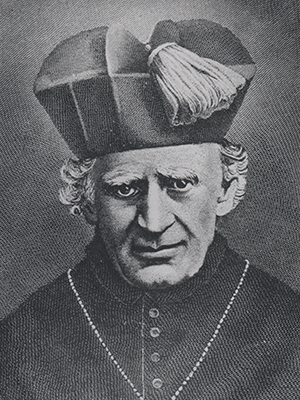
Archbishop Kenrick, originally of Dublin, Ireland, became the Archbishop of St. Louis in 1843, shortly after the death of Bishop Rosati. In 1847, Bishop Kenrick became the first archbishop of St. Louis when the diocese became the third metropolitan see in the country. Three years later, the extent of his jurisdiction was contracted to the state of Missouri. The original St. Louis Diocese was broken up to make — besides St. Louis — the Dioceses of Dubuque, Nashville, Chicago, Milwaukee and St. Paul. Archbishop Kenrick was the metropolitan archbishop of these sees. He took an active part in the Vatican Council, 1869-70. In 1891, the “Lion of St. Louis” celebrated his 50th anniversary as a bishop, the first such occasion in the history of the Catholic Church in America. Archbishop Kenrick was known for his positive treatment of immigrants, keen administrative abilities, his building up of the diocese and his qualities as a scholar. He resigned as Archbishop of St. Louis in 1895 and died in St. Louis the following year. By his death, some 18 new sees had been erected out of the original Diocese of St. Louis.
Archbishop John Joseph Kain (1895-1903)
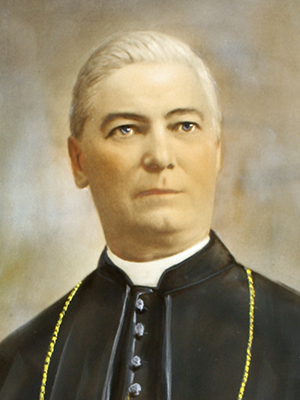
Archbishop Kain was decreed by Rome as coadjutor (successor) of the Diocese of St. Louis in 1893 and installed as archbishop in 1895. Born in Virginia, he was the first native-born American to become Archbishop of St. Louis. Archbishop Kain served eight years. He was considered zealous, capable and well-meaning, with a strong theological background and acumen. During his tenure, he gave full support to the parochial school system and chose the future site of the Cathedral Basilica of Saint Louis. He died in Baltimore in 1903.
Cardinal John Joseph Glennon (1903-1946)
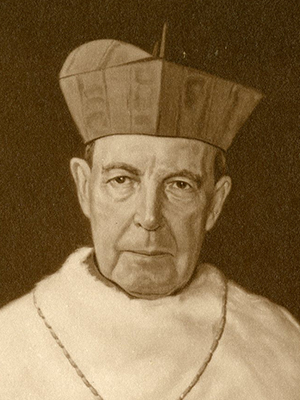
Cardinal Glennon was named in 1903 at age 40 as coadjutor of St. Louis with the right of succession. Cardinal Glennon was recognized as a great orator and was known as the Cathedral Builder because of his work in the erection of the New Cathedral, now the Cathedral Basilica of Saint Louis. During his term, several charitable institutions were started. While he was archbishop, the Church prospered, with many vocations and religious institutes flourishing, and the Archdiocese of St. Louis grew significantly in the number of parishes and parochial schools, expanding well beyond the City of St. Louis to the suburbs. Major and minor seminaries, new hospitals and diocesan high schools also were erected. He inaugurated a program, known as the Colonization Movement, where he invited colonists to come from Italy, Austria, Russia, Poland and Germany to his diocese. He helped by building up rural communities and giving aid in the form of parishes and priests to staff the churches. In Dunklin County, for example, he purchased 12,000 acres of land in 1905 and gave it to homesteading Catholic families. Two other communities in rural Missouri — Knoxville in Phelps County and Wilhelmina in Dunklin — were set up through Cardinal Glennon and his Colonization Realty Co. He died in his native Ireland on the way home from Rome after being made a cardinal at the age of 83 in 1946.
Cardinal Joseph Elmer Ritter (1946-1967)
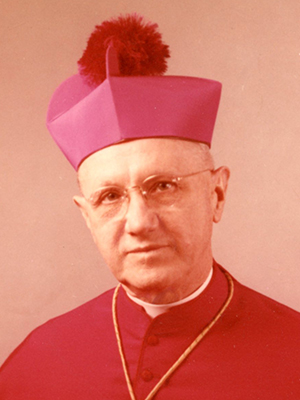
Born in New Albany, Indiana, Cardinal Ritter was appointed archbishop of the St. Louis Archdiocese in 1946. He was proclaimed a cardinal in 1961. Cardinal Ritter was recognized as an administrator, leader in integration, ecumenist and man of deep personal piety. Within a year of his arrival, Archbishop Ritter desegregated the archdiocesan schools. He was instrumental in beginning the work of revitalizing the inner city, including a renewal of the archdiocese’s institutions, inauguration of the Human Rights Commission, development of an inner-city apostolate and other actions aimed at achieving integration and a better life for the city’s poor. He had a children’s hospital built as a memorial to his predecessor, created an archdiocesan Commission on Ecumenism, launched the St. Louis Review and began a radio and television apostolate, inaugurated an annual capital funds drive to meet building needs, continued the mosaic work in the Cathedral Basilica of Saint Louis and continued the archdiocese’s parochial and high school expansion efforts. During his reign, the archdiocesan boundaries again were adjusted and realigned, leaving 10 counties surrounding the City of St. Louis within the archdiocese’s territory. Cardinal Ritter was viewed as open to new ideas and seen as a progressive leader of Vatican Council II, 1962-65, at which he attended all sessions. It also was during his reign that the St. Louis Archdiocese in 1956 founded a mission in Bolivia — the first established by a U.S. diocese. He also was a strong supporter of the Society for the Propagation of the Faith. He died in St. Louis in 1967, a little over a month before his 75th birthday.
Cardinal John Joseph Carberry (1968-1979)
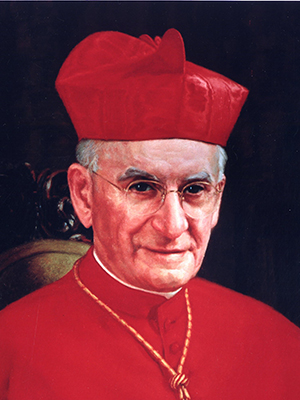
Cardinal Carberry, a Brooklyn native, was named by Pope Paul VI as fifth Archbishop of St. Louis in 1968. He was made cardinal in 1969. He emphasized allegiance to the papacy and a strong Marian devotion. During his tenure, he established new county parishes and St. Patrick Parish Downtown, instituted the archdiocese’s diaconate program, completed the high school and parish expansion programs that had been underway and continued the effort to guide the inner city toward restoration. Cardinal Carberry also was chosen by his fellow bishops for several leadership roles, including vice president of the National Conference of Catholic Bishops and as a delegate to three world Synods of Bishops. He made the archdiocese a national leader in the pro-life movement immediately following the U.S. Supreme Court’s pro-abortion rulings in 1973. He retired at age 75 in 1979 and was appointed apostolic administrator until the installation of a new archbishop in May 1980. He died in 1998 in St. Louis.
Archbishop John Lawrence May (1980-1992)
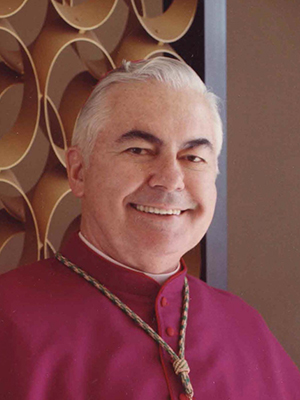
Archbishop May, born in Evanston, Illinois, was appointed Archbishop of St. Louis in 1980. Like his predecessor, Archbishop May was known as a national leader, serving terms as vice president and then president of the National Conference of Catholic Bishops. He was recognized for having strengthened ties between the Vatican and the Church in the United States. During his episcopacy, he was an accessible pastor. He supported the revival of the Archdiocesan Pastoral Council and the formation of deanery and parish councils. Archbishop May advocated ecumenical dialogue, desegregation of public schools and improved race relations. During his tenure, he completed the mosaic work in the Cathedral Basilica of Saint Louis and consolidated the seminary system. He named the first chief financial officer, a layperson, and the first woman superintendent of schools. He often led calls for more aid for the poor and oversaw and expansion of Catholic Charities’ programs for people in need and pro-life assistance for women with crisis pregnancies. He retired in 1992 and died in St. Louis in 1994.
Cardinal Justin Francis Rigali (1994-2003)
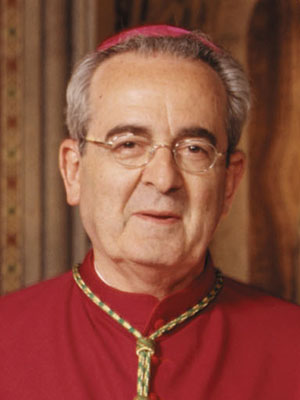
A native of Los Angeles, Cardinal Rigali was installed as the eighth bishop/seventh archbishop of the Archdiocese of St. Louis in 1994. During his episcopacy, he stabilized the archdiocesan finances and oversaw a successful $55 million capital campaign that established endowments to help support future needs in the archdiocese. He established the first strategic pastoral plan for the archdiocese and had the archdiocese take over the direction of Kenrick-Glennon Seminary from the Vincentian Fathers. Then-archbishop Rigali continued the strong pro-life efforts of his predecessors and promoted sound values in the areas of morality, education and family life. He strongly emphasized the promotion of eucharistic adoration throughout the archdiocese. He actively promoted vocations, evangelization efforts and ministry to young people. Those efforts were strengthened by St. John Paul II’s pastoral visit to the archdiocese on Jan. 26-27, 1999. Cardinal Rigali was appointed in 2003 by St. John Paul II to be the Metropolitan Archbishop of Philadelphia, and was installed in October of that year. In September 2003, he was named a cardinal by St. John Paul II.
Cardinal Raymond Leo Burke (2004-2008)
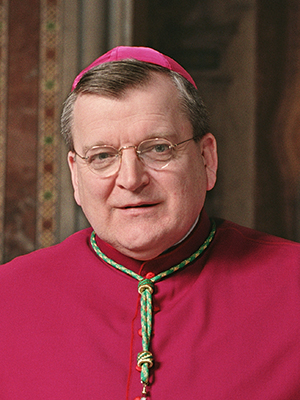
Cardinal Burke, born in Richland Center, Wisconsin, was appointed the ninth bishop/eighth archbishop of the Archdiocese of St. Louis in December 2003 and installed in January 2004. He was recognized as a standard-bearer for the Church’s pro-life stance; a strong promoter of the New Evangelization efforts; an advocate for vocations, particularly the priesthood; and a devotee and promoter of the Sacred Heart and Our Lady of Guadalupe. He played an instrumental role in the campaign against a statewide initiative to constitutionally protect embryonic stem-cell research and human cloning. Declaring Kenrick-Glennon Seminary as the heart of the archdiocese, he began an effort to enhance its programs, infrastructure and facilities. During his tenure, he served as a member of the College of Judges of the Supreme Tribunal of the Apostolate Signatura, the Church’s highest court. He was appointed prefect of the Supreme Tribunal of the Apostolic Signatura in June 2008. He was named a cardinal in 2010 by Pope Benedict XVI.
Archbishop Robert James Carlson (2009-2020)
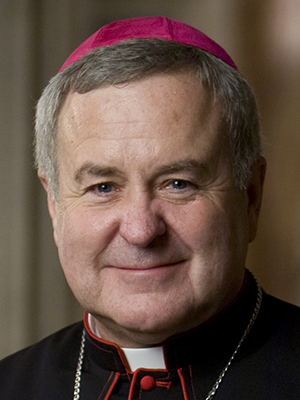
Archbishop Carlson, a native of Minneapolis, was appointed the 10th bishop/ninth archbishop of St. Louis in April 2009 and installed in June 2009. He was known as approachable, pastoral, humble and, with a genuine love for people, always mixed in a sense of humor. Each year he hosted a pastoral assembly as a forum of communication for leaders in parishes, and he established the Lay Formation Program. He appointed the first woman chancellor, inaugurated the Legatus pro-life prayer breakfast and declared Catholic education his first priority. His Mission Advancement Initiative and Alive in Christ effort focused on strengthening Catholic schools. He established the Roman Catholic Foundation of Eastern Missouri, which conducted the most successful capital campaign in the history of the archdiocese, raising more than $110 million for grants, scholarships and other needs. He brought in the Catholics Come Home program to welcome back Catholics who left the Church. He spoke out on abortion, religious liberty, immigration and the racial divide in St. Louis. Under his leadership, enrollment increased steadily at Kenrick-Glennon Seminary. Archbishop Carlson established the Rural Parish Clinic to provide health care and led the formation of the St. Joseph Housing Initiative.
Archbishop Mitchell T. Rozanski (2020-)
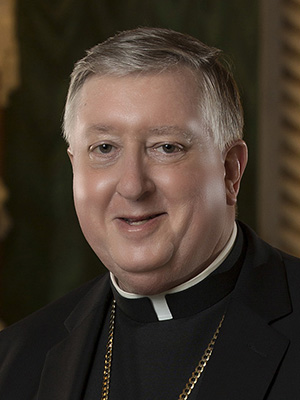
Archbishop Rozanski, born in Baltimore, Maryland, has served as the 11th bishop/10th archbishop of St. Louis since Aug. 25, 2020. He previously served as the Bishop of Springfield, Massachusetts, from Aug. 12, 2014, until his installation in St. Louis. His most defining initiative has been All Things New pastoral planning process that consolidated parishes and laid out his pastoral vision for the archdiocese, titled “Disciples Make Disciples.” His commitment to social justice also has been a hallmark of his tenure. He helped establish the Oikos Group, an ecumenical affordable housing initiative, created an Affordable Housing Fund within the Annual Catholic Appeal and launched Catholic Charities Housing in 2024 to develop long-term housing projects across the archdiocese. He established the archdiocesan Gun Violence Prevention Task Force and has participated in the archdiocese’s Maafa prayer service memorializing lives lost during the transatlantic slave trade. Under his leadership, the 95-page report “Slavery in the Historic Archdiocese of St. Louis” was released in June 2024. Beyond St. Louis, he serves as board chairman of Cross Catholic Outreach, a Vatican-endorsed nonprofit operating in more than 90 countries, and has been named to the Vatican’s Dicastery for Interreligious Dialogue.
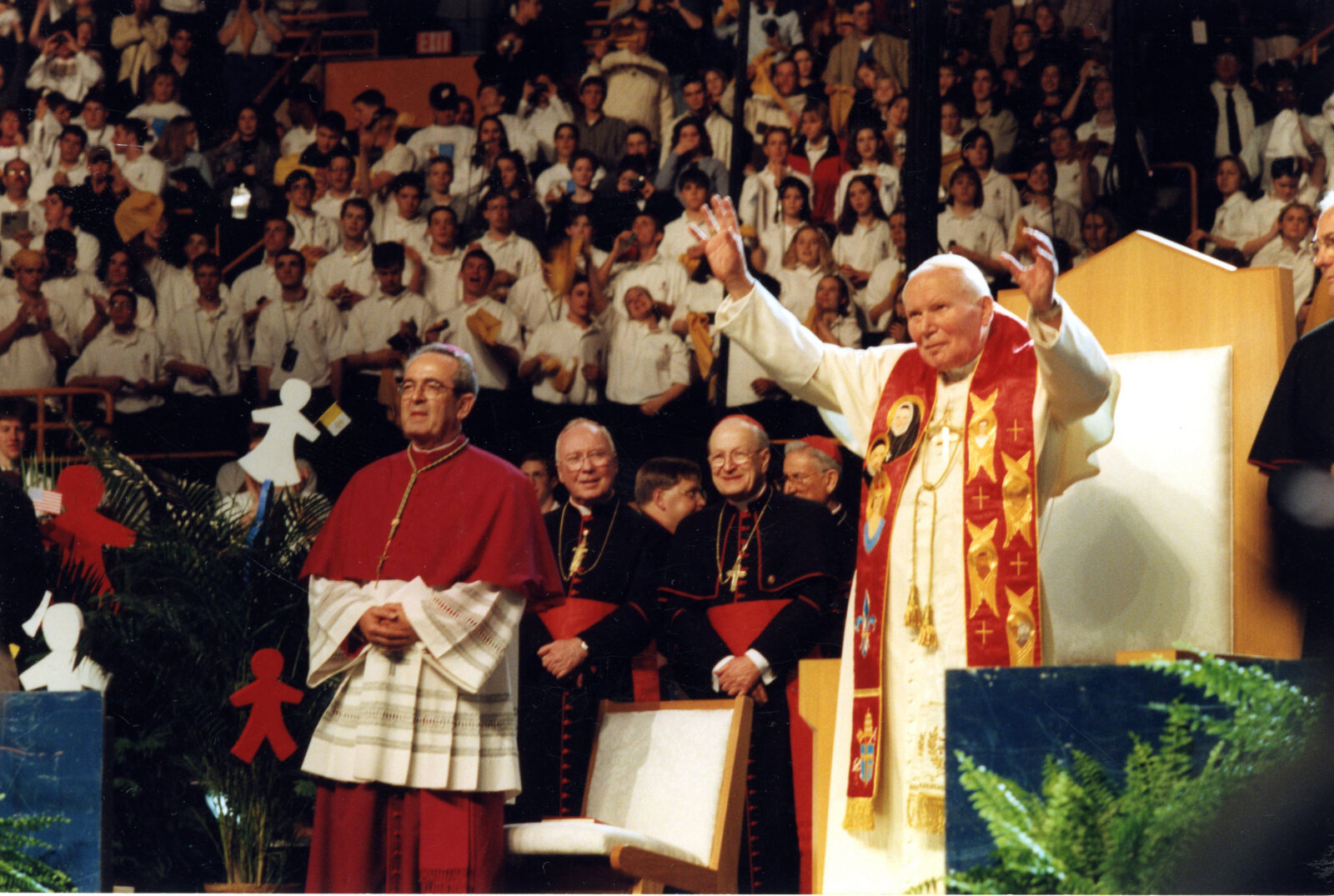
Pope John Paul II spoke to about 20,000 young people at the papal youth rally at the Kiel Center (now Enterprise Center) in St. Louis on Jan. 26, 1999.
Saints in St. Louis
The Archdiocese of St. Louis has been graced by the presence of some of the most saintly souls in modern Catholic history. Here’s a look at some of them and their historic visits to the Rome of the West.
St. Rose Philippine Duchesne (1769-1852)
St. Rose Philippine Duchesne, a French Religious of the Sacred Heart, arrived in the St. Louis area in 1818 at the invitation of Bishop William DuBourg, having crossed the Atlantic with four other missionaries. At the direction of Bishop DuBourg, the sisters traveled to St. Charles, where on Sept. 14, 1818, they opened the first free school west of the Mississippi and the first Catholic school in what would become the Archdiocese of St. Louis. The following year they relocated to Florissant, where Mother Duchesne established the first novitiate of the Society of the Sacred Heart in America. In 1841, she and three other sisters went to Sugar Creek, Kansas, to establish a school for Potawatomi girls. At the age of 72, too frail to do physical work and unable to learn the Potawatomi language, she spent much of her time in prayer, gaining the name “woman who is always praying.” She was recalled to St. Charles, her original foundation, where she died on Nov. 18, 1852, at the age 83 and having spent 34 years in America.
St. John Paul II (1920-2005)
On Jan. 26-27, 1999, the Archdiocese of St. Louis welcomed Pope John Paul II on his seventh and final visit to the United States. Arriving from Mexico City, the Holy Father was greeted at St. Louis-Lambert International Airport before embarking on a whirlwind 31-hour pastoral visit that would become one of the most celebrated moments in archdiocesan history. His visit included three major events: a youth rally at the Kiel Center (now Enterprise Center); Mass at the Trans World Dome (now The Dome at the America’s Center); and evening prayer at the Cathedral Basilica of Saint Louis (which he designated as a basilica two years before his visit). Seeds of faith planted during his visit continue to bear fruit: Many who attended the youth rally as teenagers have since become priests, religious sisters and archdiocesan lay leaders. He was canonized in 2014.
Venerable Fulton J. Sheen (1895-1979)
In May 1953, Archbishop Fulton J. Sheen, then serving as national director of the Society for the Propagation of the Faith and already known for his television preaching, came to St. Louis as the headline speaker for the Archbishop Ritter Worldmission Exhibition, a showcase of American missionary work held at Kiel Auditorium. Over five days, an estimated 270,000 people participated in the event, attending Mass, eucharistic adoration and presentations on the Church’s global mission. It would prove to be the largest Catholic gathering the city had ever seen at that point and a testament to Archbishop Sheen’s preaching and personality. On Sept. 24 the Archdiocese of St. Louis will host the beatification Mass of Venerable Fulton Sheen at The Dome at America’s Center, marking the first beatification ever held in the Archdiocese of St. Louis.
Servant of God Sister Thea Bowman (1937-1990)
Sister Thea Bowman, the only African-American member of the Wisconsin-based Franciscan Sisters of Perpetual Adoration, was no stranger to St. Louis. A gifted singer, scholar and evangelist who awakened in the Church a deeper appreciation of Black Catholic spirituality, Sister Thea visited the city on several occasions throughout the 1980s. In July 1987 — three years after her diagnosis with breast cancer — she taught a two-week course on African-American spirituality at the former St. Engelbert Parish in north St. Louis, sponsored by the archdiocesan Paul VI Institute of Catechetical and Pastoral Studies. “To help us as Black people to become more aware of our strengths and gifts and to share those gifts with our brothers and sisters of whatever culture,” she said at the time. Participants recalled that despite her illness, her voice rang out with power as she sang and taught. She died in 1990 at age 52, and her canonization cause continues to advance. In February, the diocesan phase of her investigation was formally closed in Jackson, Mississippi.
St. Teresa of Kolkata (Mother Teresa) (1910-1997)
Cardinal John J. Carberry requested that Mother Teresa send some members of her order to St. Louis. During a meeting for inner-city priests at a forum in Minnesota in 1976, Cardinal Carberry said he invited Mother Teresa to visit St. Louis and “if she could see a way for it, to establish a convent of her sisters in the north St. Louis area.” In April 1978, Mother Teresa visited St. Louis to participate in the Congress of the Institute on Religious Life. At the time, she took a tour of north St. Louis with Cardinal Carberry, searching for what she described as “the poorest of the poor.” The following year in 1979, Mother Teresa visited St. Louis with three Missionaries of Charity to start a community here. It was the second community the religious order established in the United States, with the first in New York. The sisters continue to operate a soup kitchen in the Jeff-Vander-Lou neighborhood today.