The Eucharist nourishes us to imitate Jesus’ sacrificial love
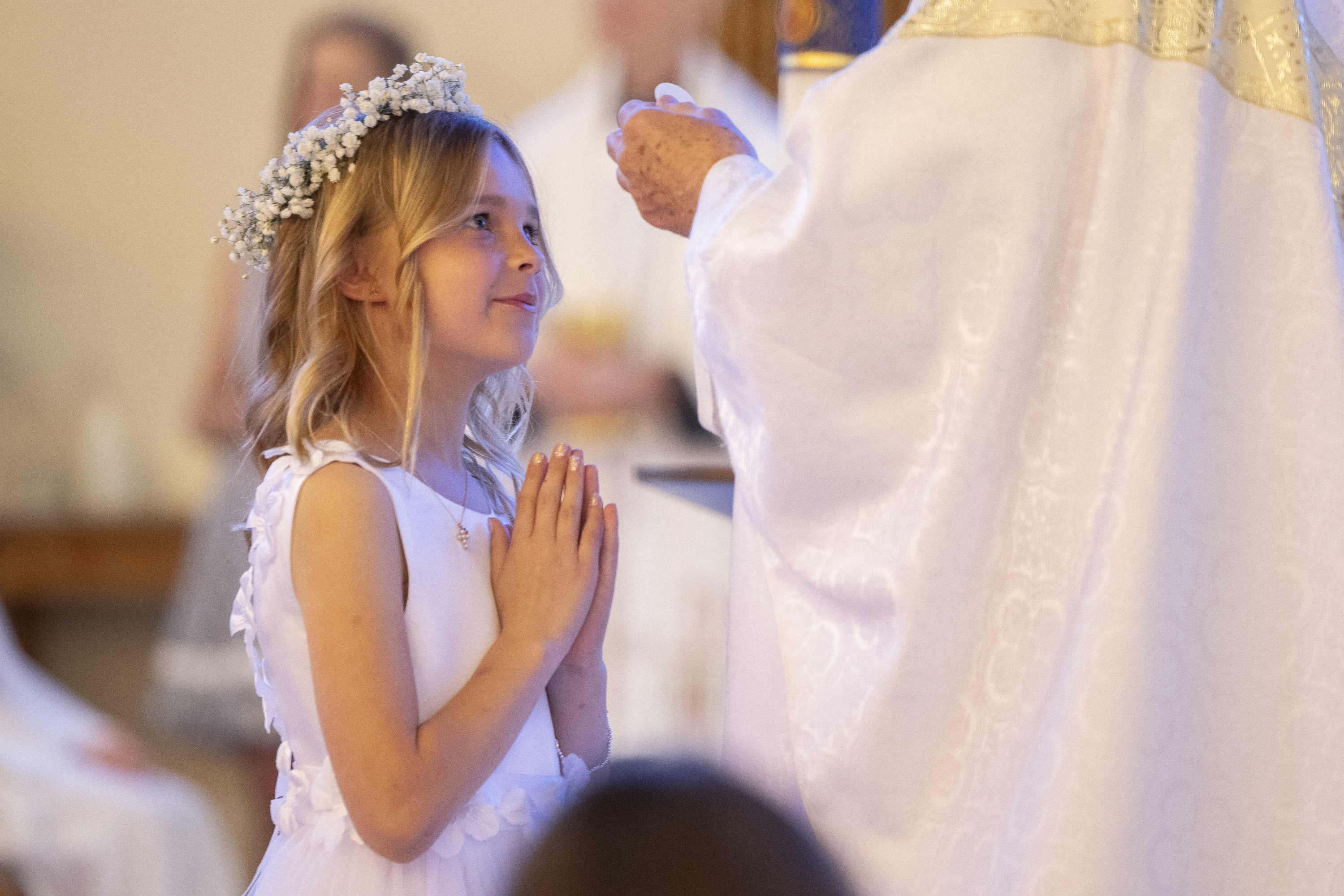
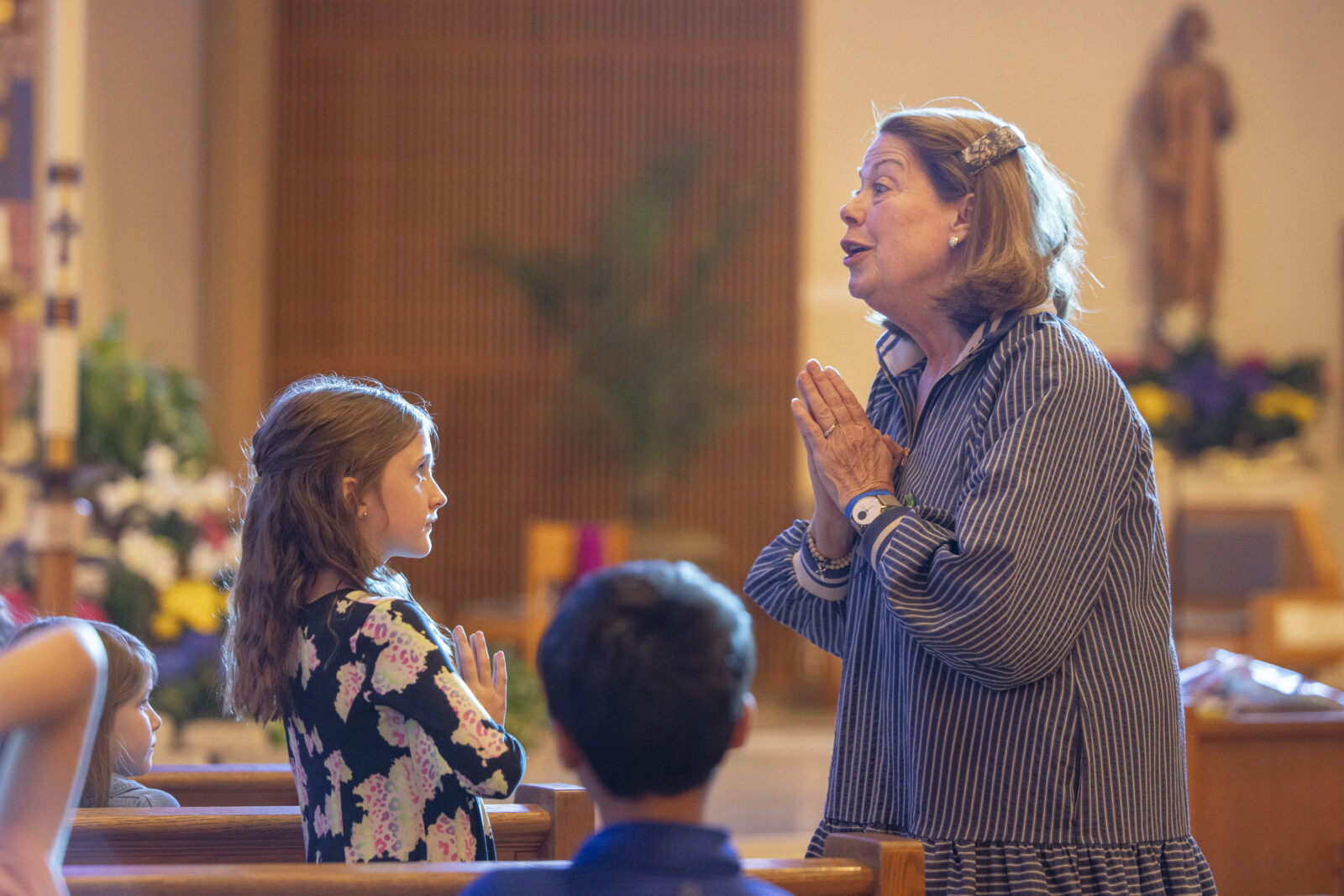
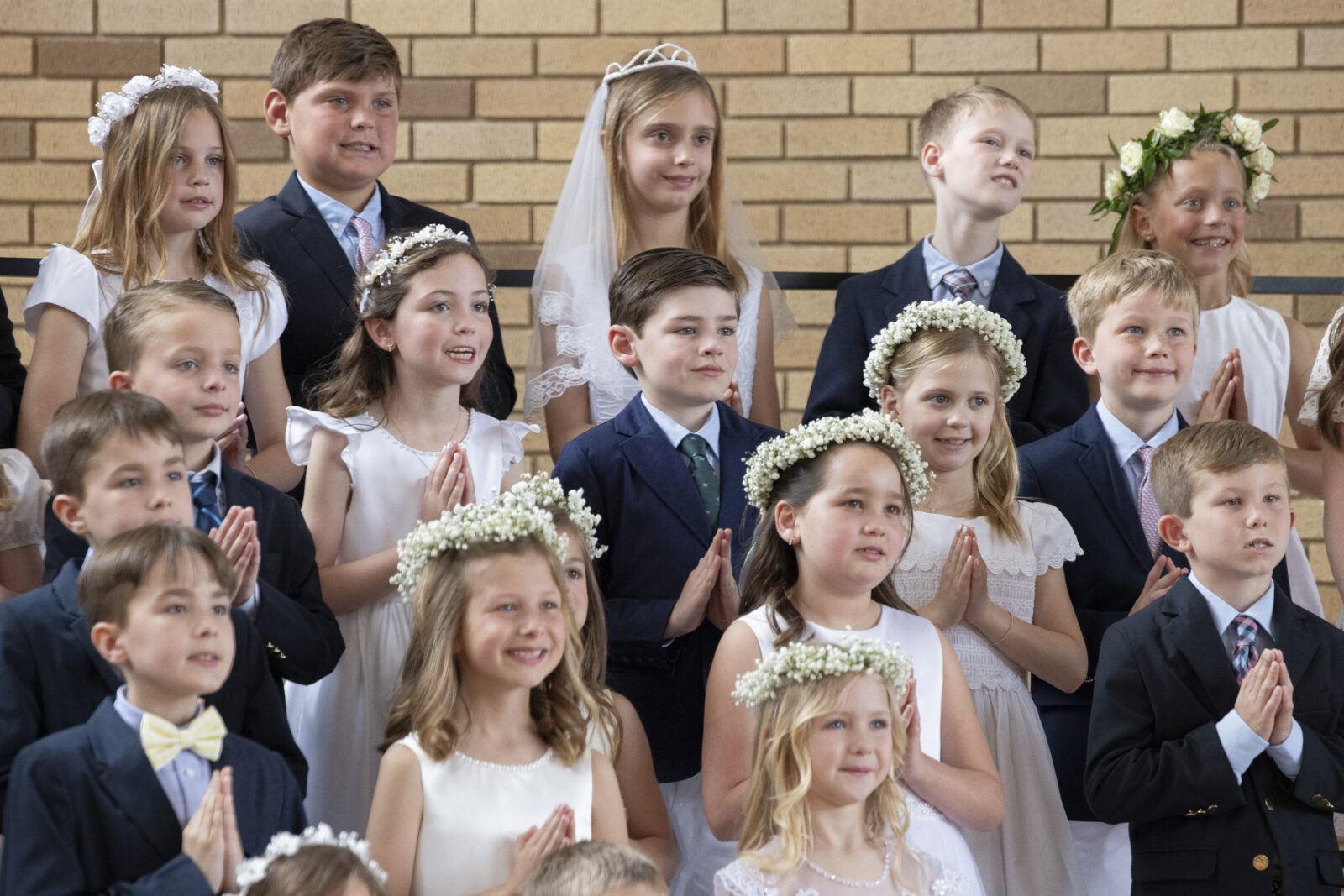
Colorful streams of light poured through the stained glass windows in St. Clement of Rome Church onto second graders and their parents gathered to rehearse for first holy Communion.
“This is your big day — you’re going to receive Jesus!” catechist Jeanne Fluri told them.
One by one, the students practiced the proper reverence needed to receive the Body of Christ, walking solemnly to the sanctuary step, bowing their heads and choosing to receive the host (unconsecrated, for practice) in the hand or on the tongue. Then, the children and parents had the opportunity to go to the sacrament of reconciliation to cleanse their sins before the big day.
Second grader Sullivan Owens had been looking forward to receiving the Eucharist all year. “I get to receive Communion. I don’t have to just get a blessing!” he said.
Throughout the year, Sullivan’s parents and younger sister have participated in St. Clement of Rome’s family catechesis program alongside him, an alternative to a more traditional Parish School of Religion that includes instruction and activities for the whole family both at the parish and in the home. Walking alongside her son as he prepares for first Communion has been a reminder of how the Eucharist is “the foundational piece of my faith,” said his mother, Tricia Owens.
“It just really comes back to the basics of receiving Jesus, loving what that can do for me, and then what it does for me to push out into the world and be a better person in the world,” she said.
Source and summit
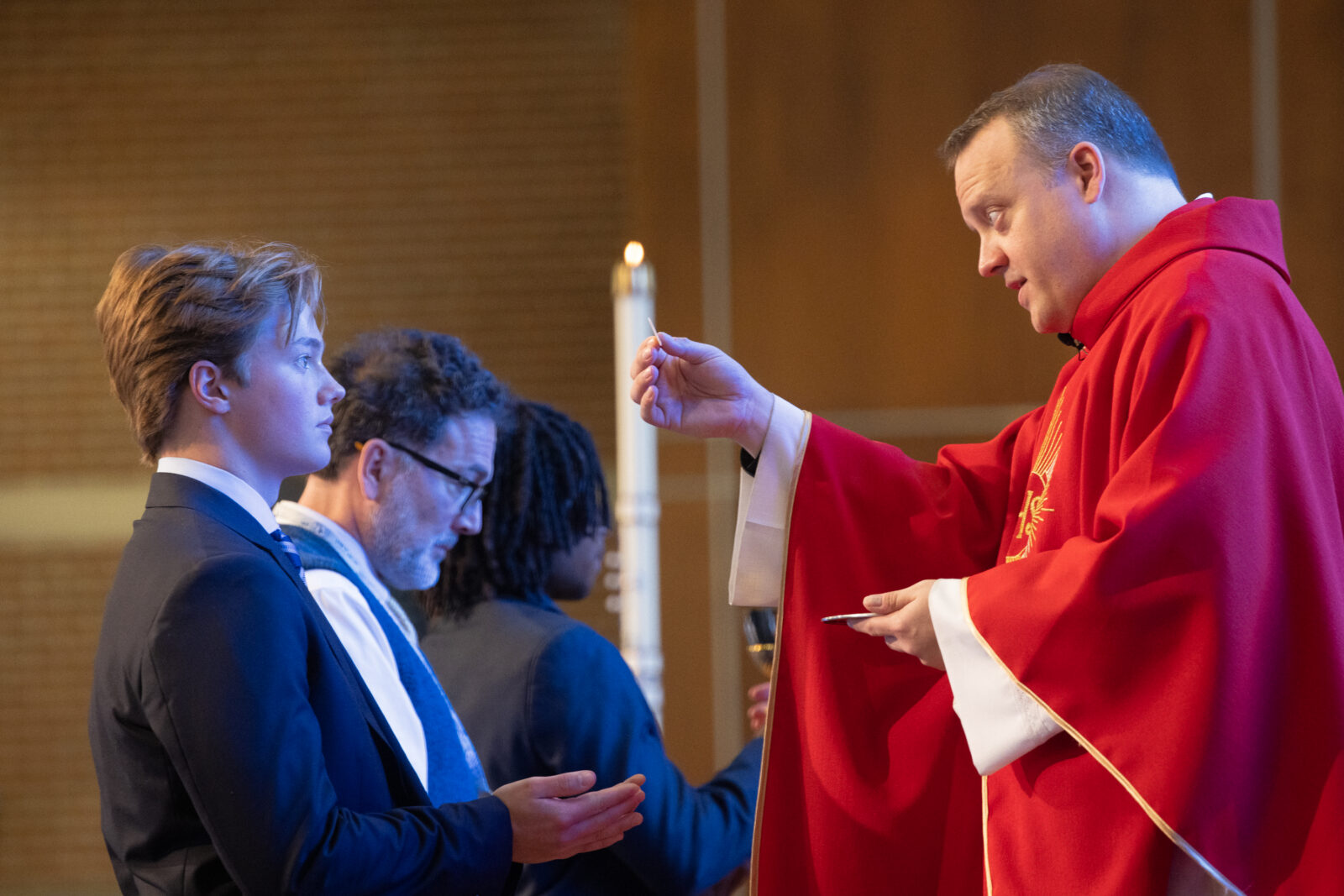
The Eucharist is “the source and summit of the Christian life,” the Second Vatican Council declared in its document “Lumen Gentium.”
“The other sacraments, and indeed all ecclesiastical ministries and works of the apostolate, are bound up with the Eucharist and are oriented toward it. For in the blessed Eucharist is contained the whole spiritual good of the Church, namely Christ Himself, our Pasch” (Catechism of the Catholic Church 1324).
The Catholic Church teaches the Real Presence of Jesus in the Eucharist: the Body, Blood, Soul and Divinity of our Lord truly present under the appearances of bread and wine. It is indeed a mystery, but Catholics do our best to understand through definitions given to us by the Church, including transubstantiation, which means to change from one substance to another.
When the priest consecrates the bread and wine, we believe there is a miraculous transformation into the Body and Blood of Jesus. The substance changes, but the accidents — secondary characteristics or the changeable aspects of a thing — stay the same.
A 2019 Pew Research Center study found that 69% of self-identified Catholics said they believed the bread and wine used at Mass are not Jesus, but instead are “symbols of the Body and Blood of Jesus Christ.” Only 31% said they believed in the Real Presence of Jesus in the Eucharist.
The study has been criticized by several Catholic scholars, but it was often cited as a motivating factor behind the U.S. bishops’ three-year National Eucharistic Revival held from 2023 to 2025 that included the 10th National Eucharistic Congress, National Eucharistic Pilgrimages and local and diocesan events.
A 2022 study from Georgetown University’s Center for Applied Research in the Apostolate found that 64 percent of respondents indicated they believe in the Real Presence. The survey, which aimed to clarify the 2019 Pew findings, found a high correlation between belief in the Eucharist and weekly or even monthly Mass attendance. Ninety-five percent of Catholics who attend Mass at least once per week showed knowledge of the Church’s teaching on the Eucharist and belief that the teaching is true.
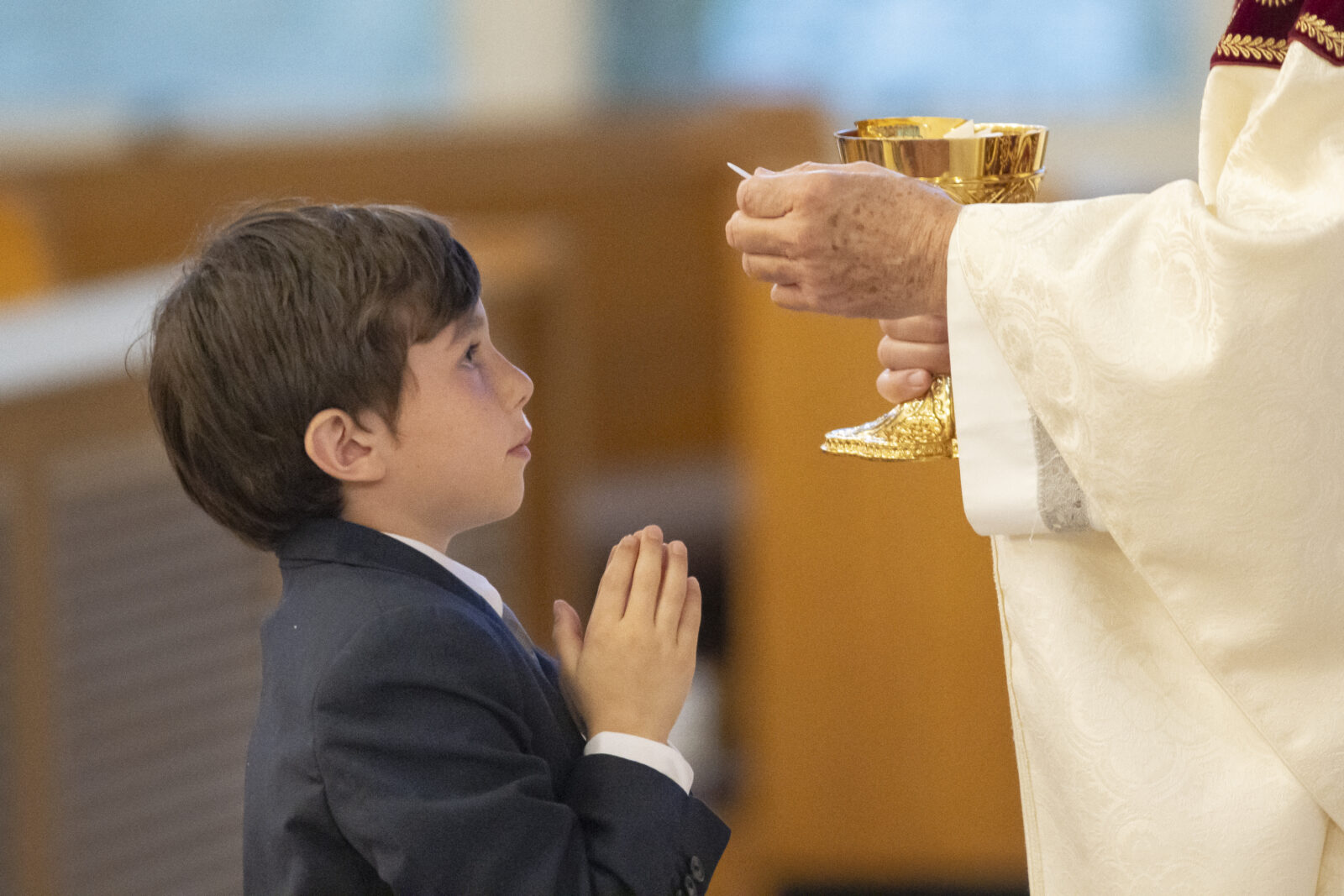
There are numerous references to the Eucharist in Scripture, including when Jesus told His apostles: “I am the living bread which came down from heaven…if anyone eats this bread, he will live forever…I say to you, unless you eat the flesh of the son of man and drink His blood, you have no life in you; he who eats my flesh and drinks my blood abides in me, and I in him” (John 6:25-58).
There are also references in all four Gospels of Jesus’ institution of the Eucharist at the Last Supper (Matthew 26:17-30; Mark 14:12-26; Luke 22:7-39; John 13:1-17:6.)
First Communion is one of the three sacraments of initiation. While baptism and confirmation are only received once, Catholics continue to receive the Eucharist throughout our lifetime as nourishment in our life of faith. It also unites us with the other members of the body of Christ.
The catechism explains, “As bodily nourishment restores lost strength, so the Eucharist strengthens our charity, which tends to be weakened in daily life” (CCC 1394).
Communion can be understood through the context of the eucharistic celebration of the Mass, Kenrick-Glennon Seminary professor of theology and philosophy Lawrence Feingold said in a series of talks during the Eucharistic Revival.
Communion is inextricably linked to sacrifice, Feingold said. When the priest consecrates the bread and wine, Christ’s sacrifice on the cross is made present, and we participate in offering it to the Father. Then, as we consume the sacrifice, we receive nourishment to pick up our own crosses and follow Jesus.
“It’s a banquet in which we receive the victim who’s just been offered to God the Father — Jesus — and we receive Him to be configured more to Him,” Feingold said. “That is, to be made more like Christ on the cross…in this sense of being able to give ourselves to others, even when sometimes that hurts.”
At the Last Supper, Jesus gave us not just His Body and Blood but also the new commandment to love one another as He has loved us, Feingold said.
“He wouldn’t have given us that commandment if He didn’t give us the strength or power to do it,” Feingold said. “And the Eucharist is the ordinary way that He nourishes in us the power to love, not just on a natural level, but to love supernaturally — that is, to love as Jesus has loved us. And doing that it precisely what builds up communion between ourselves.”
The Eucharist’s sacramental grace helps us grow in charity in our own particular circumstances, he added. It’s important to take time immediately after receiving Communion to thank God for His gift and ask Him to increase His graces in us even more as we are sent forth.
“It could be resolutions, good thoughts. That’s when I find I get my best ideas for teaching in class,” Feingold said. “And it makes sense, because Jesus is in us in a very special way, Body, Blood, Soul and Divinity for that time, so we should make use of it.”
In St. John Paul II’s 2003 encyclical “Ecclesia de Eucharistia,” the late pontiff wrote that the faithful are called to undertake “with renewed enthusiasm the journey of Christian living,” with the Eucharist at the center.
“Every commitment to holiness, every activity aimed at carrying out the Church’s mission, every work of pastoral planning, must draw the strength it needs from the Eucharistic mystery and in turn be directed to that mystery as its culmination,” St. John Paul II wrote. “In the Eucharist we have Jesus, we have his redemptive sacrifice, we have his resurrection, we have the gift of the Holy Spirit, we have adoration, obedience and love of the Father. Were we to disregard the Eucharist, how could we overcome our own deficiency?”
The sacrament of the Eucharist
The minister of the sacrament of the Eucharist is a validly ordained priest. For distributing the Eucharist to the faithful, the ordinary minister of Holy Communion is a priest or deacon, while extraordinary ministers are acolytes or members of the faithful designated by the pastor. The matter is wheat bread and grape wine mixed with a little water, and the form is the words of consecration spoken by the priest.
Receiving the Eucharist
In 1910, St. Pius X lowered the age of admittance to Communion from 12 years old to around 7 years old (the “age of reason”).
“The Church obliges the faithful to take part in the Divine Liturgy on Sundays and feast days and, prepared by the sacrament of reconciliation, to receive the Eucharist at least once a year, if possible during the Easter season. But the Church strongly encourages the faithful to receive the holy Eucharist on Sundays and feast days, or more often still, even daily” (CCC 1389).
Anyone concsious of a grave sin must receive the sacrament of reconciliation before coming to Communion. According to Canon Law can. 919, a person who is to receive the Eucharist is to abstain for at least one hour before holy Communion from any food and drink, except for only water and medicine.
“Communion with the Body and Blood of Christ increases the communicant’s union with the Lord, forgives his venial sins, and preserves him from grave sins. Since receiving this sacrament strengthens the bonds of charity between the communicant and Christ, it also reinforces the unity of the Church as the Mystical Body of Christ” (CCC 1416).