Southern Vicariate event highlights role of faith in facing disordered attachments and addictions
Learning to surrender, over and over again, is how David Smock maintains his sobriety.
Smock describes himself as a recovering alcoholic and drug addict. He grew up in a household of alcoholics, and his painful childhood left him seeking ways to numb his feelings. But his addictions only brought more shame and unrest, he said.
“My first act of surrender was the realization that I was out of control,” he said. “It was the pain that caused me to see I needed help, and I had nothing to lose by going to a meeting.”
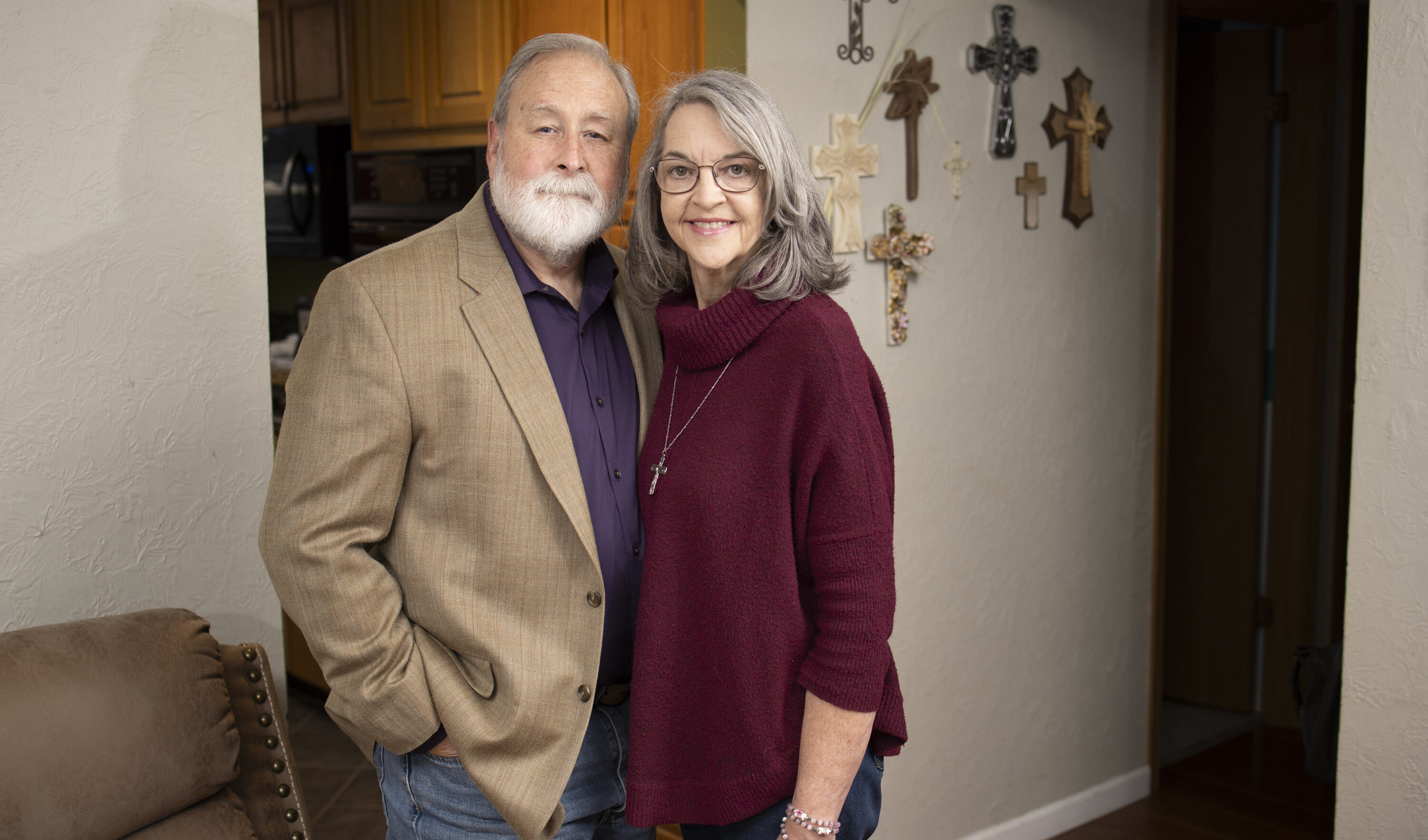
Smock and his wife, Jill, parishioners at Our Lady in Festus, shared their testimony of addiction and recovery as part of “Freedom in Christ,” a morning of reflection on disordered attachments and addictions hosted by the Southern Vicariate of the Archdiocese of St. Louis on Jan. 31.
The theme was drawn from Galatians 5:1: “For freedom Christ set us free; so stand firm and do not submit again to the yoke of slavery.”
If Christ has set us free, why are we still wrapped in so many chains?
As humans with eternal souls but mortal bodies, we often find ourselves fixing our desires on “something that’s finite, when in fact, the only thing that really satisfies us ultimately is God,” episcopal vicar Father Mike Lydon said.
Our disordered attachments usually stem from trying to find fulfillment in the “four great idols” of power, honor, pleasure and security/wealth. We turn to alcohol, or drugs, or pornography, or sugar, or social media, and so on; the more we do so, the deeper we spiral into shame, Father Lydon said.
Southern Vicariate pastoral ministry coordinator Jennifer Meehan shared how disordered attachments came into her life when she was avoiding dealing with a difficult situation or emotional pain. She had to learn to sit in the tension and discomfort and offer it to God, she said.
“I know that I’m going to struggle, especially in these areas of honor, power, pleasure and security, every day of my life until I’m lucky enough to cross into eternal life,” she said. “But every time, I know Jesus is there, welcoming me back, offering me that freedom in Him.”
For Catholics, confession can be a first step in bringing disordered attachments and addictions to light. Participating in a 12-step program, finding a trained spiritual director or mentor or seeking other professional help can help us continue to share our struggles instead of keeping them hidden, Father Lydon said.
“The way out of the locked jail of shame is, you’ve got to open up to at least one other person or more,” Father Lydon said. “You open up with people in a group who suffer like you do, and they talk about the cracks in their lives in the darkness. It’s only by revealing those cracks in our lives that the grace and light of Christ can come in.”
As David Smock began his recovery, he joined 12-step programs to gain tools and mentors who had been in his position. He learned that recognizing his own powerlessness over the addiction and surrendering to God doesn’t mean “waving the white flag, going back to bed and pulling the covers up over my head,” he said. It’s putting in the work, day by day — and often moment by moment — to remove himself from toxic situations, engage in service work that turns his focus outward and reach out to others when he needs a reminder to stay on the right path.
“It’s my weakness and the constant realization of my need for God that draws me closer to Him,” David said.
For a long time, Jill Smock didn’t think she was addicted to anything. She had attended Al-Anon meetings, which offer support for families and friends of alcoholics. It took deep reflection to realize that she was, in fact, addicted to chaos.
“I reveled being in the midst of a situation I could attempt to fix so much that if I didn’t have one, I would create one,” she said. “This insight…set my recovery on a whole new trajectory. God knew I needed clarity on what I was powerless over.”
In the book “The Twelve Steps and the Sacraments,” Catholic in Recovery founder Scott Weeman suggests that an essential part of Catholic spirituality is maintaining a connection with our inherent brokenness. “This is not a bad thing,” Jill said. “In fact, it reminds us of our need to keep Christ — His life, passion, death and resurrection — ever-present in our lives. Acknowledgment of my powerlessness is a tangible way for me to open myself to the mercy made available by God’s grace.”
Timothy Johns, a parishioner at Sacred Heart in Crystal City, attended the morning of reflection to connect with others who have similar experiences. Johns is recovering from addictions to alcohol and drugs. He returned to the Church last year after falling away during college.
One of the biggest things that kept him trapped as an addict was the idea that he was the only one dealing with those vices, believing everyone else must be better and holier than him, he said. Opening up helped him realize that nearly everyone has some kind of disordered attachment they struggle with, and we can help each other along the way.
“We can’t do it alone. What I’ve noticed over the past four months of my journey is that every time my life has gone wrong and things have gone bad, it’s always been because I tried to be in control…I’ve got this, I don’t need God, I don’t need anybody else, I’m going to do it all on my own,” he said. “That’s been the biggest realization and what was most impactful with this event.”
Catholic in Recovery
Catholic in Recovery is a nonprofit organization that seeks to serve those suffering from addictions and unhealthy attachments. Meetings integrate the principles of 12-step recovery with the wisdom of Catholic tradition.
To learn more and find resources from Catholic in Recovery, visit catholicinrecovery.com.
David and Jill Smock are seeking interest in starting in-person Catholic in Recovery meetings within the Archdiocese of St. Louis. If you are interested in attending a future meeting or finding out more information, email johnmcdson@gmail.com.
Other 12-step programs
Alcoholics Anonymous: aa.org/find-aa
Al-Anon, Alateen and Adult Children of Alcoholics: al-anon.org/al-anon-meetings
Sexaholics Anonymous: sa.org
Narcotics Anonymous: stlna.org
Overeaters Anonymous: oa.org
Internet and Technology Addicts Anonymous: internetaddictsanonymous.org