The sacrament of confirmation completes Christian initiation and enables Catholics to become disciples of Christ
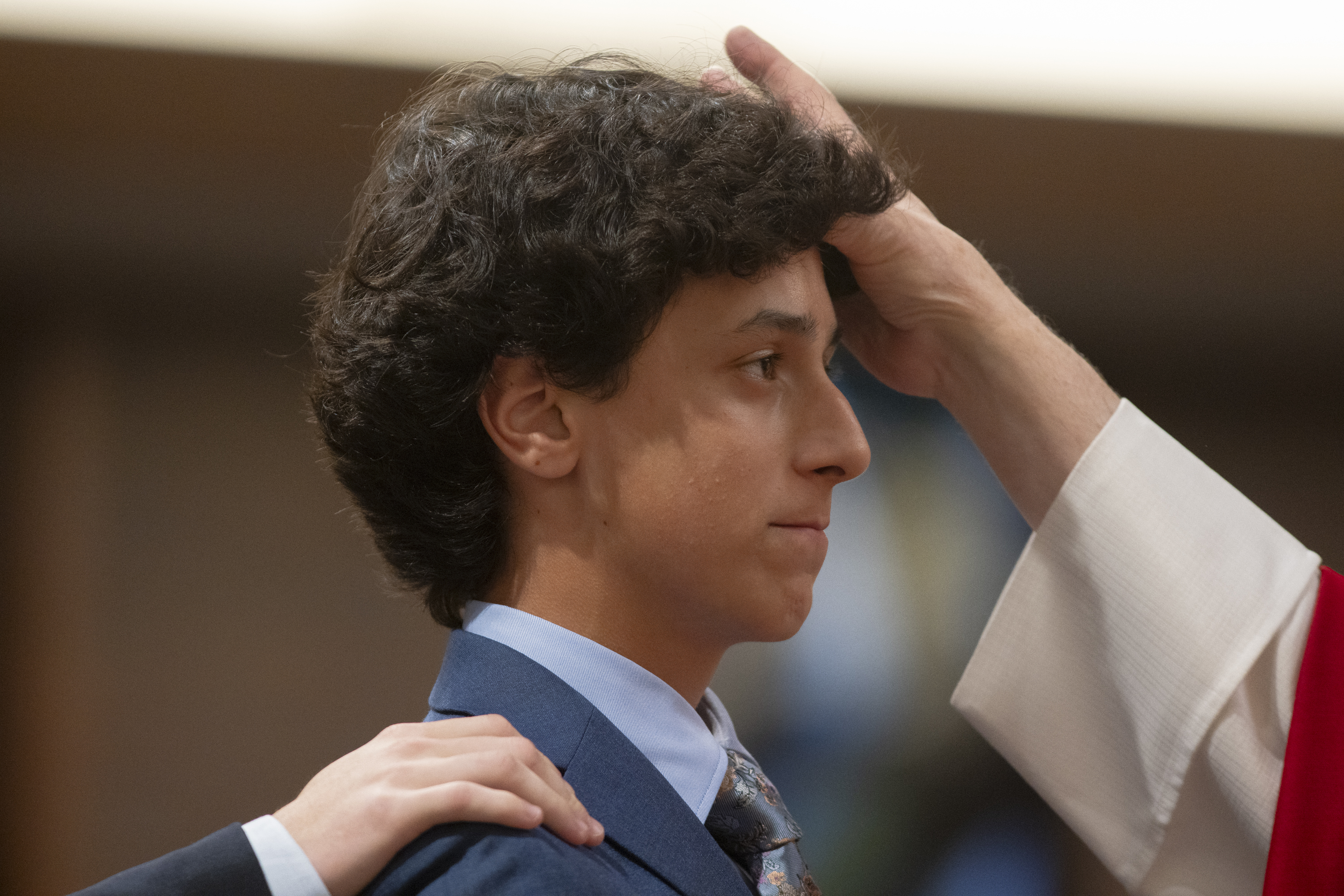
Louisa Crimmins stood still as Archbishop Mitchell T. Rozanski’s thumb, dipped in sacred chrism, traced the sign of the cross on her forehead, sealing her with the gift of the Holy Spirit.
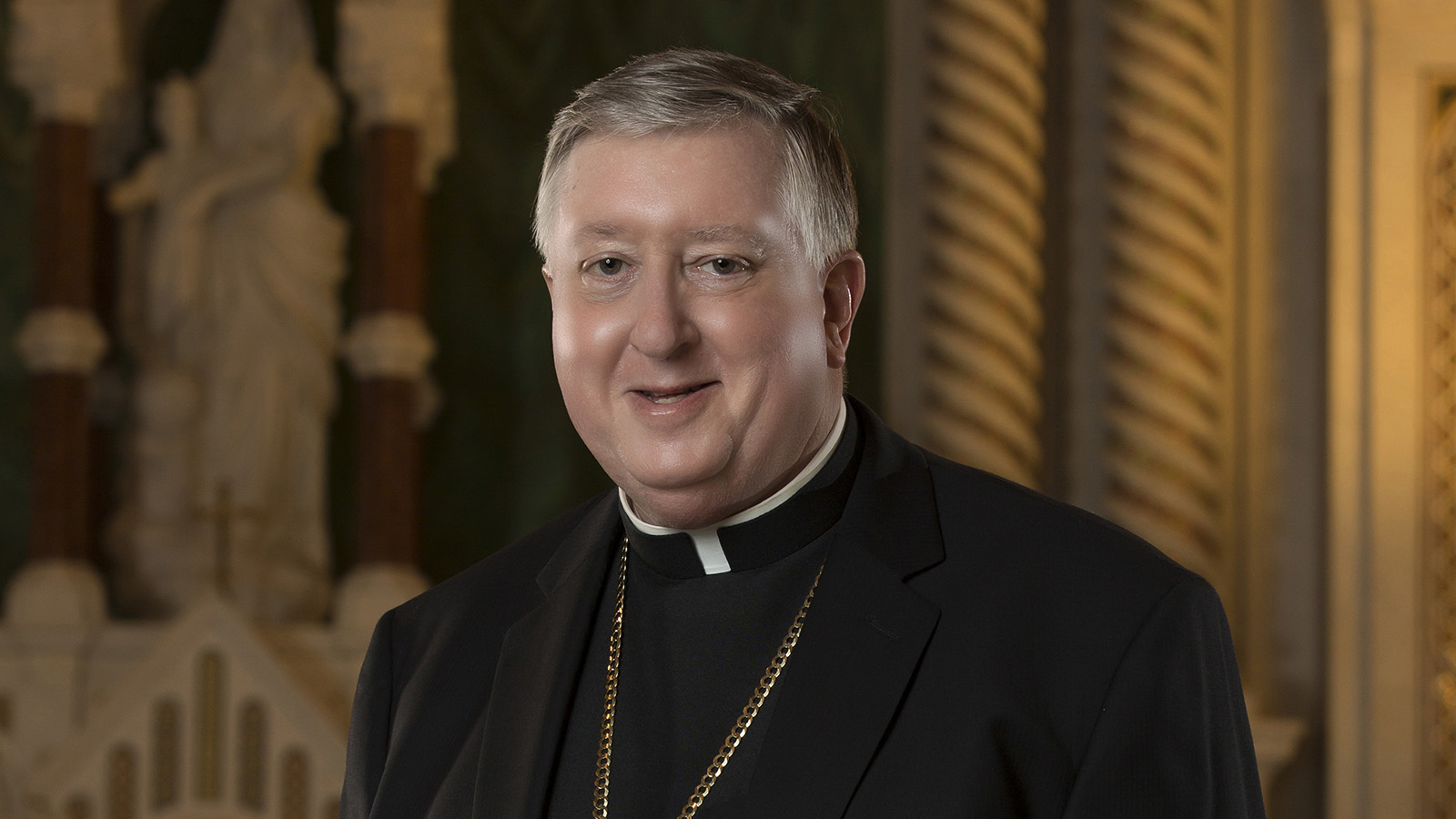
One by one, she and 68 other eighth graders at St. Gerard Majella Church in Kirkwood received the sacrament of confirmation from Archbishop Rozanski on April 16.
With the scent of balsam still lingering, Louisa returned to her pew, praying she would find the courage — one of the seven gifts of the Holy Spirit — to share her faith with others.
Confirmation is “getting to say that you believe,” said Louisa, who attends the Parish School of Religion at St. Gerard Majella. “It’s not just something like a PSR class your parents want you to take. It’s that you get to say ‘Yes, I do actually believe in God, in Jesus.’”
As a student at North Kirkwood Middle School, Louisa said she hopes that the gifts of fortitude and courage will give her the strength to be open about her faith with her classmates, some of whom have different or no faith upbringing.
“There are a lot of people who are like, ‘Oh, you’re Catholic?’” she said. “So it’s having the courage to say, ‘Yes, I am Catholic.’”
The completion of Christian initiation
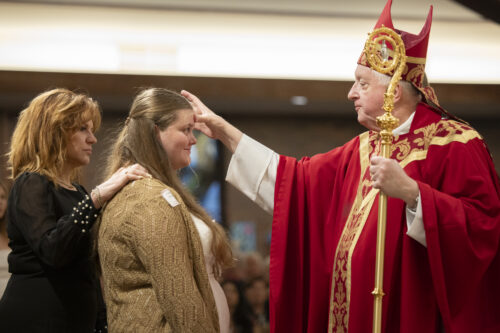
Archbishop Mitchell T. Rozanski confirmed Gabrielle Black on April 16 at St. Gerard Majella Parish in Kirkwood. Margaret Kraick, Gabrielle’s sponsor and godmother, stood behind her. Gabrielle chose St. Thérèse of Lisieux as her confirmation saint. Sixty-nine people received the sacrament of confirmation at the Mass.
Confirmation is one of the three sacraments of initiation in the Church, along with baptism and first Communion. It is often referred to as the “sacrament of maturity” because it completes the process of initiation into the Christian community and matures the soul for the work ahead.
The Church teaches that confirmation is necessary because it enriches the person with the strength of the Holy Spirit to build up the Church and to be a witness of Christ to others.
For “by the sacrament of confirmation, (the baptized) are more perfectly bound to the Church and are enriched with a special strength of the Holy Spirit. Hence they are, as true witnesses of Christ, more strictly obliged to spread and defend the faith by word and deed” (Catechism of the Catholic Church, 1285).
In the Archdiocese of St. Louis, confirmation is generally offered in seventh or eighth grade, with a year of formation leading up to the big day. The sacrament is typically conferred within the context of Mass. The rite of confirmation includes three key parts: the renewal of baptismal vows, the laying on of hands by the bishop (or his designate) and anointing with the sacred chrism oil.
The renewal of baptismal promises is a reminder that, as Christians, we have essentially “died” to our own lives and begun our new life in Christ in the Church. Through confirmation, Catholics realize the fullness of the promises that were first given in baptism.
Confirmation effectively completes the sacramental graces of Christian initiation, said Father Donald Anstoetter, assistant professor of sacramental-liturgical theology at Kenrick-Glennon Seminary. Through baptism, a person is first claimed for Christ and marked as belonging to the Lord. Confirmation deepens and seals that baptismal grace, placing a permanent mark on the soul — one that remains for eternity, he said.
In the events of Easter Sunday, Father Anstoetter said, the apostles already had everything they needed for salvation after the resurrection, yet they remained fearful and stayed behind locked doors. But then at Pentecost, they were filled with the Holy Spirit and could no longer stay hidden, choosing to go out and boldly to proclaim the risen Christ.
In the same way, confirmation seals a lasting mark on the soul, showing that a person belongs to the Lord and carrying God’s ongoing promise to provide the graces we need to live as a disciple, he said.
“Confirmation is giving us the graces we need to stand up for what we believe, to share what we believe, and, if necessary, to experience the consequences for what we believe,” Father Anstoetter said.
Service as disciples of Christ
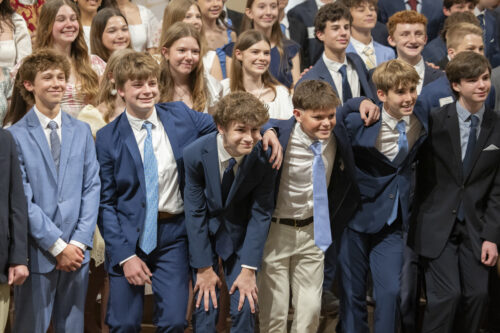
As part of their confirmation preparation, students perform acts of service. Those service hours are akin to an apprenticeship in becoming a disciple of Christ.
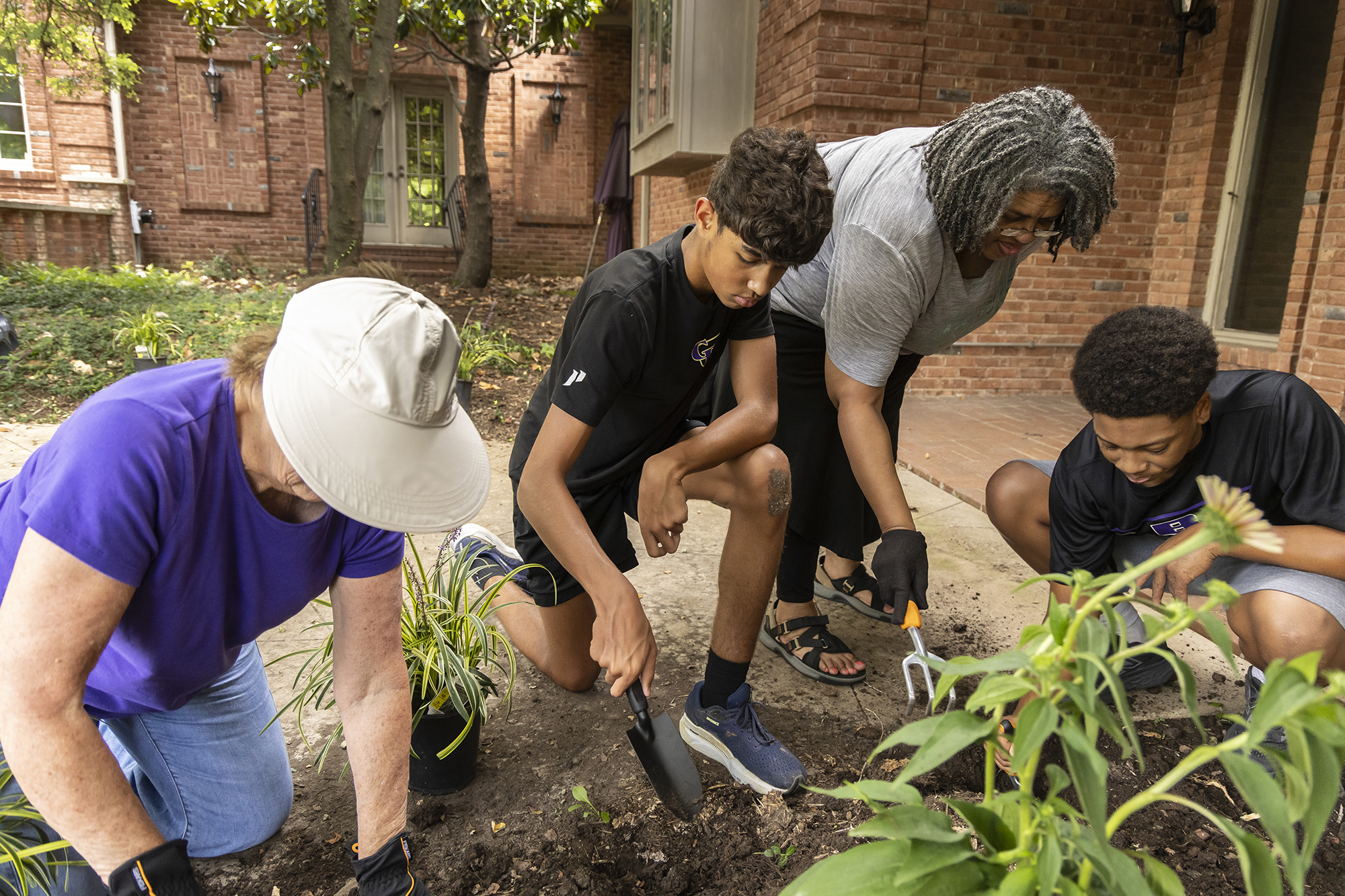
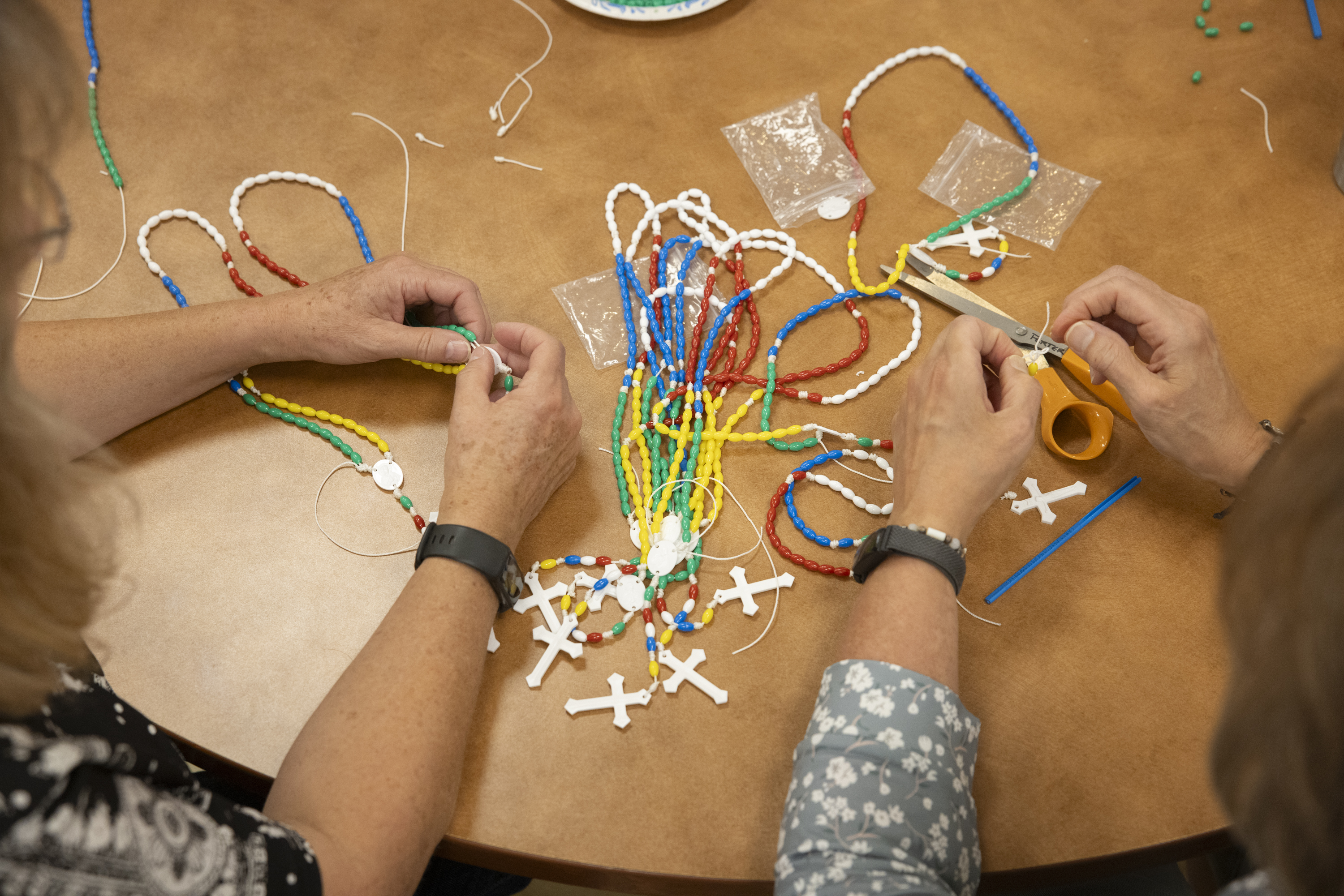
Eighth graders at St. Gerard Majella School and PSR helped serve at Mass, volunteered at the parish fish fry and with younger children attending Totus Tuus, made meals for the homeless and assembled Easter and birthday baskets for children in need, among other activities.
Several of them noted that their service was a way to be fully brought into the Church, acting as Jesus did by helping others. Some said that they built habits they hope to carry into adulthood as they take responsibility for their own faith and be the face of Christ to the people around them.
“I think you have to serve others and make sure that you yourself are a part of the Christian community before you’re fully brought into the Church,” said Hank Stevens, who helped serve at Mass and volunteered his time at a pro-life organization as part of his service hours.
Since becoming vicar general in 2023, Father Carl Scheble has confirmed hundreds of young people all over the archdiocese. The experience has been a meaningful way to engage with youth one-on-one and to witness as they take the next step in their faith journey. (A bishop typically administers confirmation, but priests may administer the sacrament either by mandate of the law or by delegation from the bishop.)
What moves him most is the encounter with each candidate in the moment of the rite. “It’s just to be face to face when you’re doing the actual sacrament, just to see it in their face,” Father Scheble said. “Some are scared to death or nervous, … (but) especially for their age, just to kind of pause for a minute and to make this an intentional decision, that I believe, and I want to continue this” faith journey. “To me, that’s where it’s at.”
Confirmation: The completion of Christian initiation
Baptism, the Eucharist and the sacrament of confirmation together constitute the “sacraments of Christian initiation,” whose unity must be safeguarded. It must be explained to the faithful that the reception of the sacrament of confirmation is necessary for the completion of baptismal grace. For “by the sacrament of confirmation, (the baptized) are more perfectly bound to the Church and are enriched with a special strength of the Holy Spirit. Hence they are, as true witnesses of Christ, more strictly obliged to spread and defend the faith by word and deed” (Catechism of the Catholic Church, 1285).
Anointing and laying on of hands
“From that time on the apostles, in fulfillment of Christ’s will, imparted to the newly baptized by the laying on of hands the gift of the Spirit that completes the grace of baptism. For this reason in the Letter to the Hebrews the doctrine concerning baptism and the laying on of hands is listed among the first elements of Christian instruction. The imposition of hands is rightly recognized by the Catholic tradition as the origin of the sacrament of confirmation, which in a certain way perpetuates the grace of Pentecost in the Church.
“Very early, the better to signify the gift of the Holy Spirit, an anointing with perfumed oil (chrism) was added to the laying on of hands. This anointing highlights the name ‘Christian,’ which means ‘anointed’ and derives from that of Christ Himself whom God ‘anointed with the Holy Spirit.’ This rite of anointing has continued ever since, in both East and West. For this reason the Eastern Churches call this sacrament Chrismation, anointing with chrism, or myron which means ‘chrism.’ In the West, the term Confirmation suggests that this sacrament both confirms and strengthens baptismal grace” (CCC 1288-1289).
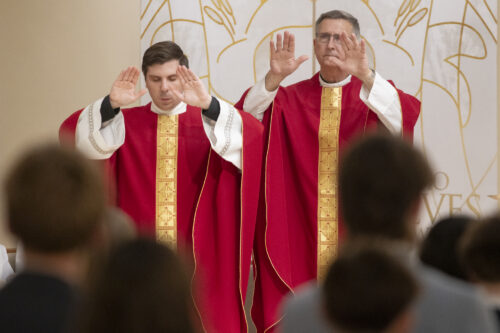
Laying on of hands (matter)
The bishop extends his hands over the confirmandi, saying a prayer:
“All-powerful God, Father of our Lord Jesus Christ, by water and the Holy Spirit you freed your sons and daughters from sin and gave them new life. Send your Holy Spirit upon them to be their Helper and Guide. Give them the spirit of wisdom and understanding, the spirit of right judgment and courage, the spirit of knowledge and reverence. Fill them with the spirit of wonder and awe in your presence. Through Christ our Lord.”
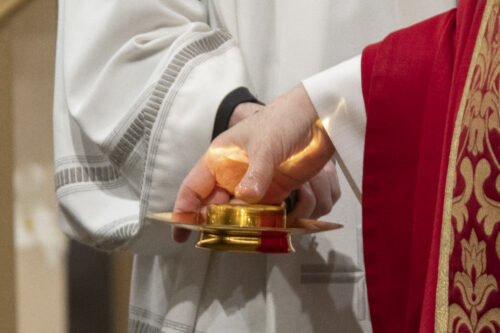
Anointing with the chrism oil (matter)
Afterward, each candidate, with their confirmation sponsor, approaches the bishop, who makes the sign of the cross on the person’s forehead with the chrism oil, while saying these words (the form of the sacrament): “Be sealed with the gift of the Holy Spirit.” There also is an exchange in which the bishop says, “Peace be with you.” The person responds: “And with your spirit.”
The sacred chrism (sacrum chrisma) that is used for confirmation is a sacramental, a blessed substance. The chrism is consecrated by the bishop at the annual chrism Mass, while the other two oils, the oil of the catechumens (oleum catechumenorum) and the oil of the sick (oleum infirmorum), are blessed by the bishop. These oils are then distributed to the parishes throughout the archdiocese.