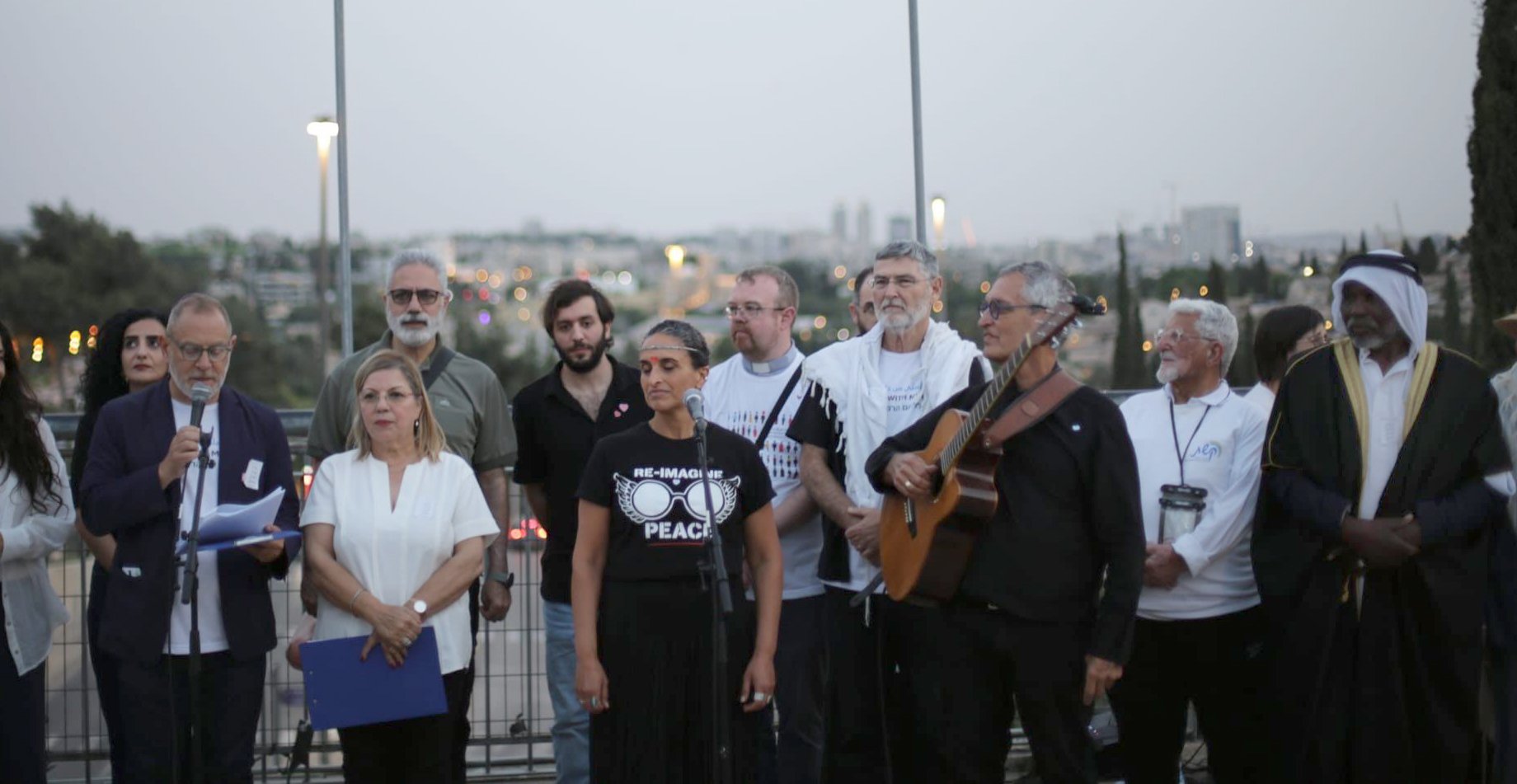
JERUSALEM — Holding placards calling for “justice,” “trust” and “peace,” religious leaders led hundreds of peace activists, Jews, Muslims, Christians and Druze in a march in Jerusalem May 18, days after thousands of Israelis clashed with Palestinian residents in the Old City during the annual Jerusalem Day’s Flag Parade.
In its fourth year, the interfaith march of the Forum for Human Rights is organized by religious organizations as an alternative to the nationalist Flag March.
Jerusalem Day commemorates the reunification of Jerusalem during the 1967 war, bringing Jordanian-held East Jerusalem under Israeli control together with West Jerusalem.
“We march this evening out of a deep commitment to the sanctity of life. To the sanctity of every human life. To the ability to see an entire world within every woman, man and child,” said Rabbi Amichai Lau-Lavie, co-chair of the Board of Rabbis for Human Rights, one of the march organizers, at the opening of the march in the courtyard of the historic YMCA building just outside the Old City.
“Precisely in these days when it is so easy to become accustomed to pain, to fear and to the language that divides us, we seek to remind ourselves and those around us that life precedes every conflict and that preserving our humanity is a spiritual, moral and courageous act.”
Women religious, priests and rabbis gathered on the grounds of the YMCA alongside young people with piercings, families and ultra-Orthodox Jews during the opening ceremony, which included a prayer asking for God’s mercy sung in Aramaic by Jerusalem Christian resident Nadeen Fanous.
“It is hard to hear the discussions that keep us apart,” Fanous said. “Being here as part of the movement of love and friendship we leave behind the hate, injustice and division. If we don’t see each other, we can’t work for the vision each of us has. We must build a common vision.”
Sister Monica Dullmann, a German Sister of St. Joseph of the Apparition who has lived in Jerusalem for decades, said she was happy to see so many people marching for “peace, friendship and trust.”
“I believe in peace and justice, and it is nice to be together with others who feel the same way and together we will be stronger,” she said. “I have always believed peace is possible and I still believe it.”
Avraham, 33, and Shlomit Kelman, 33, who are Orthodox Jews, said they brought their two young sons to participate in the march as a way of showing them how a shared life in Jerusalem and Israel is possible.
“We are all upset about what is happening in the country and all the violence that is happening, so we are here in solidarity with other people of different religions and nationalities. It is exciting to be in a place where we can publicly march together and show our solidarity,” Avraham said. “It is the contradiction of Jerusalem. There is so much love and hatred (at the same time), but it shows there can be another way that can bring people together and celebrate our differences.”
Nadia Attallah, 62, a Druze activist from northern Israel, said she came to Jerusalem for the interfaith march because she believes in peace between religions and wanted to bring attention also to the massacres of Syrian Druze by Bedouin militia, which took place in 2025 in Suwayda.
“Peace is the only way,” she said.
Participating with his parishioners for the fourth year, Father Piotr Zelazko, a Polish priest who serves as the patriarchal vicar for the St. James Vicariate for the Hebrew-speaking Catholics in Israel, said the march was a part of who he is. He led his choir in song, greeting the march with “We Shall Overcome” as they arrived at Jaffa Gate.
“If we stop praying for peace … there will be no peace,” he said. “When religions walk together, peace will walk with them. Some people say Middle East religions cause the problems. I would rather seek the solution in loving God, in loving each other. When you get to know other people, when you see the other, you are no longer strangers.”