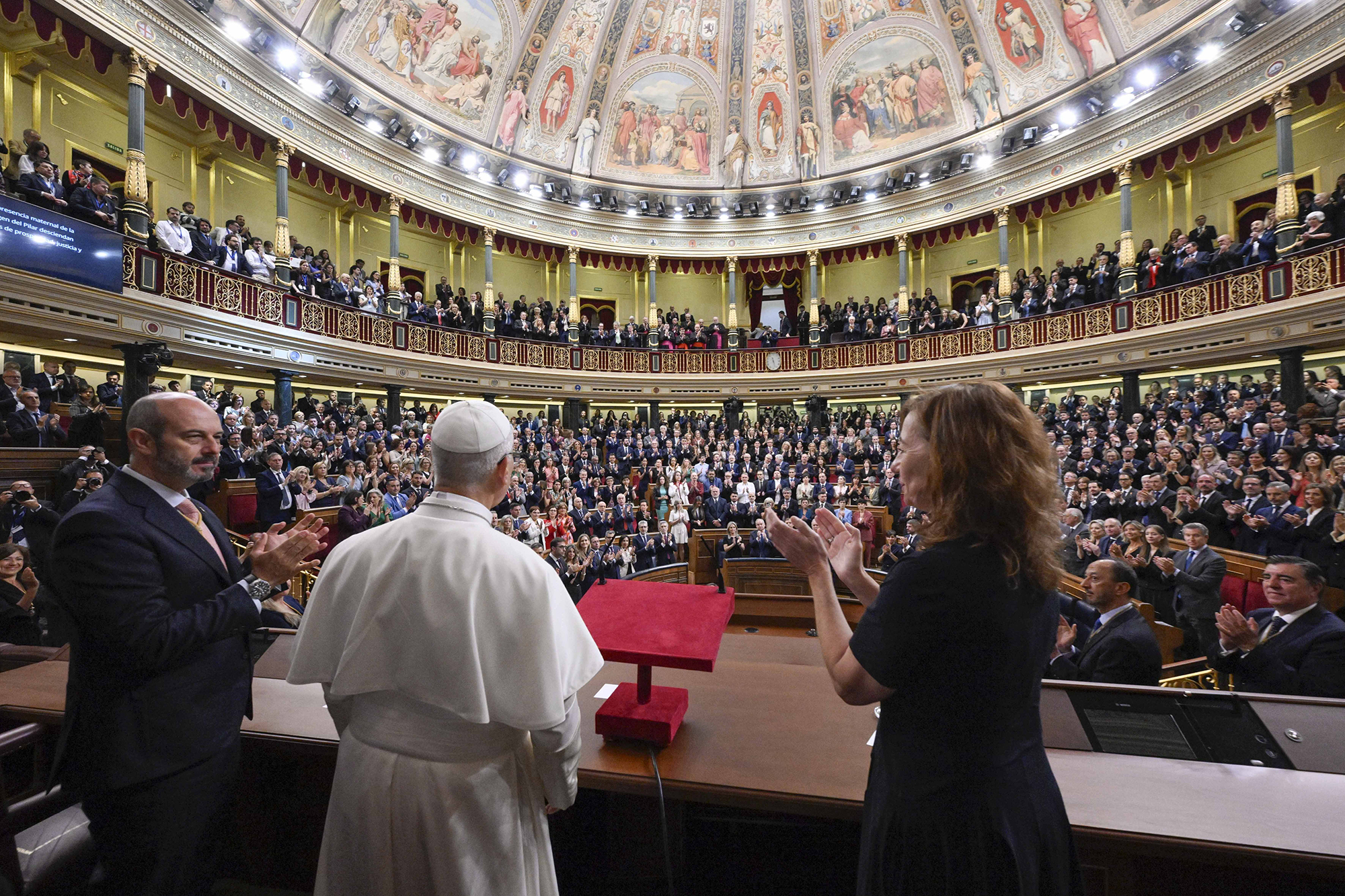
Pope Leo addressed the Spanish parliament on June 8, during an apostolic visit to Spain
MADRID — In an address to the Spanish parliament, Pope Leo XIV delivered a forceful defense of the dignity of every human life, declaring that its protection is not a partisan issue but “a goal of civilization,” while addressing the issues of abortion, migration, freedom of conscience, the seal of confession and the Church’s role in public life.
“If life ceases to be recognized as a fundamental value, what future can our societies have? Can a community that casts into the shadows the unborn child, the elderly, the sick, those who suffer in silence or those who depend entirely on the care of others be called fully just?” the pope asked the members of congress in his speech on June 8.
“The defense of human life is neither a partisan issue nor a confessional interest: It is a goal of civilization,” he emphasized. “Every human life must be recognized and safeguarded from conception to its natural end, in every circumstance of its existence.”
It was the first time in history that a pope addressed the Spanish parliament. In the 30-minute speech, touching on issues from euthanasia to artificial intelligence, the pope underlined that “every truly just society is built upon the recognition of the inviolable dignity of the human person,” warning that when that certainty is obscured, the most vulnerable suffer first and the law loses its deepest meaning.
“The moral greatness of a nation is manifested, above all, in its capacity to accompany, protect and love those lives that are most fragile,” the pope said.
A multifaceted analysis of migration
In addressing the highly polarizing issue of migration in Spain, Pope Leo gave a multifaceted analysis, saying no nation can handle the challenge alone and calling migration “an eminently moral and legal issue” requiring a coordinated response that addresses root causes.
“The situation of migrants and refugees calls for a response that focuses on people, addresses the root causes that force them to leave and goes beyond the mere management of migration flows,” Pope Leo said.
He described a twofold demand for social justice: offering safe and legal pathways with real integration opportunities, while also promoting the right to remain in one’s homeland by addressing lack of peace, security and decent living conditions.
The pope also called for stronger prevention and rescue efforts for trafficking victims through regional and multilateral cooperation.
The importance of family
Pope Leo called the family “the primary human reality and the natural foundation of community,” saying that where families are upheld, the spiritual and social stability of nations is strengthened. He described the family as “the first school of humanity,” where people learn to welcome life, care for others, forgive, serve and live together.
“Educational institutions also play a decisive role in this task. In them, new generations can learn to seek and love the truth, to reflect on the meaning of life and the dignity of every person,” he said.
“For this reason, many parents who wish for their children to learn to relate to others, to think critically and to acquire solid values place great hope in these institutions, seeing them as valuable allies in their children’s education.”
The role of the Church in the public square
Pope Leo framed his speech within a reflection on the Church’s place in public life, stressing that when the Church speaks on public matters it does so while respecting the proper mission of civil institutions and the legitimate authority of those who legislate.
He challenged parliamentarians to consider what conception of the human person inspires their laws.
“Beyond the legitimate diversity of positions, every legislative task ultimately confronts a decisive question: what conception of the human person inspires laws, and what kind of society do those laws build?” he asked, arguing that human dignity must guide every legal system.