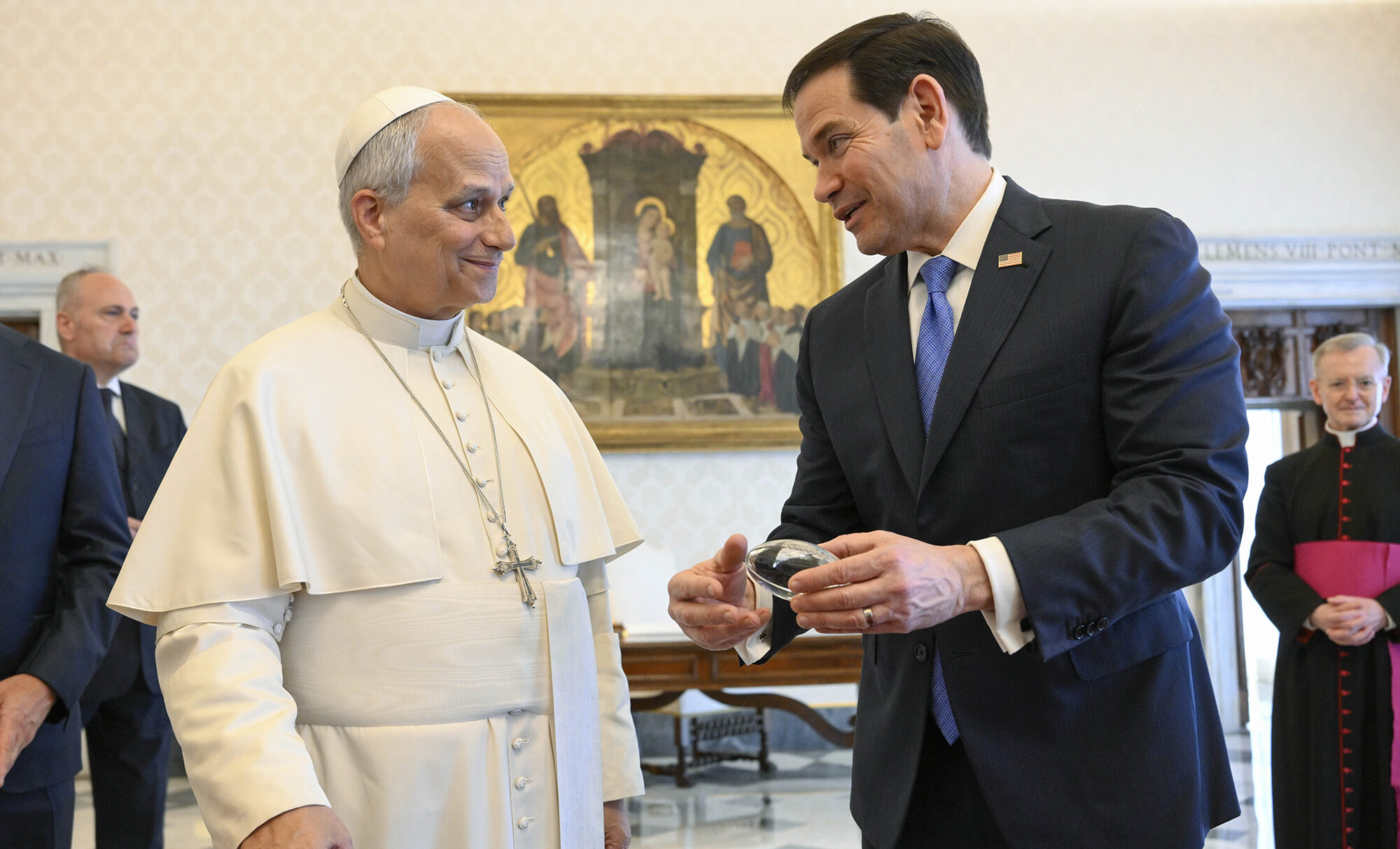
The two discussed the war in Iran, humanitarian aid and the need to work for peace
U.S. Secretary of State Marco Rubio met with Pope Leo XIV at the Vatican on May 7, discussing the war in Iran, humanitarian aid and what the Vatican described as “the need to work tirelessly to promote peace.”
Rubio, who is Catholic, spoke with the American pope for over 45 minutes in a private meeting in the Apostolic Palace before also sitting down with Cardinal Pietro Parolin, the Vatican secretary of state, and Archbishop Paul Gallagher, the Vatican’s foreign minister, for talks that reaffirmed “the shared commitment to fostering good bilateral relations between the Holy See and the United States of America,” according to the Vatican.
“There was then an exchange of views on the regional and international situation, with particular attention to countries affected by war, political tensions and difficult humanitarian situations, as well as the need to work tirelessly to promote peace,” the Holy See Press Office said in a statement released after the meeting.
Secretary Rubio wrote on social media that he met the pope “to underscore our shared commitment to promoting peace and human dignity.”
In a separate statement, the State Department said Rubio’s meeting with Cardinal Parolin covered mutual cooperation and pressing international issues, including humanitarian efforts in the Western Hemisphere and efforts to achieve a durable peace in the Middle East. Rubio also welcomed the recent arrival of Archbishop Gabriele Caccia as the new apostolic nuncio to the United States.
It was Rubio’s second substantive meeting with Pope Leo. On May 19, 2025, the day after the pope’s inauguration Mass, Rubio and Vice President JD Vance met with the pope.
On the eve of the May 7 audience, Cardinal Parolin told journalists that the U.S. government had requested the meeting and that the pope remained open to continued dialogue with Washington.
“We cannot ignore the United States,” Cardinal Parolin said. “Despite some difficulties, they certainly remain a key partner for the Holy See, not least because they play a role in almost every situation we face today.”
Cardinal Parolin said that he was expecting to discuss “themes of international politics and above all conflicts,” including issues in Latin America and Cuba — “all those that are the most pressing issues.” On Iran, he said the Holy See would offer no new proposals beyond its longstanding call for dialogue.
“These conflicts,” he said, “cannot be resolved by force, but must be addressed and resolved through negotiation,” adding, “Let it be a negotiation of good will, sincere, so that all parties can express their point of view and find points of convergence.”
The visit of the U.S. secretary of state comes days after Trump reignited tensions by repeating his claim that the pope “thinks it’s just fine for Iran to have a nuclear weapon” in an interview that aired on May 5, an assertion that Pope Leo swiftly rejected.
“If anyone wishes to criticize me for proclaiming the Gospel, let them do so with the truth,” Pope Leo told journalists outside Castel Gandolfo that evening.
“The Church has spoken out for years against all nuclear weapons, so there is no doubt about this,” the pope added. “I simply hope to be heard for the sake of the Word of God.”
At a White House press conference May 5, Rubio said the two sides have “shared concerns” including religious freedom in Africa and the distribution of humanitarian aid to Cuba.
“We gave Cuba $6 million of humanitarian aid, but obviously, they won’t let us distribute it,” said Rubio, who is the son of Cuban immigrants. “We distribute it through the Church. We’d like to do more. We’re willing to give more humanitarian aid to Cuba, by the way, distributed through the Church, but the Cuban regime has to allow us to do it.”
On the question of a possible phone call between Trump and Pope Leo, Cardinal Parolin said May 6 it was “premature” to say whether one would take place, but indicated the pope would be receptive.