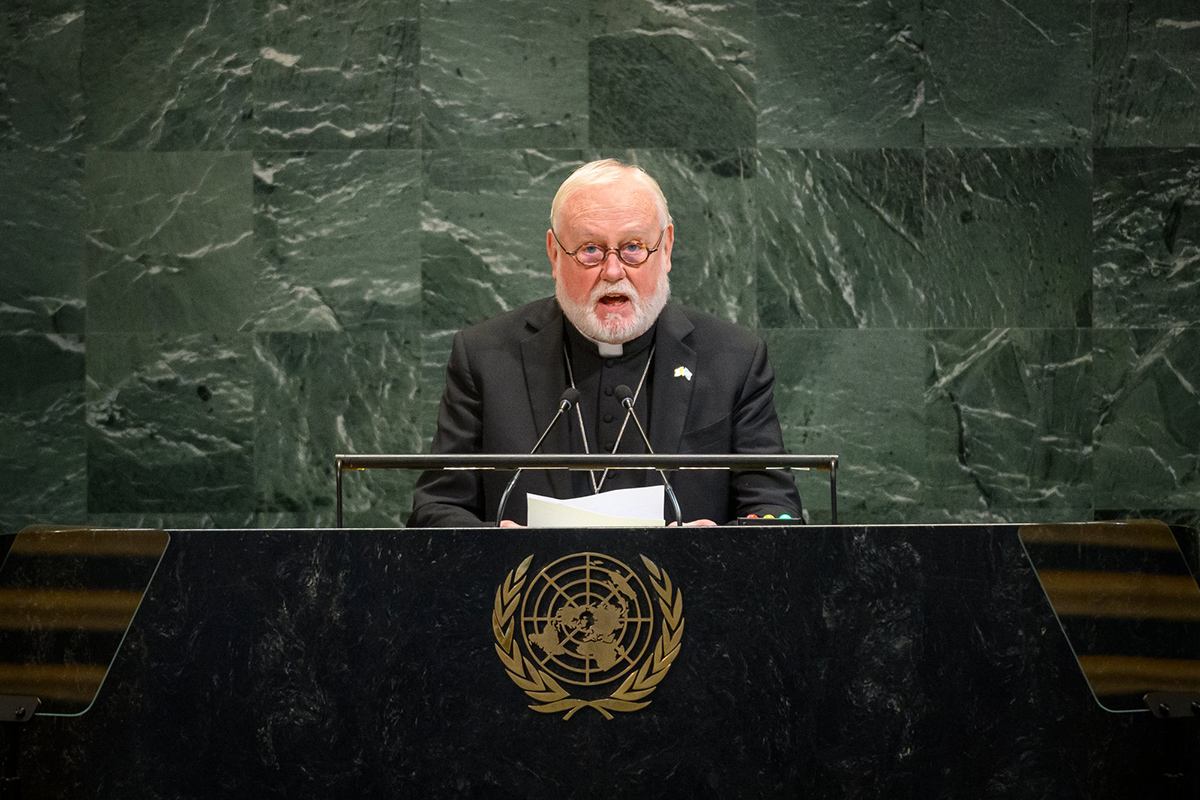
Archbishop Paul R. Gallagher addressed the United Nations General Assembly amid the opening of its 80th session
As the world grapples with “mounting challenges,” the global community must “recommit to the foundational pillars” of peace, justice and truth, learning from history and building a more equitable future, a top Vatican diplomat told the United Nations.
Archbishop Paul R. Gallagher, who serves as the Vatican’s secretary for relations with states and international organizations, shared his thoughts Sept. 29 while addressing the U.N. General Assembly, amid the opening of its 80th session at its New York headquarters.
The theme of this year’s general debate is “Better Together: Eighty Years and More for Peace, Development and Human Rights,” which Archbishop Gallagher said “highlights the ongoing importance of multilateral cooperation in addressing global issues.
With the U.N. marking eight decades since its 1945 establishment, the body’s “core values of fostering international peace, development and universal human rights” are “all the more important in an increasingly fragmented world,” said the archbishop.
He described the U.N.’s 1948 Universal Declaration of Human Rights — which affirmed human beings’ inherent dignity and inalienable rights — as “one of the most important achievements” of the global body.
At the same time, the archbishop highlighted the fraying of that legacy amid a rise in isolationism, which “leads to unpredictable instability.”
Citing “escalating geopolitical tensions, a raging climate crisis, widening inequalities and rising poverty,” he called for “renewed global solidarity,” since “unity fosters responsible resilience and shared progress.”
“The United Nations must adapt itself to a transformed world and maintain its effectiveness in the face of emerging threats such as environmental degradation and technological disruption, which no single country can tackle alone,” Archbishop Gallagher said.
Rooted in “mutual respect” and “a proper understanding of the human person,” peace also requires “a context characterized by respect for justice,” and “the rejection of hatred and vengeance in favor of dialogue and reconciliation,” he said.
Archbishop Gallagher specifically addressed several active wars and conflicts, such as those in Ukraine, “one of the most profound and painful”; the Middle East, where he urged “a just and lasting peace between Israel and Palestine based on a two-state solution, in accordance with international law and all relevant United Nations resolutions”; Syria, now in transition after the fall of the Assad regime; Congo, long home to “one of the world’s most complex multidimensional crises”; Sudan, “a source of grave concern” for its “fratricidal conflict,” and South Sudan, where the Vatican is “monitoring developments closely.”
Archbishop Gallagher called on the international community to “prioritize diplomacy over division, redirecting resources from instruments of war to initiatives that promote justice, dialogue and the uplifting of the poor and of those most in need.”
Archbishop Gallagher said that disarmament is “a moral imperative” based on “the recognition of the sacredness of human life and the interconnectedness of the human family.”
He repeated ongoing calls from the Vatican to reduce weapon stockpiles, uphold disarmament treaties and end the use of nuclear weapons.
Another “cornerstone of peace” is “freedom of thought, conscience and religion,” Archbishop Gallagher said, adding, “yet persecution of religious minorities, particularly Christians, persists globally.”
The 80th session of the U.N. General Assembly is a moment for “a recommitment to the original principles enshrined in the U.N. Charter, which remain as relevant today as ever,” Archbishop Gallagher said.
“This anniversary provides an opportunity to reinforce the United Nations’ position as a beacon of hope,” he said, “and a force for good in addressing humanity’s most urgent needs.”