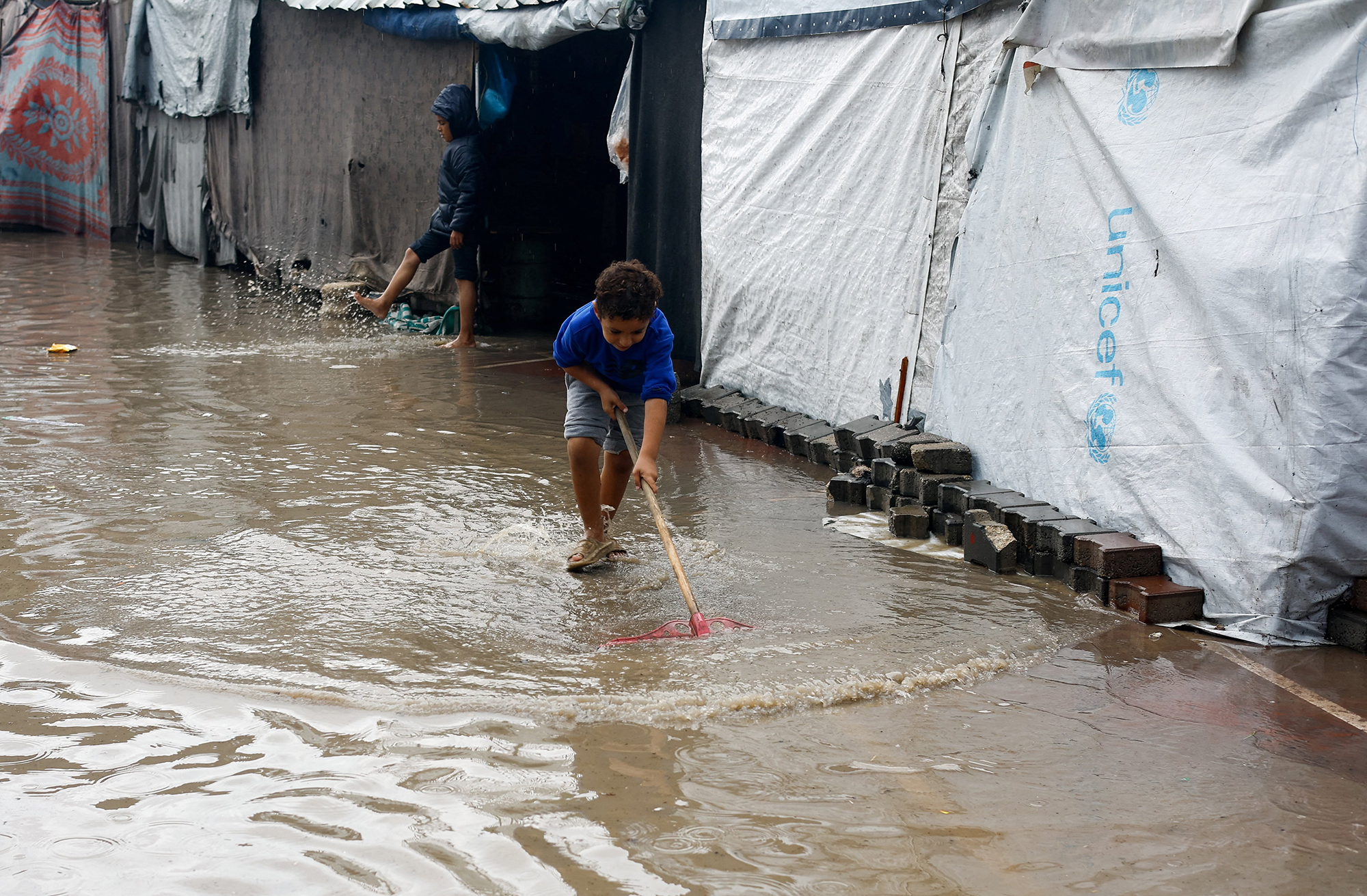
As peace plan continues to be worked out, flooding from heavy rainfall in Gaza has added to dire situation
As Pope Leo XIV urged in Turkey on Nov. 27 that “the future of humanity is at stake” with ongoing conflict in the Middle East and days after a United Nations Security Council endorsement of a U.S.-backed peace plan, Catholic leaders warn that conditions in Gaza remain grave, especially as winter approaches.
“The situation continues to be critical,” said Joseph Hazboun, regional director for the Catholic Near East Welfare Association-Pontifical Mission’s Jerusalem office.
Hazboun said his agency’s ongoing efforts to provide shelter, food, psychosocial support and other necessities have been hampered by Israel’s “continued siege and blockade on Gaza … hardly allowing serious relief efforts.”
Hazboun’s assessment echoed that of Cardinal Pierbattista Pizzaballa, Latin patriarch of Jerusalem, who Nov. 19 said that “everything remains to be done” in restoring daily life in Gaza.
“The only difference — thanks be to God and to those who secured it — is the end of the blanket bombing,” Cardinal Pizzaballa told Vatican News, adding that while “aid is entering more regularly than before, and more reliably,” the supplies are “still far from sufficient given the needs.”
“There isn’t much that we can do,” Hazboun said. “We provided a limited number of tents, but are unable to provide more, although there is a need, but tents are not available.”
He also said, “you can imagine that they are not very useful when the streets flood because of the rain.”
Flooding from heavy rainfall has swept through Gaza in recent days, destroying tents, bedding, clothing and other essential items.
United Nations aid workers in Gaza reported that flooding “remains a major risk,” the agency said on Dec. 1. Sandbags are in use at 41 displacement sites, according to the U.N., with paid teams reinforcing drainage and collecting empty flour sacks to improve insulation.
The World Bank noted in 2023 that rainfall events in Gaza have become more violent in recent decades, causing flash floods.
“Water is needed — of course — but in Gaza ‘water’ often means mud in an already dire situation,” Cardinal Pizzaballa said.
Hazboun said his team was also working to bolster medical services in Gaza, providing the Near East Council of Churches — an ecumenical and interfaith organization — “with equipment and tools for their main lab, so that they can resume their medical services.”
In addition, Hazboun said his office has awarded “a special grant to the Al-Ahli Arab Hospital to treat war-affected burn victims.”
The U.N. said that as of Nov. 30, 224 out of 592 functional health service points in Gaza were now operational, including 19 out of 36 hospitals — but of that 224, 215 are only partially functional, with just eight fully online. The slight increase in health service restoration includes the gradual reestablishment of a seven-bed pediatric intensive care unit at Al Shifa Hospital in Gaza City, the agency said.
Hazboun said the agency is distributing hygiene kits, material for which is expensive and unaffordable by the local communities, while coordinating with on-the-ground partners to offer food parcels and psychosocial support.
With “the blockade … expected to continue,” Hazboun and his team are also looking “to consult with the youth for creative solutions to the ongoing crisis.”
Among the rubble is also recyclable material, he said, adding that the region’s youth might “come up with creative concepts to help with water desalination, alternative energy, cooking gas, maybe even alternative solutions for the tents.”
He added, “Besides these very limited interventions, we continue to pray for an end to the war and the killing of people that has never stopped since the ceasefire.”
Catholic leaders have expressed grave concern for the region’s Christian communities, which have come under attack in Gaza and in the West Bank.
In November, Hazboun reported that only 596 people, or 207 Christian families, remain in Gaza, with 382 people — 136 families — sheltering at the Holy Family Church, Gaza’s only Catholic parish, and 214 people, or 71 families, sheltering at St. Porphyrios Greek Orthodox Church, which was struck in both 2023 and 2024.
Hazboun said his office is “finalizing a survey on the Christian community, to get as much data as possible on their current status, who will remain in Gaza and who plans to leave upon opening of the Rafah crossing.”
The data will also assess housing needs for those planning to remain in Gaza, he said.
Speaking on Dec. 2 after Mass in Beirut amid his apostolic journey to Turkey and Lebanon, Pope Leo said that “new approaches” were needed in the Middle East “to reject the mindset of revenge and violence, to overcome political, social and religious divisions, and to open new chapters in the name of reconciliation and peace.”
“We need to change course. We need to educate our hearts for peace,” he said. “From this square, I pray for the Middle East and all peoples who suffer because of war.”