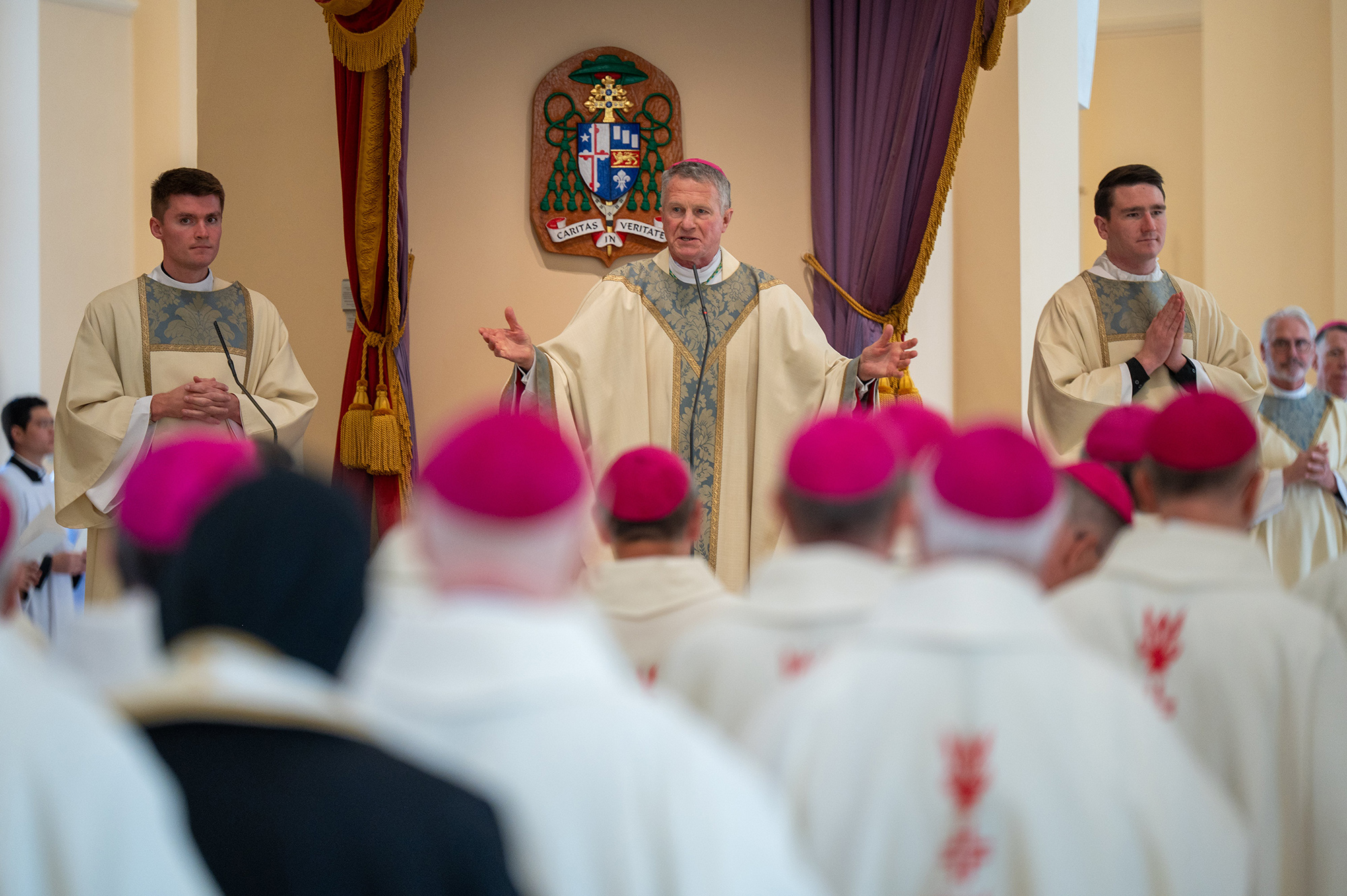
At assembly, Archbishop Paul Coakley was elected president and Bishop Daniel Flores was elected vice president
BALTIMORE — From the opening gavel to adjournment Nov. 11, the immigration issue was at the forefront for much of the first day of public sessions of the U.S. bishops’ fall plenary assembly in Baltimore.
The day’s agenda included elections for new leadership of the U.S. Conference of Catholic Bishops; a report on the immigration situation in the U.S. under the Trump administration; preliminary presentations on possible revisions to the bishops’ “Ethical and Religious Directives for Catholic Health Care Services”; and the unveiling of a new English version of the Bible for the United States that will be released in 2027.
They also approved a local diocesan effort to put forth a sainthood cause for Jesuit Father Richard Thomas (1928-2006), who for over 40 years led various ministries to the poor of El Paso, Texas, and Ciudad Juarez, Mexico.

The bishops elected Archbishop Paul S. Coakley of Oklahoma City as USCCB president and Bishop Daniel E. Flores of Brownsville, Texas, as the conference’s vice president.
The 2025 elections were notable because they marked the first leadership change at the conference since Pope Leo XIV, the U.S.-born pontiff, began his pontificate in May.
The day began with the bishops’ message to Pope Leo XIV at the start of their Nov. 10-13 gathering. The U.S. bishops told the pope Nov. 11 that they “will continue to stand with migrants and defend everyone’s right to worship free from intimidation.”
“As shepherds in the United States, we face a growing worldview that is so often at odds with the Gospel mandate to love thy neighbor,” they wrote. “In cities across the United States, our migrant brothers and sisters, many of whom are fellow Catholics, face a culture of fear, hesitant to leave their homes and even to attend church for fear of being randomly harassed or detained.” They told the pope that united in their concern, they “will continue to stand with migrants and defend everyone’s right to worship free from intimidation.”
“We support secure and orderly borders and law enforcement actions in response to dangerous criminal activity,” they told the pope, “but we cannot remain silent in this challenging hour while the right to worship and the right to due process are undermined.”
Later in the afternoon, the bishops approved a “special pastoral message on immigration,” voicing “our concern here for immigrants” at their annual fall plenary assembly in Baltimore.
There are several flashpoints around the country for tensions over the Trump administration’s hardline immigration policies, with regular protests taking place outside a number of Immigration and Customs Enforcement field offices.
Among Catholic concerns over how this policy is playing out in U.S. cities are detainees being denied the sacraments. The issue of the ability of immigrants in ICE detention to receive sacraments “is now at the top of our concerns,” Bishop Kevin C. Rhoades of Fort Wayne-South Bend, Indiana, said Nov. 11 during the midday press conference at the bishops’ plenary. He is chair of the USCCB’s Committee for Religious Liberty.
The bishops’ focus, he said, has been “the Church’s right to provide charitable services for immigrants.”
“It’s heartbreaking,” Bishop Rhoades added, “when you think of the suffering and especially those who’ve been detained, separated from families … they need spiritual support in this, and they need the sacraments.”
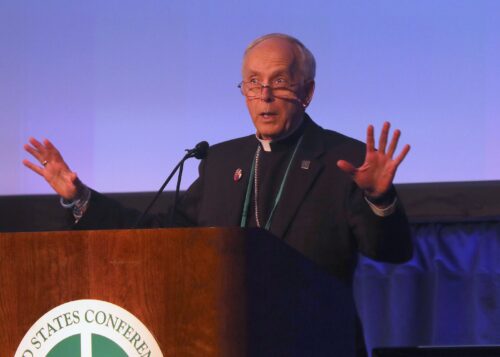
Bishop Mark J. Seitz of El Paso, Texas, spoke during a Nov. 11 session of the fall general assembly of the U.S. Conference of Catholic Bishops in Baltimore. Bishop Seitz is the outgoing chair of the USCCB’s Committee on Migration.
In an afternoon presentation, Bishop Mark J. Seitz of El Paso, Texas, outgoing chair of the bishops’ migration committee, said the Trump administration’s “unyielding commitment to mass deportation,” as well as “curtailing legal immigration,” and deportations to “third countries completely unfamiliar to them,” make clear “this is just the beginning.”
Bishop Seitz said the migration committee, its staff and its partners are working on an initiative, titled “You Are Not Alone.” It will focus “on four thematic areas of ministry: emergency and family support, accompaniment and pastoral care, communications and Church teaching, and fourthly, solidarity through prayer and public witness.”
But he did offer a glimmer of hope over religious worker visas, a process held up since the spring of 2023, saying he was “very optimistic” that efforts to resolve backlogs for religious worker visas were moving forward, thanks to potential new legislation and dialogue with the current presidential administration.
In a close election, Archbishop Coakley was elected president on the third round of voting in a run-off with Bishop Flores. The U.S. bishops then selected Bishop Flores on the first round of the vice presidential election.
Their three-year terms begin at the conclusion of the Nov. 10-13 fall plenary assembly in Baltimore. They succeed, respectively, Archbishop Timothy P. Broglio of the U.S. Archdiocese for the Military Services and Archbishop William E. Lori of Baltimore, who will complete their three-year terms in office at the assembly’s conclusion.
Ahead of the elections, Archbishop Broglio, as outgoing president of the USCCB, delivered his final presidential address. He emphasized the need to “convince people to listen to each other” amid polarization. “May the lessons learned through the synod spread throughout society so that we might take the time to listen to the other,” he said, “and if we must disagree, we do so with courtesy, appropriate speech and even attentiveness to the personal situation of the other.”
Cardinal Christophe Pierre, apostolic nuncio to the United States, then addressed the USCCB. His remarks at this year’s plenary were his first as Pope Leo XIV’s representative.
“Where have we been and where are we going?” he asked, pointing to “a guiding light: the teaching and vision of the Second Vatican Council.” He emphasized that Vatican II “remains the key to understanding what kind of Church we are called to be today and the reference point for discerning where we are headed.”
Bishop Steven J. Lopes, head of the Ordinariate of the Chair of St. Peter and chair of the bishops’ Committee on Divine Worship, announced that a new English version of the Bible will be released in 2027 with the name The Catholic American Bible.
The bishops adjourned that afternoon after hearing presentations on The Catholic University of America and the Pontifical Missions Societies. The public session of the bishops’ plenary meeting was scheduled to resume Nov. 12.