National policy shift would move billions in funding toward programs that impose work rules and other restrictions
WASHINGTON — The Trump administration has issued plans for a complete turnaround in homelessness policy, which involves a two-thirds reduction in current funding used to place homeless people in permanent dwellings.
Brian Corbin, executive vice president of member services at Catholic Charities USA, said that nationally, it could make as many as 170,000 people — all of them either disabled, experiencing drug addiction, mental health issues or otherwise “unable to pay the rent” — vulnerable to losing housing and being back on the streets.
The statistic came from internal Housing and Urban Development documents obtained by Politico, which first reported the development Sept. 29.
The policy shift moves billions to short-term transitional housing programs that impose work rules, help police dismantle tent encampments and require people experiencing homelessness to accept treatment for mental illness or addiction.
The Department of Housing and Urban Development detailed the changes in a 128-page notice issued Nov. 13. It involves more than $3.9 billion in what are called Continuum of Care funds and could affect people utilizing these services as soon as January.
“These are pretty substantial reductions,” Corbin said. “That’s where the flashpoint is.”
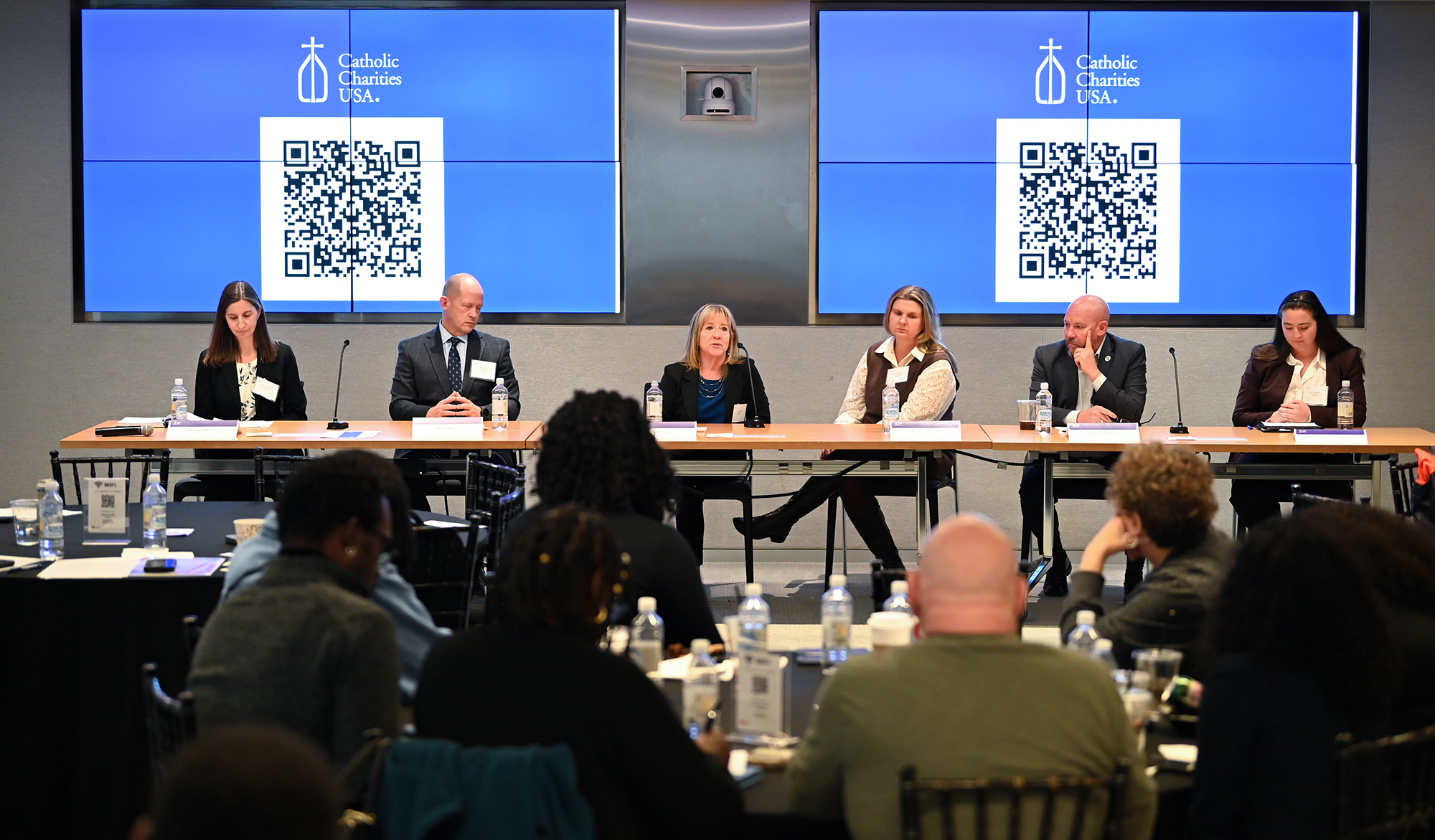
The major change in federal policy on homelessness and its potential impact on the people Catholic Charities agencies serve was among the issues discussed at a summit of Catholic Charities’ leaders and local politicians on Nov. 18.
Also discussed was the use of surplus church properties such as schools and hospitals to convert to emergency housing, an idea that’s been developed for more than a decade.
The 168 diocesan agencies within the Catholic Charities USA network supervise 38,000 housing units, Corbin said.
The consensus of most speakers was that homelessness would be best addressed through cooperation with local governments and CCUSA member agencies sharing ideas.
“How do we help people stretch the resources that they have?” asked Mayor Alyia Gaskins of Alexandria, Virginia.
She pointed to an evening meal service for people in need provided by Catholic Charities as one example.
The mayor also emphasized the need for charities to stay involved in long-term municipal land planning, since “90% of what I’m focused on right now is land-use development.”
“Make local policymakers partners in your work,” said Steve Berg, chief policy officer for the National Alliance to End Homelessness. “(Tell them) what the shortfalls are, and what they can do to help.”
An important part of that communication, he added, “is to make clear that this is a long-term work. We’re not going to solve homelessness this year.”
As for repurposing church properties as homeless housing, Heather Huot, secretary for Catholic Human Services in the Archdiocese of Philadelphia, called it “an interesting and complicated process. You’d think working with the diocese would be easy. It is not.”
“If you really want to use church property, it’s going to take a little time to get pastors and school administrators to see your vision,” she said. “Not every church property is going to be the best to use.”
“We are the largest provider of permanent housing in the state of Minnesota,” said Jamie Verbrugge, president and CEO of Catholic Charities Twin Cities, in the Archdiocese of St. Paul and Minneapolis. “They recognize that we’re expert(s) at what we do, and we do it very well.”
Verbrugge explained that the average monthly income for those seeking housing under his agency is just $500 a month.
He said the organization is “at a crossroads” when it comes to emergency shelters for adults and housing.
Participants at the CCUSA summit were also encouraged to recognize that, while they face a long road ahead, their milestones are in the differences they make with the people they serve.
“We need to celebrate the victories that we have,” said Curtis Johnson Jr., vice president of housing strategies for CCUSA. “We have to remind ourselves, ‘We have helped someone today.’ This is marathon work.”