The Vatican has declared the Society of St. Pius X to be “in schism” after the traditionalist group consecrated four bishops without the papal mandate, marking the most serious rupture in the Church since Archbishop Marcel Lefebvre’s unauthorized episcopal consecrations in 1988.
In a bombshell move, the Vatican also declared sacraments of penance and marriage invalid if they proceeded within the society.
The decree also said, “Clerics and lay faithful are warned not to adhere to the schism of the Priestly Society of Saint Pius X, as they would ipso facto incur the penalty of latae sententiae excommunication.”
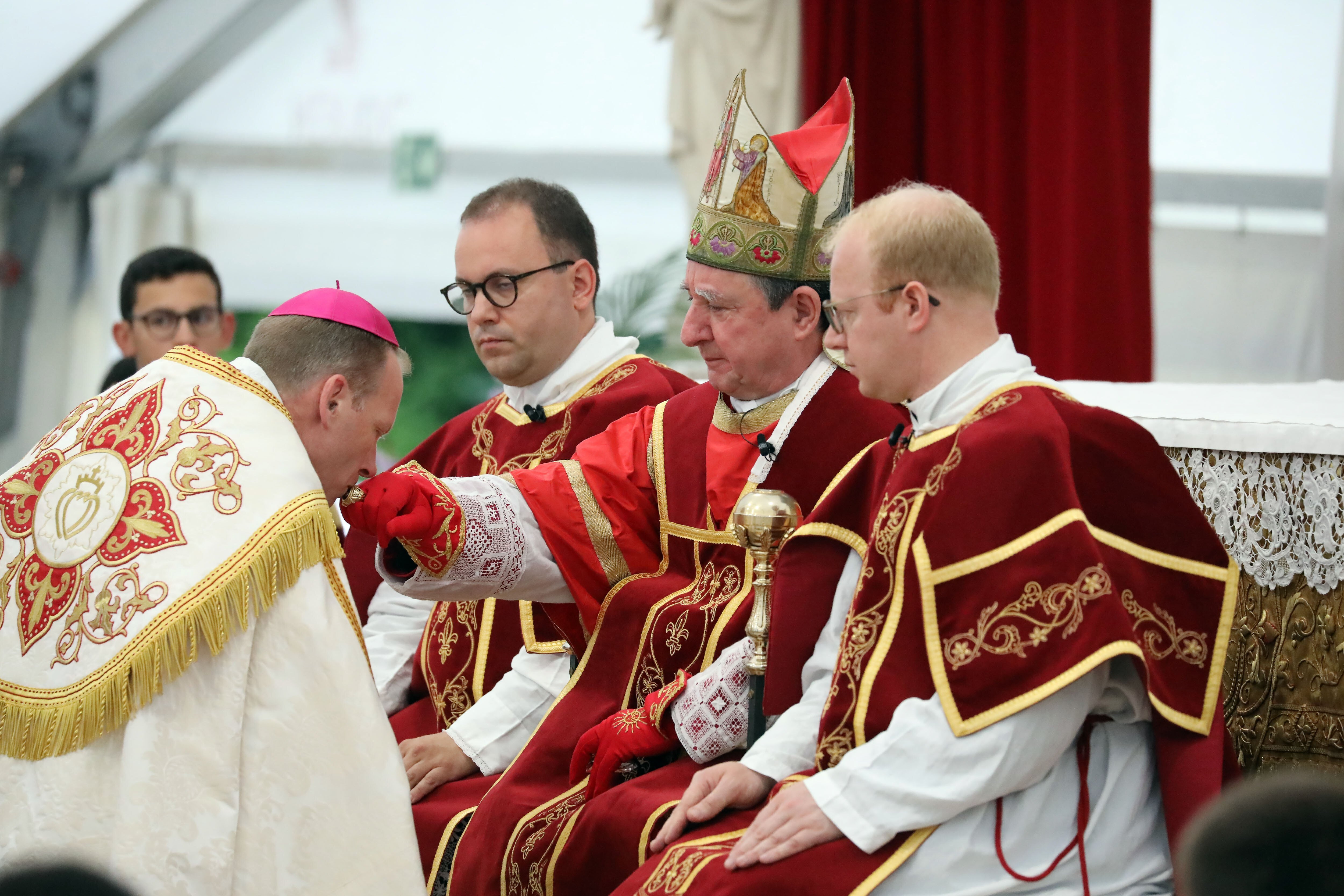
In a case of history repeating itself after the 1988 excommunication of the society’s founder along with four bishops he then consecrated without the papal mandate, the Vatican on July 2 excommunicated four SSPX bishops consecrated without the authorization of the pope at the society’s seminary in Écône, Switzerland, along with two bishops leading the liturgical celebration July 1.
“Despite the warnings addressed to the Superior General” of SSPX, Bishop Alfonso de Galarreta led the consecration liturgy on July 1, accompanied by Bishop Bernard Fellay, and thus “committed an act of a schismatic nature through the episcopal consecration of four priests, without pontifical mandate and against the will of the Supreme Pontiff,” the Dicastery of the Doctrine of Faith said in a July 2 decree, released in Italian.
The rebel bishops, the DDF said, “have ipso facto incurred a latae sententiae excommunication reserved to the Apostolic See,” with latae sententiae meaning “automatic,” or “by the deed itself” in Latin.
The four newly consecrated SSPX bishops — Fathers Pascal Schreiber, Michael Goldade, Michel Poinsinet de Sivry, and Marc Hanappier — were also excommunicated, the DDF said in a document signed by Cardinal Victor Manuel Fernández, prefect of the DDF, Archbishop John Kennedy, secretary of the disciplinary section, and Msgr. Armando Matteo, secretary of the doctrinal section of the dicastery.
The apostolic mandate is required to proceed with bishops’ consecrations, which the society did not have for the July 1 ceremony — a fact that they publicly acknowledged.
At the episcopal consecrations, Father Foucauld Le Roux, secretary general of the society, read the declaration in which the society “sets forth the reasons justifying these consecrations in the current circumstances of the Church,” claiming “The authorities of the Church have been animated by a spirit contrary to that of the Faith, and act against holy Tradition.”
The explanatory memorandum that followed the decree from the DDF included measures affecting both ministers of the society and lay faithful, preceded by the note that from the time of St. Paul VI “until the most recent discussions held at this Dicastery, the multiple attempts to bring the adherents of the movement initiated by Archbishop Lefebvre back into full communion with the Catholic Church have proven futile.”
Noting that “this situation has been further aggravated by the recent episcopal consecrations celebrated without pontifical mandate, against the will of the Holy Father, in open violation of canon law,” the dicastery said that the “act constitutes the crime of schism, with canonical consequences for the sacred ministers and lay faithful involved.”
In a memorandum signed by the same group of prelates as the decree, the DDF said that “the sacred ministers belonging to the Priestly Fraternity of Saint Pius X are in schism and must therefore be considered schismatic,” citing the 1988 letter of St. John Paul II “Ecclesia Dei” and the 1996 Explanatory Note from the Pontifical Council (now Dicastery) for Legislative Texts on the excommunication for schism incurred by the adherents of the movement of Archbishop Lefebvre (1905-1991).
The long list of documents regarding SSPX spanning almost four decades prove the long process of the Vatican to try to reach an agreement with the traditionalist group.
For decades — since 1988 when St. John Paul excommunicated the society’s founder, Archbishop Lefebvre and four bishops consecrated without papal mandate in his “Ecclesia Dei” apostolic letter — the Vatican had sought several ways to reintegrate SSPX members into the life of the Catholic Church.
Pope Benedict lifted the excommunications of the four bishops in 2009, opening the way for more regular talks.
During the 2015-2016 Year of Mercy, Pope Francis made special provisions to validate the absolution offered by SSPX priests through the sacrament of confession. After the Holy Year ended, he extended that provision “lest anyone ever be deprived of the sacramental sign of reconciliation through the church’s pardon.”
In April 2017, the late pontiff continued pursuing initiatives aimed at a reconciliation with the SSPX by allowing their bishops to ensure the validity of marriages celebrated in the traditionalist communities.
After the July 1 ceremony, the Vatican took measures to extend its decree to the whole society, including the laity, and said that lay faithful “who formally adhere to the Priestly Fraternity of Saint Pius X … are to be considered schismatic and excommunicated.”
The Holy See warned that “the sacred ministers of the Priestly Fraternity of Saint Pius X are administering the sacraments illicitly,” declaring invalid the sacrament of penance and marriage administered by SSPX priests.
The celebration of the Mass and the confection of the Eucharist, because they are done by an ordained priest, are still valid, though illicit. The sacraments of penance and marriage need an authorization, or faculty, which the society lacks.
“The Church, as a caring mother, will welcome with sincere affection and lively solicitude all those who wish to return to full communion,” the DDF prelates concluded, pointing to the apostolic nuncios as ones that “will have procedures that the Ordinaries can use in different cases.”
The DDF noted in the memorandum that “all the faithful are exhorted to remain steadfast in communion with the Roman Pontiff, with the Bishops in communion with him and with the whole Church” and to “abstain from participating in the celebrations and activities” promoted by SSPX.