Marian grotto from former Jesuit seminary comes to life again in Hazelwood subdivision
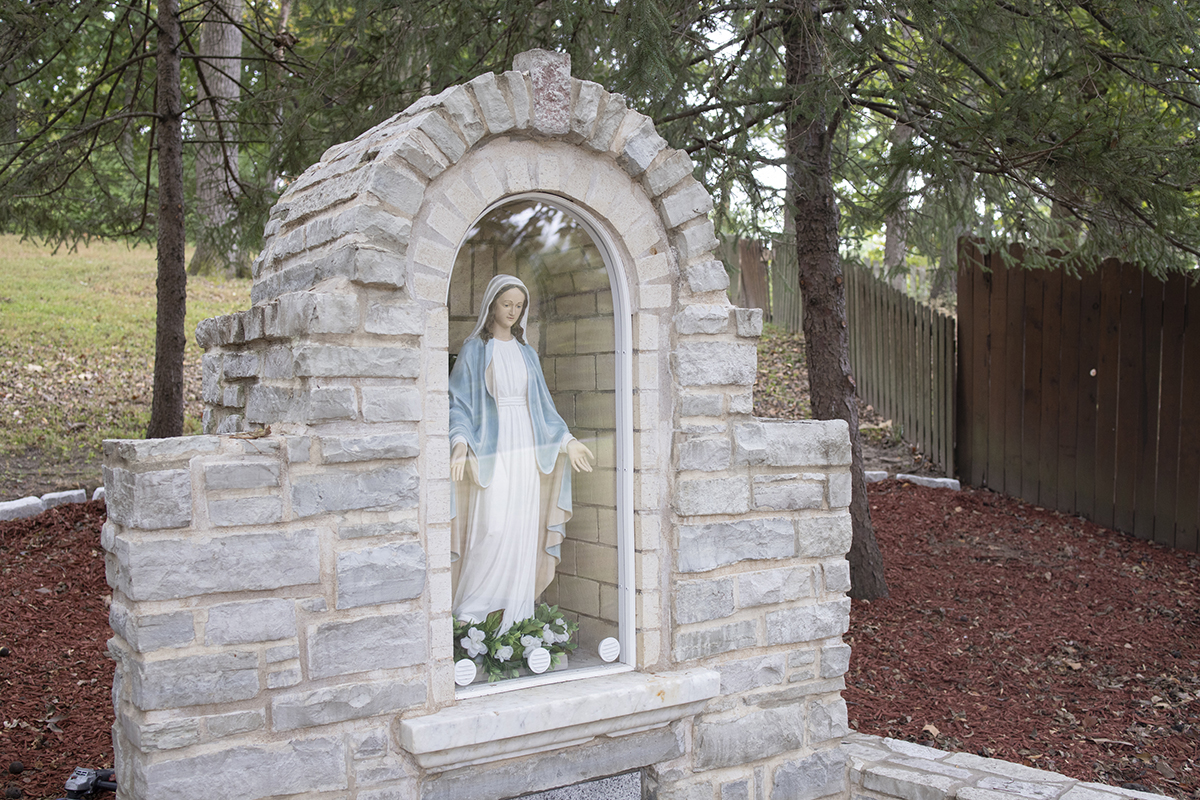
When Ted and Debbie Drury Deibel moved into a new subdivision in Hazelwood in 1983, a grotto dedicated to the Blessed Mother and tucked into a wooded common area caught Debbie’s attention.
The grotto, a remnant of the Jesuits’ former St. Stanislaus Seminary, was a selling point for the Riverwood Estates subdivision. An advertisement from the homebuilder, McBride &Sons, described the restored grotto as an “aesthetic point of interest.”
Over the years on her walks throughout the neighborhood, “we’d stop and say a Hail Mary and then we go on our walk,” said Debbie, a member of St. Norbert Parish in Florissant. “It’s just a nice grounding area and the best part of the subdivision.”
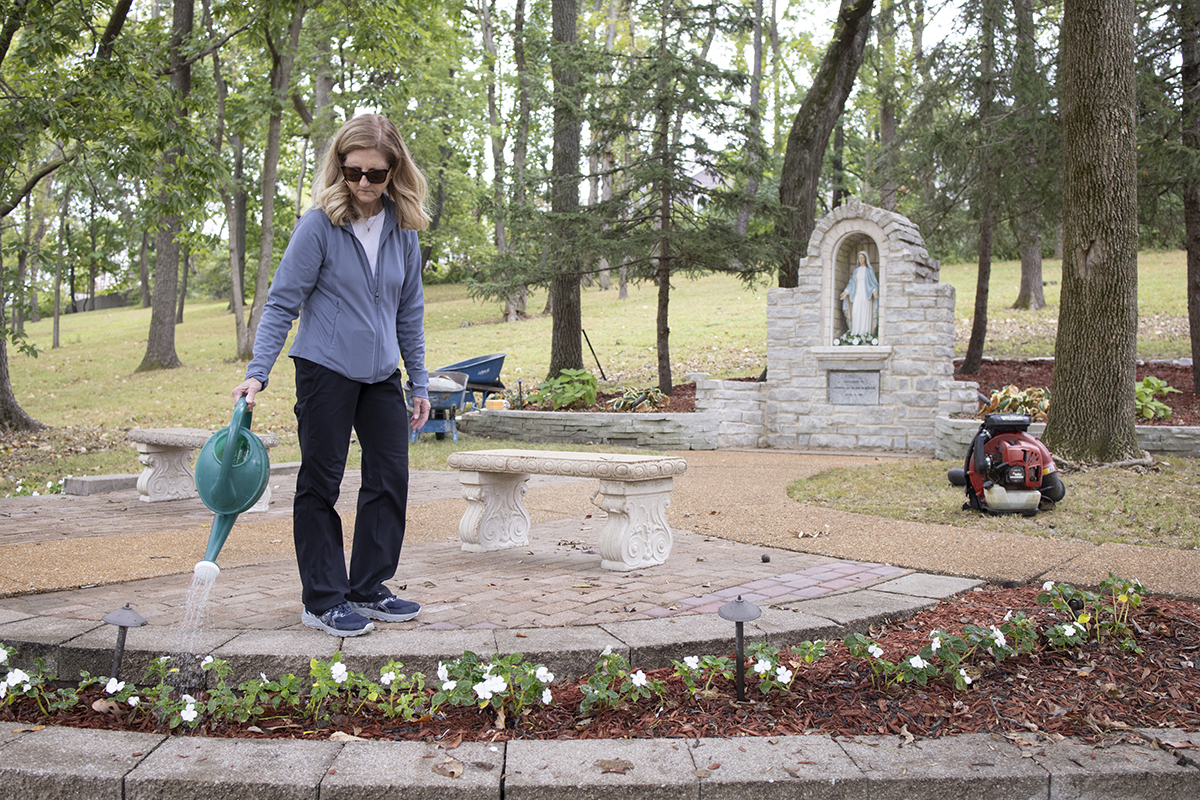
Located along the main road of the subdivision, the grotto is an inviting space for visitors to stop and rest at one of the benches or to pick up a book from one of the little library stands along the nearby sidewalk. Neighborhood children are often seen playing under the shade of the trees.
The McBride family rededicated the grotto when Riverwood Estates opened in 1983, but over the years, it had fallen into disrepair. On her walks through the neighborhood, Debbie sometimes would stop by to clean the spiderwebs off the Blessed Mother statue and tidy the grounds around the grotto.
About two years ago, Debbie decided it needed more work than she could take on. Mary needed some new glass for her enclosure and tuckpointing work needed to be done to the stone grotto. She reached out to subdivision trustee Sharon Dash to enlist the help of other residents.
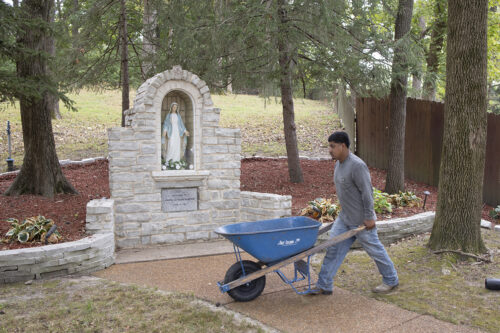
“It bothered a lot of people in our community to see that it was getting run down, so we just slowly started getting things together,” Debbie said. With the blessing of the subdivision’s trustees, the Deibels, along with residents Tim Korte and Terry and Debbie Henderson, got to work. The statue was cleaned and repainted, the enclosure was repaired and a ventilation system was installed, the small bridge leading to the grotto was restained and the grounds were spruced up, including new mulch and plants.
Residents held a rededication ceremony Oct. 4 and invited several Jesuit priests to share their memories of the grotto and their time as seminarians at St. Stanislaus.
Jesuit Father Mark McKenzie, who led the rededication and blessing, attended the novitiate and juniorate at St. Stanislaus for four years in the 1950s. The seminary was founded on the outskirts of Florissant in 1823 as St. Francis Regis Seminary, a mission school for indigenous children. By 1831, the onsite novitiate expanded and the seminary was renamed after St. Stanislaus Kostka. At its peak, the property extended over 1,000 acres and included a farm with an orchard, chicken ranch, cattle barn, wheat fields, vineyards, a butcher shop, creamery and bakery.
“We’d walk from the seminary to a place we had on the river called Charbonniere, and the grotto was a place to stop at,” Father McKenzie said. “We’d walk across the grain fields and into the woods. The grotto was much bigger than it is now. I remember going by it and in our pious way of life, we’d stop and say a prayer to Mary and then hustle our way on to the villa.”
An article from a 1929 Jesuit Bulletin described the grotto as the “shrine of a million Memorares.”
“The little canyon, the open timber ceiling of the live oaks, the suppliant rise heavenward of the slender fountain, the Madonna sheltered in the cool cleft of the rocks, all invite to prayer. And not to prayer couched in fine phrases, but to that old, simple plea which is but a child’s gentle nudge to a loving Mother’s memory — the Memorare.”
St. Stanislaus Seminary closed in 1971, and the land was sold to several groups in subsequent years. The last of the property, the seminary’s Old Rock Building and four acres of land, were maintained by the Jesuits until 2003.
The grotto was restored to its original intent — to give honor to the Blessed Mother, Debbie said. “It’s a really special, beautiful place to honor her,” she said. “And not all people who come here to pray are Catholic, and that makes it even sweeter.”
“I think the people in this subdivision ought to be very proud of the history of the seminary and the land,” said Dash, the subdivision trustee. “We have become a part of that history. (The Blessed Mother) has been around for a long time, and if the Jesuits recognized her, why wouldn’t we? Why wouldn’t we continue to take care of her and and tell her story?”