
Instituted acolytes provide support to priests, deacons at liturgical celebrations
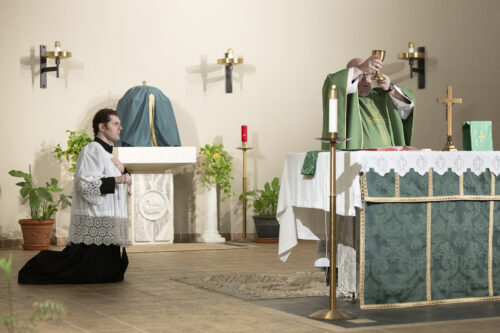
When the last communicant had returned to the pews at Epiphany Church, Steven Gilroy remained at the altar, carefully purifying the priest’s chalice and returning the sacred vessels to their place.
Next to him in the sanctuary, Father Tom Pastorius settled into the presider’s chair, spending quiet time in prayer after concluding the celebration of the Eucharist.
As an acolyte, Gilroy is part of an instituted ministry of the Church, in which he is trained to support the priest and deacon in the liturgy. He attends to the service of the altar in liturgical celebrations, especially at Mass.
Gilroy became an altar server at the age of 17, and his service became a regular occurrence, helping at Masses anywhere from seven to 10 times a week at several parishes, including his home parish of Epiphany and St. Mary of Victories Chapel in Downtown St. Louis.
“That love of serving at the altar and being close to the Eucharist kept growing and growing on me,” he said. “I started praying about whether I could be instituted as an acolyte — that was on my heart.”
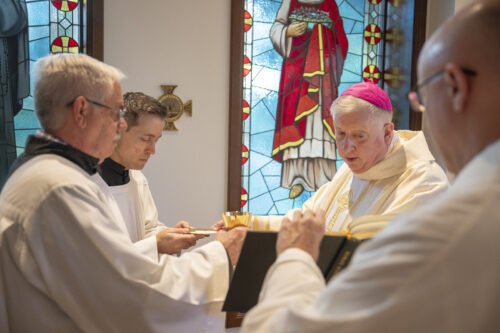
In 2018, then-Bishop Mark S. Rivituso installed Gilroy as an acolyte at a midday Mass at the Cardinal Rigali Center in Shrewsbury. That followed a letter of petition he submitted to the archbishop as well as a meeting with the archdiocesan Office of Worship to review his understanding of liturgical theology and the order of the Mass.
“It’s helpful to entrust him to purify (the vessels) so that I can go back to the chair and pray a little more,” said Father Pastorius, who has a dual role as pastor of Epiphany and St. James the Greater in south St. Louis. “An acolyte is somebody who’s been trained. He’s got the formation, he knows the liturgical norms. I can trust him to not only do his role, but also guide the servers and help the visiting priests.”
Being an acolyte “brings you to a deeper love of and closeness to the Eucharist in a very special way,” Gilroy said. “You don’t get to consecrate the Eucharist, but you get to be close to the altar, to the sacred action, and assist the priest and everything surrounding them.”
What is an acolyte?
Canon law describes an acolyte as an instituted lay ministry that is conferred by the bishop through a formal rite (Canon 230.1). As a stable ministry — meaning that an acolyte is formally instituted to serve in a particular parish — the role of the acolyte carries specific responsibilities, said Father Nicholas Smith, director of the archdiocesan Office of Worship.
“An instituted acolyte is entrusted with the care of the altar and the sacred vessels and is the first among the lay ministers in the sanctuary,” he said.
In 1972, Pope Paul VI revised several ministries and minor clerical orders. One ministry that was preserved was the ministry of the instituted acolyte, which the Church considers a permanent institution.
“As one set aside in a special way for the service of the altar, the acolyte should learn all matters concerning public divine worship and strive to grasp their inner spiritual meaning: in that way he will be able each day to offer himself entirely to God, be an example to all by his gravity and reverence in church, and have a sincere love for the Mystical Body of Christ, the people of God, especially for the weak and the sick,” the pope wrote in his apostolic letter, “Ministeria Quaedam.”
Several responsibilities distinguish an acolyte from an altar server or a sacristan. The General Instruction of the Roman Missal says that an acolyte is permitted to purify the chalice, patens, ciboria and other vessels if the priest or deacon is unable to do so (GIRM 192).
Acolytes also may assist with eucharistic adoration when a priest or deacon is not able to be present. In that role, he is permitted to open the tabernacle and place the Eucharist in the monstrance for a simple exposition and to remove it at the end of adoration and replace it in the tabernacle. Acolytes also may assist with the distribution of Communion and help with the training of altar servers where needed, Father Smith said.
Pope Francis, in his 2021 apostolic letter, “Spiritus Domini,” modified canon law to allow both men and women to be instituted as acolytes. However, dioceses in the United States are still waiting for guidance from the U.S. Conference of Catholic Bishops on admitting women to the ministry.
Once an acolyte has received appropriate training in liturgical theology, the rubrics of the Mass and care of the Eucharist and sacred vessels, his pastor petitions the archbishop to have him formally instituted. The candidate also sends a letter of petition to the archbishop. Once approved, the archbishop formally institutes the acolyte for service in that parish at a Mass that includes the rite of institution. The Office of Sacred Worship offers resources for pastors to train acolytes, Father Smith noted.
New acolytes
In early October, the Cathedral Basilica of Saint Louis instituted two new acolytes, bringing the total number of acolytes to seven who serve at the parish.
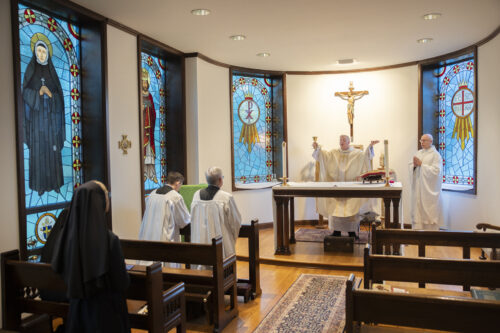
At an early morning Mass at his residence, Archbishop Mitchell T. Rozanski presided at the rite of institution for Salvador Alatorre and Jonathan Klimpel. “We are reminded that Jesus in the Church uses so many different ministries so that we can bring the grace of God to others,” the archbishop said.
As acolytes, “you should strive to live more fully by the Lord’s sacrifice and be molded more perfectly in its likeness,” the archbishop told them. “You should seek to understand the deep spiritual meaning of what you do so that you may offer yourselves daily to God as spiritual sacrifices acceptable to Him through Jesus Christ. In performing your ministry, bear in mind that as you share the one bread with your brothers and sisters, so you form one body with them.”
Alatorre and Klimpel had been serving in other roles at the cathedral basilica for decades. Alatorre joined the cathedral parish in 1973, and before the COVID pandemic, he became a lector. A few years ago, a sacristan at the parish was thinking of stepping back from his duties and asked Alatorre if he had considered helping out more at Mass.
Klimpel, who has been at the cathedral basilica for the past 20 years, has served in a variety of roles, including sacristan, server, usher, lector and finance committee member and has taken Communion to the homebound.
Now, as acolytes, the two assist at Masses primarily by retrieving consecrated hosts from the tabernacle in the Blessed Sacrament chapel. Both said that duty has been a help, especially to visiting priests who are unfamiliar with the layout of the cathedral.
“That does help to just sort of keep things a little more prayerful for the priest” and to keep their focus on celebrating Mass, Klimpel said.
“I think we don’t realize how many different roles we need at Mass, in service, and so the acolyte is one of those roles of service,” Archbishop Rozanski said. “Usually it’s been reserved (for) seminarians, because they’re installed as lector and then as acolyte on the way to the priesthood. But now certainly since Vatican II, it’s been opened up to the laity to participate.”
Acolytes in the Church
The Ministry of Instituted Acolyte is a permanent institution in the Catholic Church, which has its roots in the formation of ordained clergy and is dedicated to service at the altar. Instituted acolytes strive to learn all they can about public divine worship and to grasp its inner spiritual meaning.
The instituted acolyte is appointed to assist the deacon and serve the priest in the celebration of the liturgy. A primary responsibility is to assist with the purification of vessels used in the distribution of holy Communion and may assist with other duties, including accessing the Eucharist in the tabernacle. Instituted acolytes, as necessary, may also assist with the formation of other servers who assist at the altar and bring holy Communion to the sick.
The ministry of the instituted acolyte was among several ministries and minor clerical orders Pope Paul VI revised in 1972.