Pauline Media Center director Sister Nancy Usselmann offers practical ideas for parents in balancing media use

Parents have a double responsibility to parent their children and the media they consume, Sister Nancy Usselmann said. But how can they accomplish that through the lens of faith and invite Christ into our media experience?
From accumulating likes to swipes and scrolling, young people have become the “guinea pigs of a great social experiment” through their engagement with social media platforms and other media consumption, said Sister Nancy, a Daughter of St. Paul and director of the Pauline Center for Media Studies in Los Angeles.
“These issues have put a lot of pressure on parents, especially because not only do you have to parent your children, but you have to parent the media that they experience and that they engage in,” she said.
By approaching media use through the lens of faith, parents can ensure that their children engage with a digital culture safely and virtuously, Sister Nancy said at a Feb. 28 discussion on “Parenting the Media: Raising Disciples in a Digital World” at Pauline Books &Media in Crestwood.
She invited parents to move from reacting to media to pastorally guiding their family’s digital life. She also offered practical tools for setting healthy media boundaries and modeling virtue online.
“It’s a chance for us to take back our lives, to take a step back and really reflect on what are we doing in this digital culture,” she said.
Sister Nancy recommended several approaches for parents to take a balanced approach to their children’s media use, noting that it’s important to set clear boundaries and make intentional choices. Instead of letting screens dominate their daily lives, parents should implement practical approaches, such as no phones at the dinner table, removing devices from bedrooms at night, placing limits on social media or gaming and agreeing on times to unplug at night. Creating that structure contributes to the growth of virtues such as temperance and self‑control and reminds them that technology is a tool, not a master, she said.
“We have to step out and reflect on in this world of masters, how do we truly be a disciple of Christ?” Sister Nancy said. “These are tools, these means of communication, the media are tools to help us to communicate. There are positive ways, and the Church always sees them as gifts of God, but it’s also how we use them, and it requires a lot more intentionality now than ever to navigate what has become previously uncharted terrain for parents, not only for yourselves, but also for your children.”
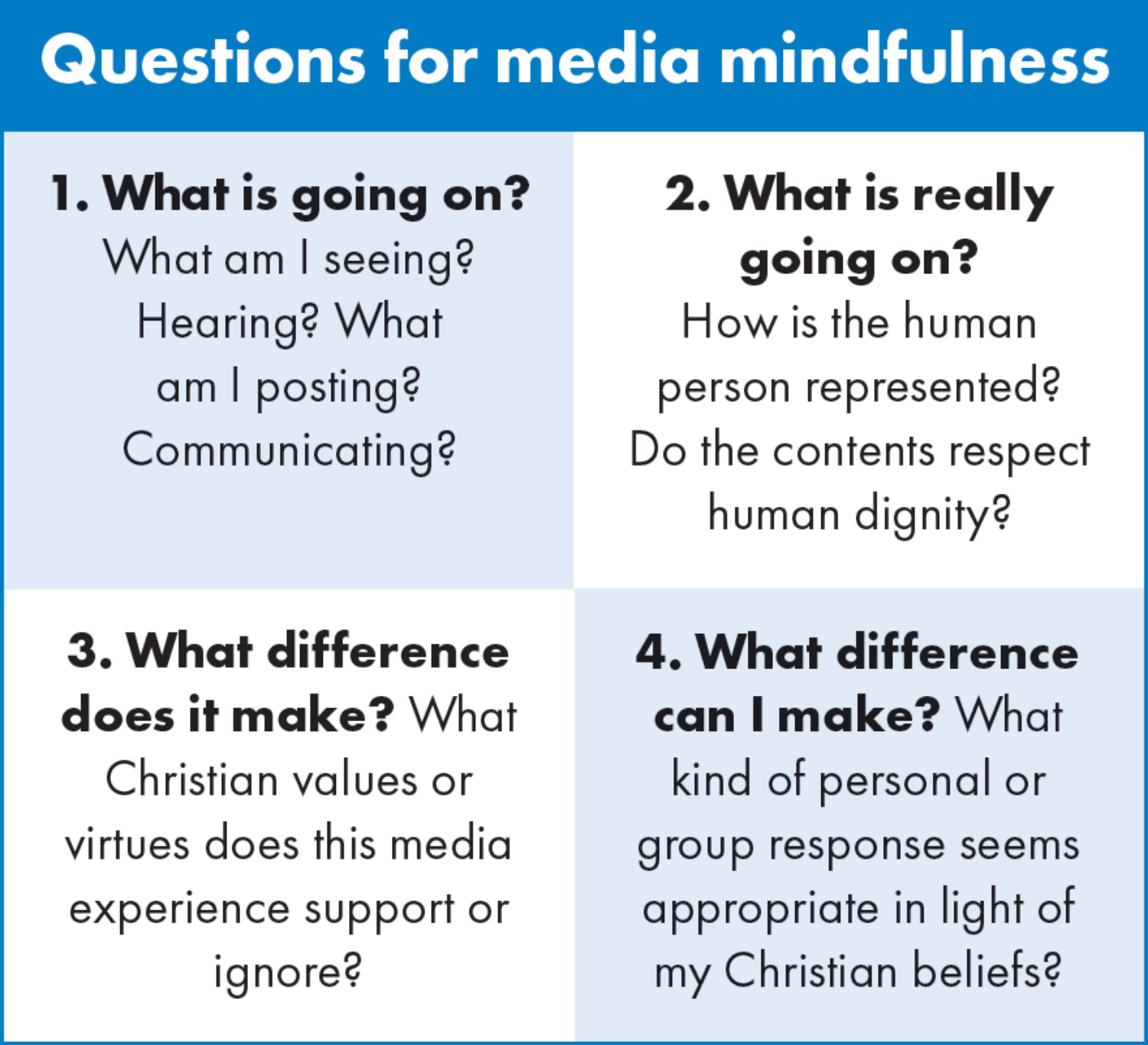
She suggested that families ask “media mindfulness” questions to develop a habit of thinking critically about the messages found in media. Rather than passively absorbing content, families can critically think about how the messages measure against the Gospel and recognize what is true, good and beautiful — and what is not, she said.
Sister Nancy also encouraged periodic fasting from media use as a way to reflect on how media is used and to focus on what matters most. That can include choosing one day a week with no social media or video games, planning device-free evenings and weekends or temporarily giving up the use of certain apps.
“We realize how much digital devices are consuming us and the messages — we’re receiving more than 4,000 media messages a day, whether we’re aware of it or not,” she said. “We have to unclutter ourselves from that sometimes, and a media fast can do that. It’s a way to pray over our media. It’s about praying the media, which is really important that we don’t just see this as removing it from our lives or limiting its use, but that we invite Christ into our everyday media experience.”
Implementing a media fast can also allow families to connect with God and increase opportunities for prayer, she said. “Now we have time to pray instead of scrolling on social media,” she said. “Maybe you were on Instagram reels or TikTok reels and you realize 30 minutes have gone by, right? Maybe I could have used that time for prayer.”
Blessed James Alberione, who founded the Pauline family to evangelize, educate and spread the Good News using modern means of social communication, said that any small exploration made with the idea of discovering ourselves brings us closer to the pinnacle of knowledge, Sister Nancy said.
“In other words, media fasting can be that way that we come to know who we really are,” she said. “We come to recognize our areas of weakness and what is tempting for us, especially in our media use. And the more we can recognize it, the more we can do something about it.”
How much screen time?
Set an age for screen use: Before 6 years old, screen use can affect language skills, depression issues and social interaction. Consider no screen for babies and toddlers and limited use thereafter (less than one hour).
Set an age for smartphones: Consider flip phones until high school and no social media accounts before then. Teens may complain, but in the end they will thank you.
Set boundaries and stick to them: Set screen time limits for children and teens and evaluate the type of content of media they use. Review everything, including movies, video games, TV series, music, YouTube videos and social media. Know who your children are texting and what they are playing, watching or listening to. Talk to them about why you made certain choices and ask them how various media make them feel.
Unplug together: Put all devices away while you eat together as a family. Your example of unplugging gives your children permission to not always be “on.” Create a “media fast” challenge.
Create central area for screens: To prevent your children from engaging in inappropriate content or losing sleep because they are on screens, put all devices (computers, tablets, TVs, gaming consoles and phones) in a central area of the house to monitor screen use.
For additional resources, visit bemediamindful.org.