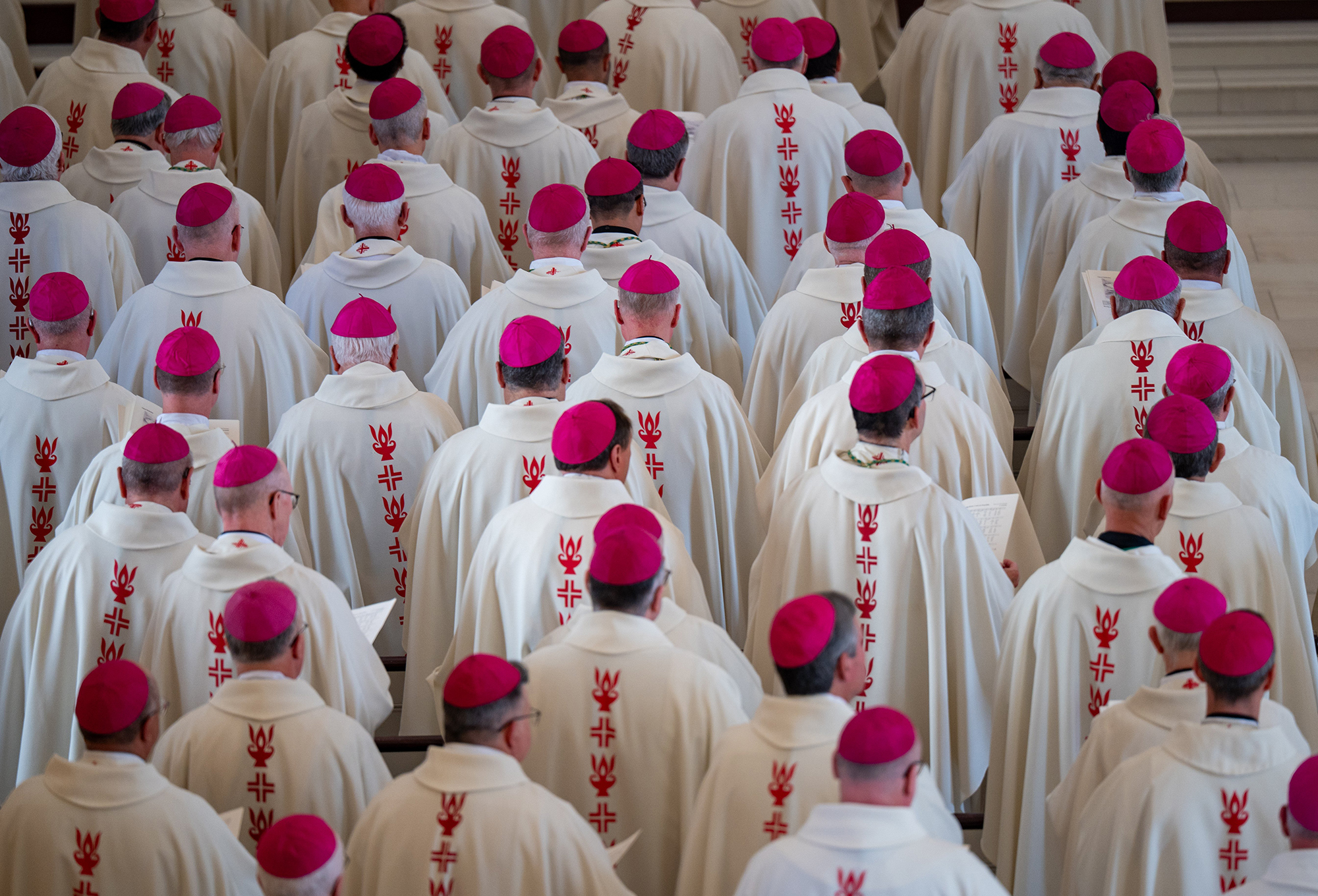
The bishops also elected the chairs of several committees on the first day of plenary assembly
BALTIMORE — Amid U.S. anxieties over disruptions to air travel, finance and cybersecurity undergirding modern life, the U.S. bishops kept the first public session of their annual November plenary assembly squarely focused on how the Church could build a better, peaceful and more humane world centered around Jesus Christ.
At the start of the Nov. 17 public session of the Nov. 16-19 gathering of the U.S. Conference of Catholic Bishops in Baltimore, the bishops approved a special message to Pope Leo XIV, expressing thanks for his recovery from surgery to remove lung cancer, and addressing peace, artificial intelligence, immigration and marriage and family life.
They highlighted Pope Leo’s “renewed call to safeguard human dignity in an age of profound technological change,” and underscored their own formation of a special task force in September “to examine the ethical, pastoral, and societal implications of artificial intelligence.”
Referring to the special pastoral message on immigration they issued at last November’s assembly, the bishops said, “Please be assured that we continue to advocate for the dignity and rights of immigrants and to pray for everyone experiencing fear, uncertainty, and separation from their loved ones.”
The message asked for Mary’s intercession to “bring about lasting peace in all areas of the world torn by conflict and strife.” The bishops also thanked Pope Leo “for your continued witness to the beauty and vocation of marriage and family life, and for your reminder that promoting the family is an urgent task for the Church and society.”
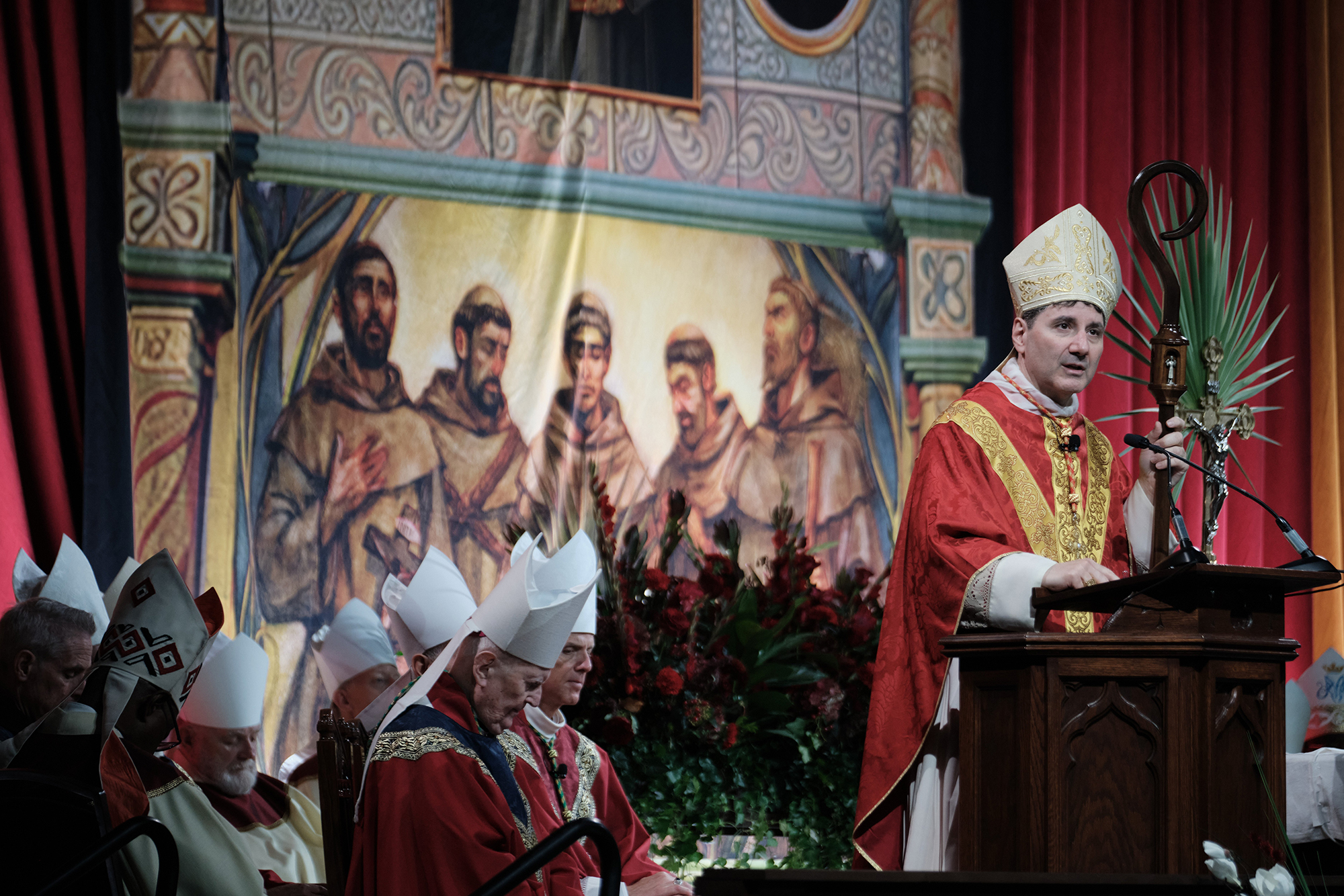
Addressing the body of bishops as president of the USCCB, Archbishop Paul S. Coakley — borrowing an image from Pope Leo’s encyclical “Magnifica Humanitas” — laid out what he saw as four “construction sites” for the Church: rebuilding the family, worship, synodal dialogue and discernment and civic life.
“To a world that is deprived of a sense of hope, where isolation, depression, confusion and anger all come into play, in such a world, the mission of the Church is to act as a construction site of hope, where hope is rooted in Christ and His promise,” he said.
With a standing ovation, the bishops warmly received the message of Archbishop Gabriele G. Caccia, the apostolic nuncio to the U.S. The papal ambassador shared how his travels across the U.S. showed him a Church filled with “people who love the Church and are committed to her mission,” with clergy, religious and lay faithful who work together “in a spirit of co-responsibility.”
After lunch, the bishops elected Bishop Kevin C. Rhoades of Fort Wayne-South Bend, Indiana, as the USCCB’s next secretary in a 157-59 vote. Additionally, the bishops elected chairmen-elect for the USCCB’s committees on: Catholic education, Bishop James D. Conley of Lincoln, Nebraska; communications, Bishop Louis Tylka of Peoria, Illinois; cultural diversity, Bishop Michael M. Pham of San Diego; doctrine, Bishop William M. Joensen of Des Moines, Iowa; national collections, Bishop Gerald L. Vincke of Salina, Kansas; and pro-life activities, Bishop Donald J. Hying of Madison, Wisconsin.
They will serve for one year as chairman-elect of the respective committee, then begin a three-year term as chair at the conclusion of the bishops’ 2027 fall plenary assembly.
The bishops also voted for Father Paul B.R. Hartmann, currently associate general secretary of the USCCB, to serve as general secretary of the conference for a five-year term, replacing the current general secretary, Msgr. Michael J.K. Fuller.
The bishops heard additional presentations on items they would be voting upon the following day: an expanded lectionary and Book of the Gospels that are intended to make sure the readings at Mass match what the faithful read in the forthcoming Catholic American Bible; a resolution on diocesan financial reporting through 2031; and updated socially responsible investment guidelines, which contains updated approaches to existing issues while also addressing artificial intelligence, private prisons, cryptocurrency, prediction markets and shareholder advocacy versus divestment as a strategy to advance the Church’s goals of promoting human life, dignity and the common good.
The bishops also voted 149-6 with four abstentions to extend the Religious Retirement Fund Appeal, which Bishop Rhoades said raises $28 million annually on average, for the next five years.
Just before the first public session concluded, the bishops also heard how the U.S. Church is participating in the Intercontinental Guadalupan Novena, which commemorates the 500th anniversary of the 1531 apparitions of Our Lady of Guadalupe.
Bishop Óscar Cantú of San Jose, California, chair of the USCCB’s Subcommittee on Hispanic/Latino Affairs, highlighted the “enthusiasm across the United States” generated by the “One Tilma, One Heart” initiative, where replicas of the tilma of St. Juan Diego Cuauhtlatoatzin — touched to the original — have been distributed so far to 85 dioceses.
Bishop Daniel E. Flores of Brownsville, Texas, vice president of the USCCB, explained the Guadalupan event of 1531 and encouraged everyone to read “The Wonder of America,” the pastoral letter of Los Angeles Archbishop José H. Gomez posted on the Los Angeles Archdiocese’s website, which explains the Virgin’s appearance as key to understanding the origin of the U.S. and all the nations of the Americas.