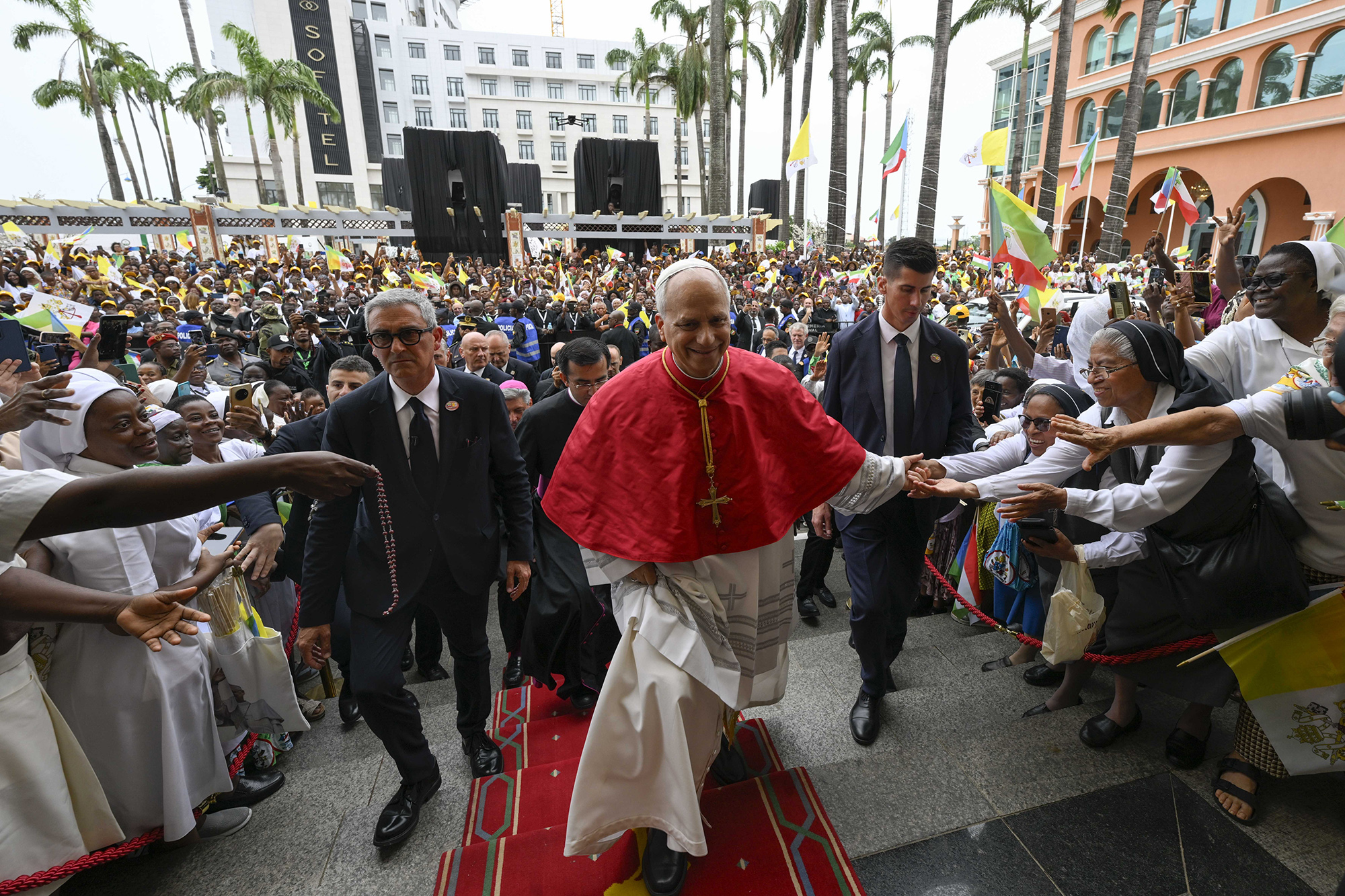
Pope Leo’s visit to Algeria, Cameroon, Angola and Equatorial Guinea ephasized hope, care for people in need
On his 11-day journey to four countries in Africa, Pope Leo XIV focused on peace and care for the poor. He visited Algeria, Cameroon, Angola and Equatorial Guinea.
In clear, direct language, Pope Leo spent his time in Cameroon denouncing violence, corruption and exploitation, while calling for reconciliation and credible leadership. He has repeatedly framed peace not as an abstract ideal, but as a responsibility shared by political leaders, communities and individuals alike. His next stop was in Angola, where he celebrated Masses with 120,000 people in the nation’s capital and in the heart of Angola’s diamond country, near the nation’s largest diamond mine. His final stop was in Equatorial Guinea, where he visited a prison and prayed at a memorial to people who died in an explosion at a military barracks in 2021.
A peace meeting in the heart of Cameroon’s conflict zone
BAMENDA, Cameroon — A religious sister in Cameroon who was kidnapped just a few months ago by separatists and held hostage for three days in the bush was among those who shared her testimony with Pope Leo on April 16 in an emotional peace meeting in Cameroon’s northwest city of Bamenda, a region marred by years of separatist violence.
“We were held hostage for three days and three nights. During those days and nights, we neither slept nor ate,” Sister Carine Tangiri Mangu told the pope. “What kept our hope alive was the Rosary which we prayed continuously for those days.”
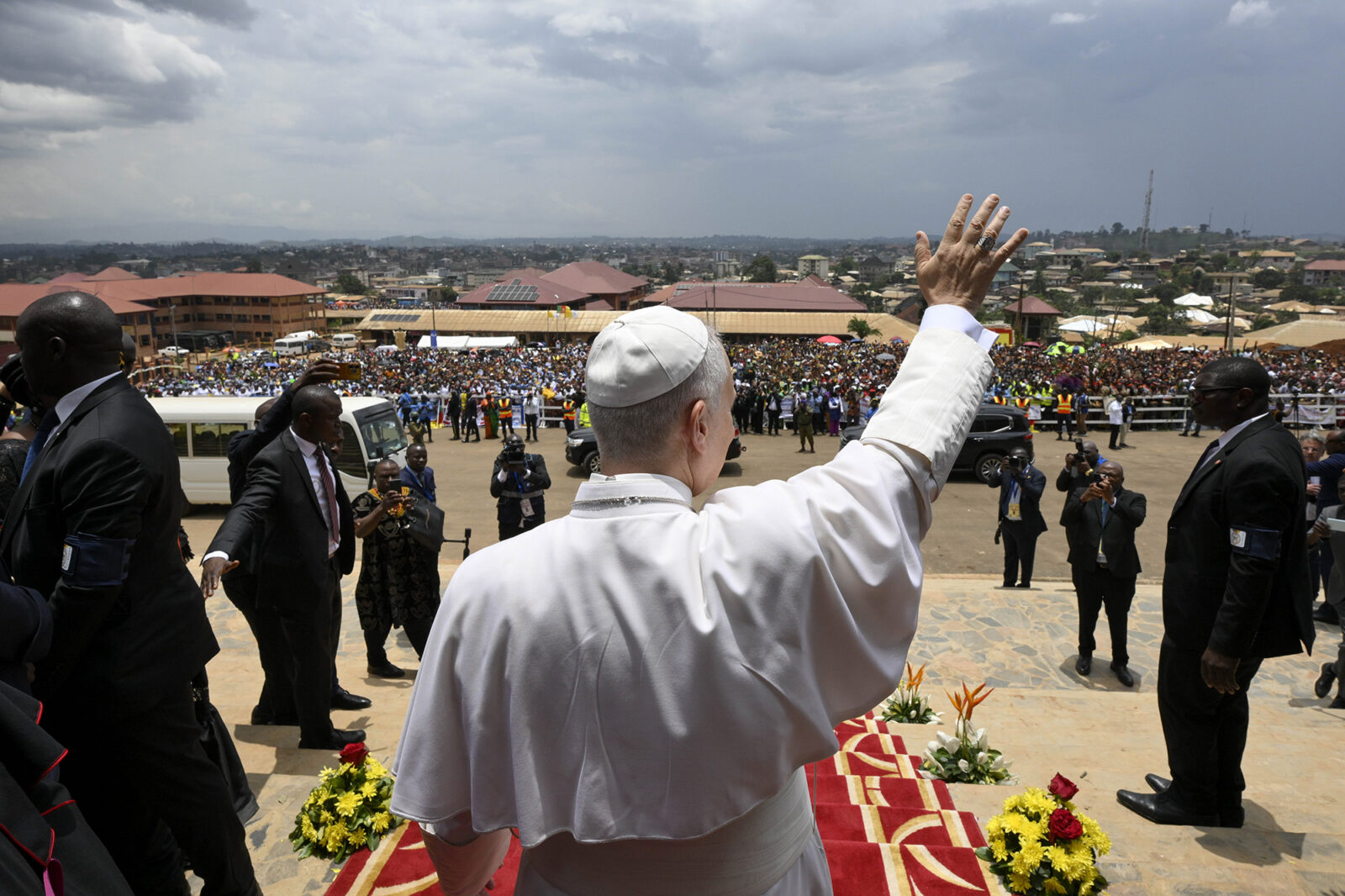
Pope Leo XIV waved after attending a Meeting for Peace at St. Joseph’s Cathedral in Bamenda, Cameroon, on April 16.
The long-running separatist conflict in its English-speaking regions has killed thousands since 2017. The violence pits Anglophone separatists against the Francophone-dominated government, leaving entire communities displaced and children out of school in what humanitarian groups describe as one of the world’s most neglected conflicts.
In his speech in St. Joseph’s Cathedral, Pope Leo loudly and passionately said, “I am here to proclaim peace,” to an enthusiastic reaction in the crowd.
The pope also had strong words of denunciation for those who perpetuate war. “The masters of war pretend not to know that it takes only a moment to destroy, yet often a lifetime is not enough to rebuild,” the pope said. “They turn a blind eye to the fact that billions of dollars are spent on killing and devastation, yet the resources needed for healing, education and restoration are nowhere to be found.”
Pope Leo strongly denounced those who “rob your land of its resources generally invest much of the profit in weapons, thus perpetuating an endless cycle of destabilization and death.”
Pope Leo tells children they can always find a friend in Jesus
YAOUNDE, Cameroon — Pope Leo brought joy to 64 orphaned and abandoned children on the evening of April 15 when he visited the Ngul Zamba orphanage in Cameroon, blessing the children and assuring them that despite their suffering, Jesus “cares especially for children like you.”
The orphanage, whose name means “the power of God” in the Ewondo language, is run by the Congregation of the Daughters of Mary and currently houses children ranging in age from 3 to 20 years old.
“Dear children, I know that many of you have endured difficult trials,” the pope told the children, speaking in French. “Some of you have known the pain of loss through the death of parents or loved ones. Others have experienced fear, rejection, abandonment, deprivation and uncertainty. Yet, you are called to a future that is greater than your wounds.”
The pope drew on the Gospel to remind the children of Christ’s particular love for the young, noting that Jesus “would often place them at the center of a gathering” and looks upon each child “with that same affection” today.
120,000 people attend papal Mass in Douala, Cameroon
DOUALA, Cameroon — Pope Leo celebrated Mass for more than 120,000 people in Cameroon’s largest city on April 17, urging “beloved children of the African continent” to share God’s love by feeding the hungry and offering the spiritual nourishment of “the bread of life.”
Because of the large turnout, the Mass was held in a parking area next to Douala’s Japoma Stadium under 90-degree heat. Remerit Ngwe, 28, waited 16 hours outside overnight for the papal Mass. “Since yesterday (at) 7 p.m. we slept here on the stone waiting for the pope,” she said. “We are so happy we finally saw the pope, Pope Leo, a once in a lifetime experience. Long live the pope!”
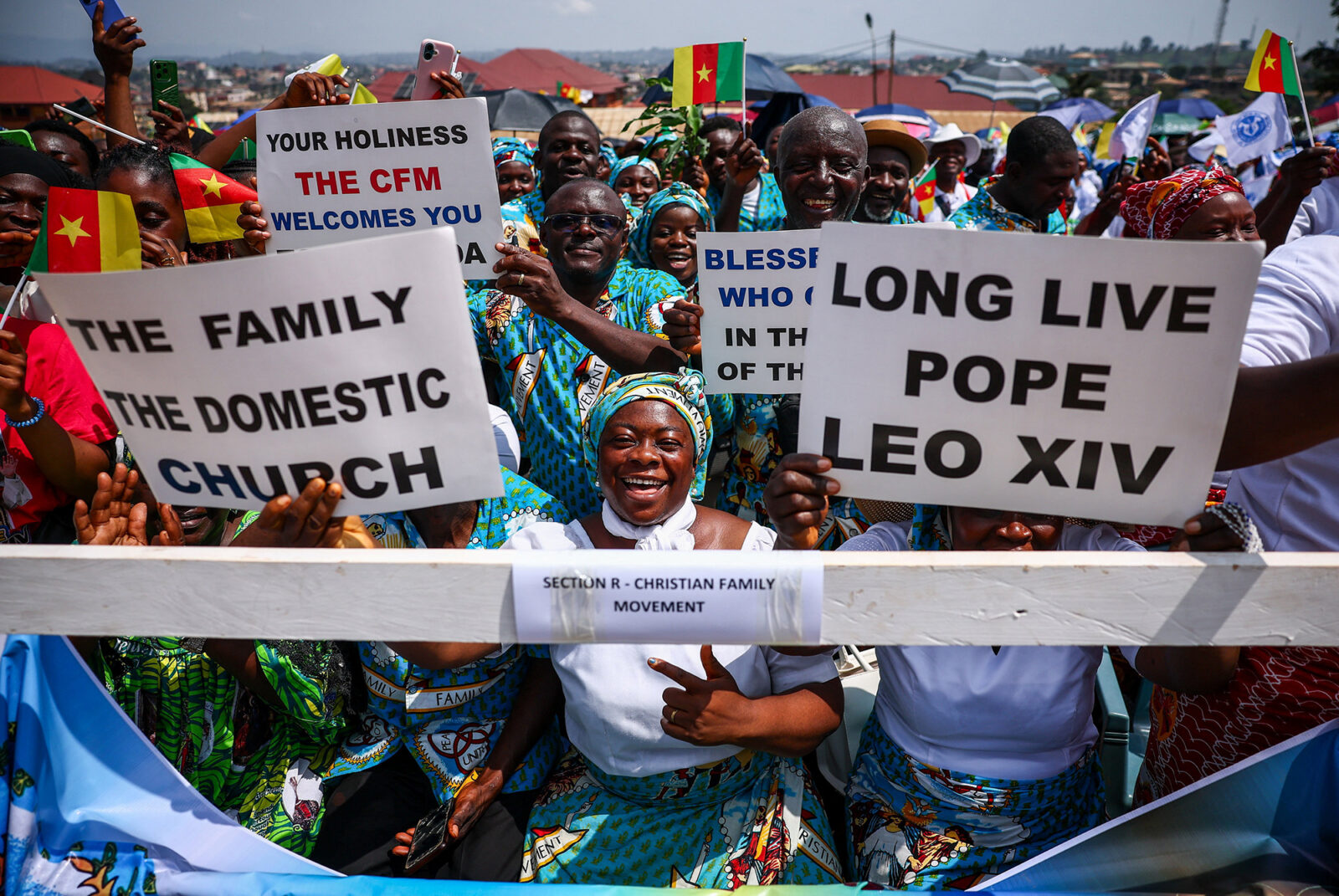
People held signs outside St. Joseph’s Cathedral in Bamenda, Cameroon, on April 16 as they waited for the arrival of Pope Leo XIV for a Meeting for Peace.
Speaking in both French and English during his homily, Pope Leo opened with a striking question to the Cameroonian congregation: “Where is God in the face of people’s hunger?”
He turned to the Gospel of John and its account of the multiplication of the loaves and fishes to respond.
“A serious problem was solved by blessing the little food that was present and sharing it with all who were hungry,” Pope Leo said in French.
“There is bread for everyone if it is given to everyone. There is bread for everyone if it is taken, not with a hand that snatches away, but with a hand that gives,” he underlined.
According to the World Food Programme, 2.9 million people in Cameroon face food insecurity and need humanitarian assistance, with about 23% of the population living below the poverty line.
The Eucharist can ‘rekindle lost hope,’ Pope Leo says at Mass in Angola
KILAMBA, Angola — Pope Leo celebrated an outdoor Mass for an estimated 100,000 Catholics in Angola on Sunday, April 19, urging the faithful of a nation still bearing the scars of a decades-long civil war to find renewed hope in the Eucharist and the risen Christ.
Speaking in Portuguese to a crowd gathered in Kilamba, a planned residential district about 18 miles south of the capital Luanda, the pope delivered a homily that wove together the biblical story of the disciples on the road to Emmaus with Angola’s painful modern history.
“The history of your country, the ongoing difficult consequences you endure, the social and economic problems, and the various forms of poverty call for the presence of a Church that knows how to walk alongside you,” Pope Leo said, adding that the Eucharist has the power to “rekindle lost hope.”
Kilamba itself reveals Angola’s complex post-war development — the planned city was built by the China International Trust and Investment Corporation (CITIC) under a bilateral financing agreement between the Angolan and Chinese governments, a reminder of Beijing’s growing economic footprint across the African continent.
Pope Leo XIV leads Rosary at beloved Muxima Marian shrine in Angola
MUXIMA, Angola — Pope Leo led tens of thousands of Angolan Catholics in praying the Rosary April 19 at southern Africa’s most visited Catholic shrine, calling the pilgrimage site a place where “the heart of the Church” is “alive and beating.”
The pope traveled by helicopter from Angola’s capital, Luanda, to the Sanctuary of Mama Muxima, which means “Mother of the Heart” in the local Kimbundu language. Pope Leo made the pilgrimage to the beloved Marian shrine situated on the banks of the Kwanza River.
Local authorities estimated approximately 30,000 pilgrims gathered on the Muxima shrine’s esplanade for the recitation of the Rosary, with even more gathered in surrounding areas. Many had camped at the site for two or three days in anticipation of the papal visit, enduring 90-degree heat in the hours before his arrival. The crowd greeted the pope with singing and dancing as he moved through the grounds in a golf cart.
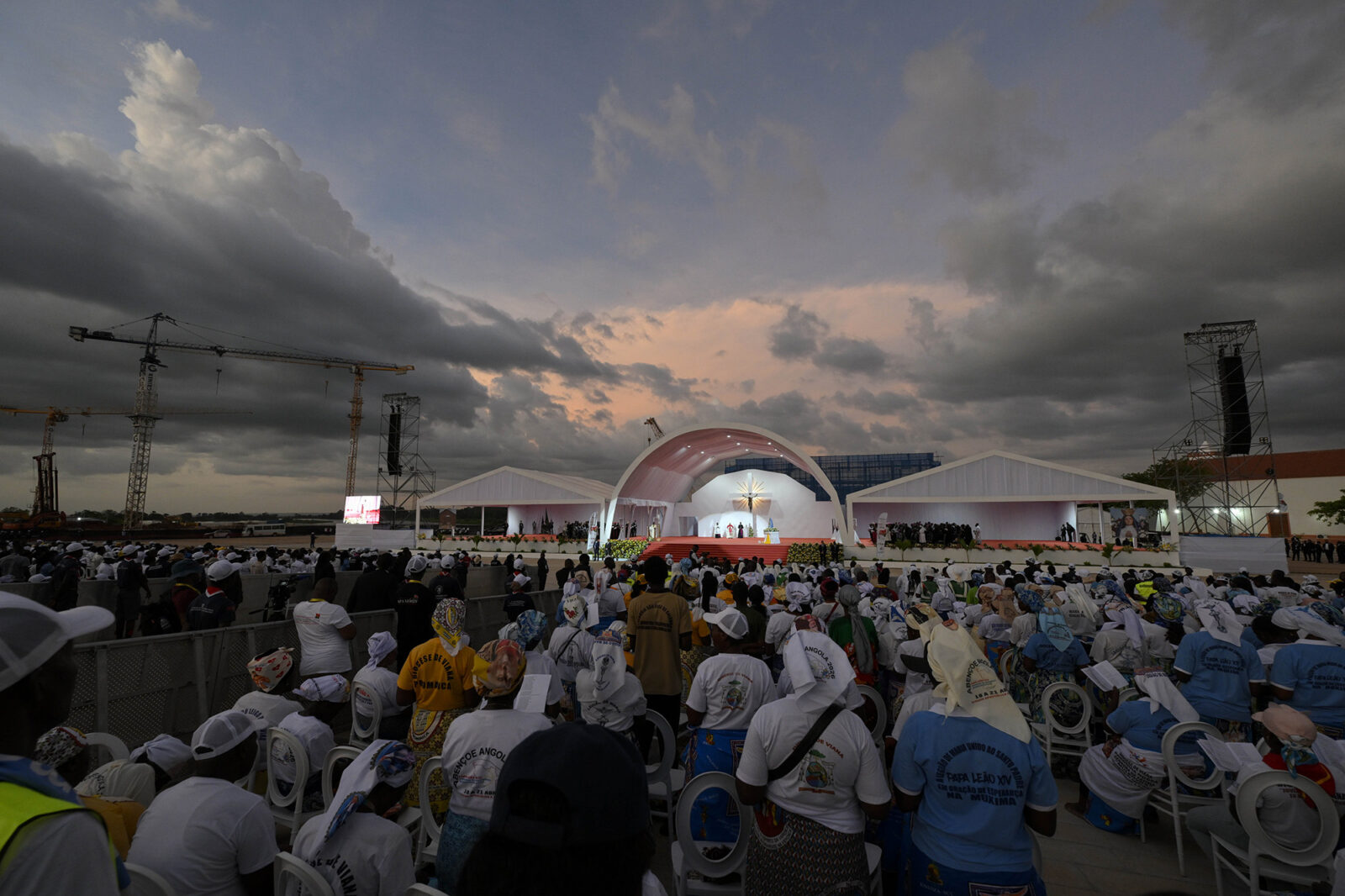
Pope Leo XIV led the Rosary at the Sanctuary of Our Lady of Muxima in Muxima, Angola, on April 19. The shrine is one of the largest in southern Africa.
“We are in a sanctuary where, for centuries, many men and women have prayed in times of joy and also in moments of sorrow and great suffering in the history of this country,” the pope said, speaking in Portuguese. “For a long time now, Mama Muxima has quietly worked to keep the heart of the Church alive and beating.”
The church, formally dedicated to Our Lady of the Immaculate Conception, was first established in 1599 during the era of Portuguese colonial Angola. More than 1 million pilgrims visit the shrine during its largest pilgrimage alone, which occurs each year between Aug. 31 and Sept. 1.
Pope Leo reflected on how the faithful had over the centuries spontaneously renamed the shrine “Mama Muxima,” calling it “a beautiful title, which makes us reflect on the heart of Mary: a pure and wise heart, capable of treasuring and pondering the extraordinary events in the life of the Son of God.”
Pope celebrates Mass near Angola’s largest diamond mine
SAURIMO, Angola — Pope Leo XIV traveled to the heart of Angola’s diamond country April 20, urging the tens of thousands gathered at the papal Mass in the country’s northeast to trust that “Christ hears the cry of the people” in the face of evil.
On the eighth day of Pope Leo’s apostolic journey to Africa, the pope flew some 500 miles east of the Angolan capital Luanda to Saurimo, a city located near the country’s border with the Congo and about 20 miles from Angola’s largest diamond mine, Catoca.
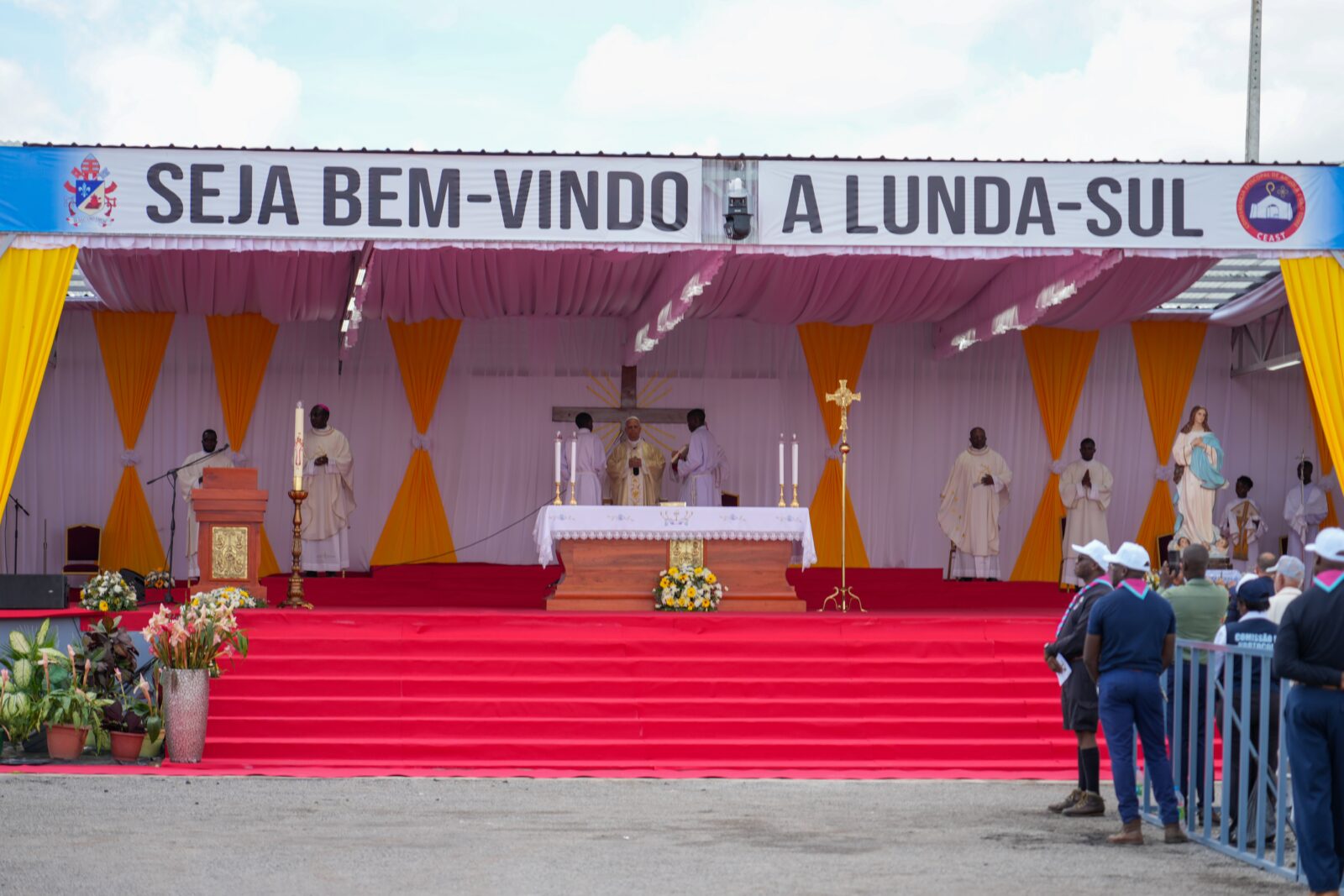
More than 40,000 people gathered for an outdoor Mass with Pope Leo XIV in Saurimo, Angola, April 20, 2026.
Amid the exploitation long associated with Angola’s diamond industry, the pope delivered a homily in Portuguese that did not shy away from the social realities of a region long marked by resource extraction and inequality.
“We can see today how the hope of many people is frustrated by violence, exploited by the overbearing and defrauded by the rich,” Pope Leo said in his homily. “Consequently, when injustice corrupts hearts, the bread of all becomes the possession of a few.”
“In the face of these evils, Christ hears the cry of the people and renews our history by lifting us up from every fall, comforting us in every suffering and encouraging us in our mission,” the pope said.
Before the Mass, Pope Leo visited a nursing home that is home to 74 elderly residents ranging in age from 60 to 93. The visit was marked by moments of joy. Several residents danced in celebration of the pope’s presence, including one elderly man who danced using a cane.
Pope Leo addressed the staff and residents directly, calling the care of the most vulnerable a measure of a society’s moral health.
“The care of the weakest is a very important sign of the quality of the social life of a nation,” the pope said.
He added: “Let us not forget that the elderly are not only in need of assistance, but first and foremost need to be listened to, because they preserve the wisdom of a people.”
Pope urges authorities to choose justice over power
MALABO, Equatorial Guinea — Pope Leo arrived April 21 in Equatorial Guinea, the fourth and final country of his 11-day apostolic journey in Africa, where the pope met the country’s longtime ruler and urged the country’s civil authorities to choose justice over power, quoting St. Augustine’s “City of God.”
At the airport, Pope Leo was welcomed by a military band and President Teodoro Obiang Nguema Mbasogo, who has ruled the oil-rich Central African nation since seizing power in a 1979 coup and is regarded as one of the world’s most authoritarian leaders.
Speaking in Spanish at the presidential palace, with Obiang seated beside him, Pope Leo delivered a pointed appeal for justice and ethical governance in a country long criticized for corruption and human rights abuses.
“In a world wounded by arrogance, people hunger and thirst for justice,” the pope said, telling the authorities that the Church can help to form “free and responsible consciences.”
Turning to St. Augustine, the pope reflected on the contrast between two “cities” described in St. Augustine’s classic work “The City of God”: one built on love of God and neighbor, the other on self-interest and the pursuit of power.
The “city of God” is characterized by love, especially for the poor, Pope Leo said. “The earthly city … is centered upon the proud love of self, on the lust for power and worldly glory that leads to destruction.”
He urged leaders and citizens alike to discern “which city they wish to serve.”
Equatorial Guinea, a former Spanish colony that gained independence in 1968, is one of sub-Saharan Africa’s largest oil producers. Despite its high per capita income, much of the population lives in poverty, with wealth concentrated among elites.
In his speech, Pope Leo warned against economic systems that exclude the poor, echoing his predecessor Pope Francis and his criticism that “such an economy kills.” He added that global conflicts are increasingly driven by the exploitation of natural resources “with no regard for international law or the self-determination of peoples.”
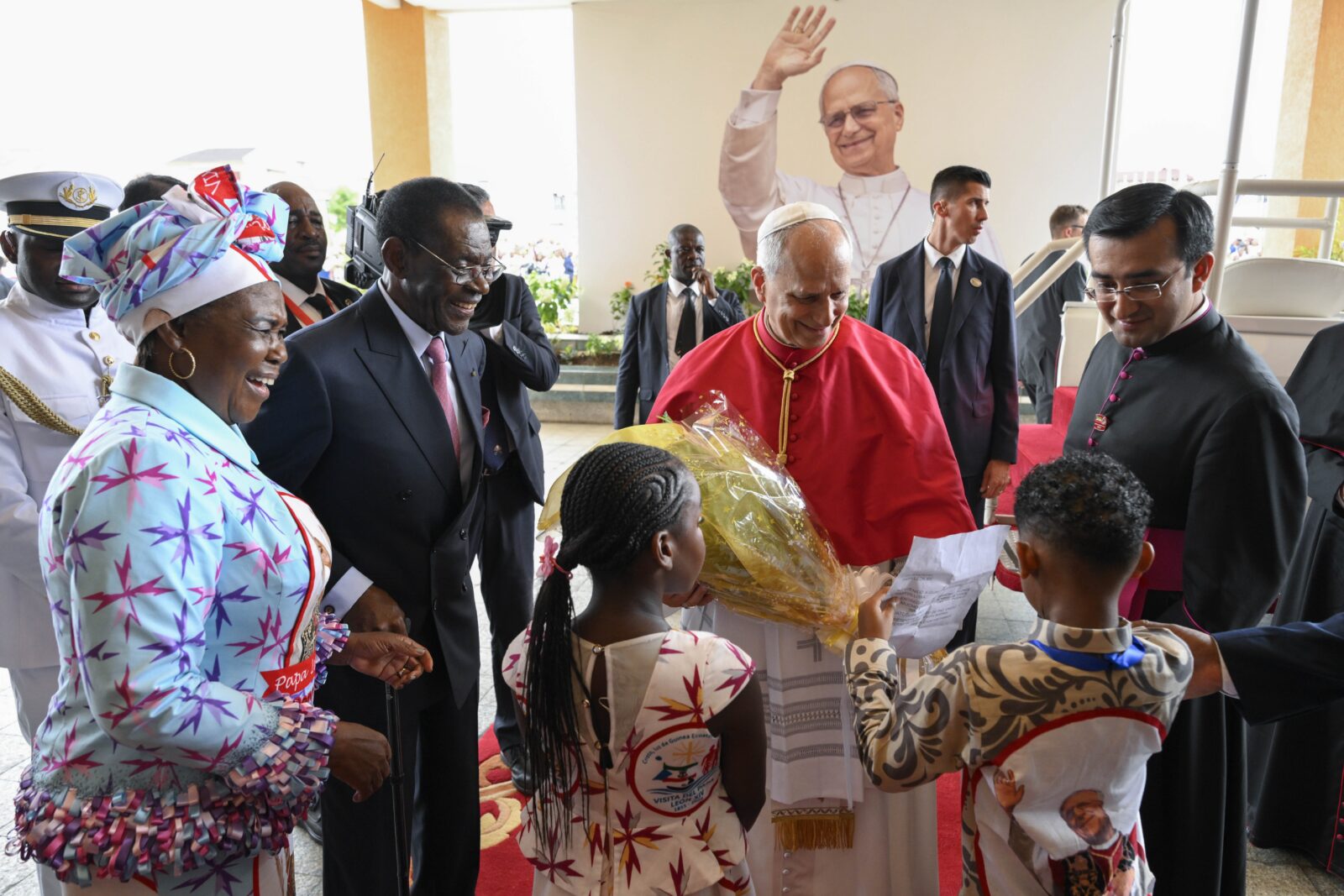
Pope Leo XIV was greeted by children as he met with President Teodoro Obiang Nguema Mbasogo of Equatorial Guinea, to his left, at the Presidential Palace in Malabo April 21, 2026, as he began his apostolic visit to the African nation. To the far left is First Lady Constancia Mangue de Obiang.