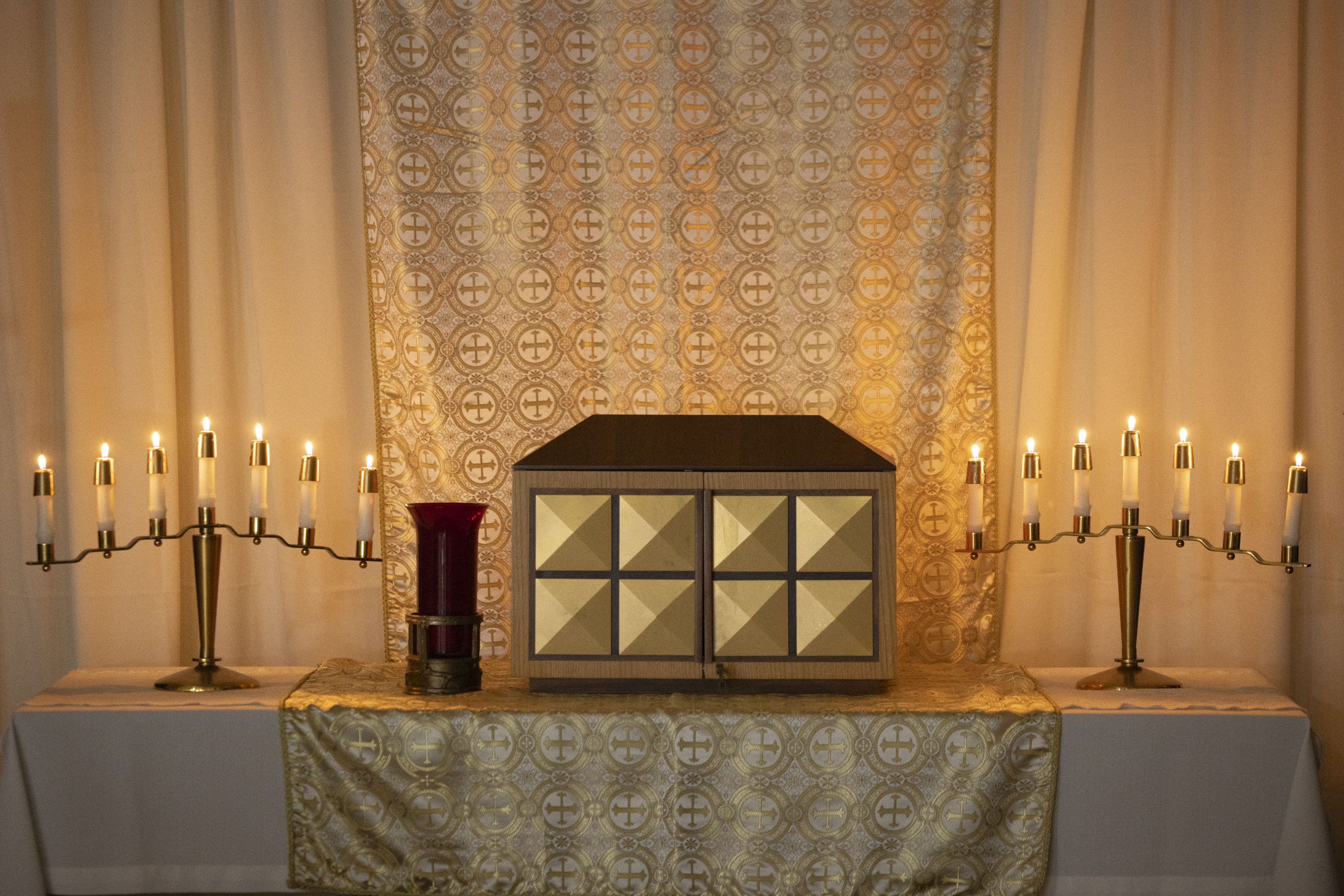
Tradition meditates on events from Jesus’ agony in the garden through His crucifixion
After the Last Supper, Jesus’ apostles accompanied Him to the Garden of Gethsemane to pray and keep watch. On Holy Thursday evening, Catholics are invited to do the same through a longstanding tradition known as the seven churches visitation.

Alyson Radford fell in love with the tradition after experiencing it for the first time in 2022. Now, as the director of evangelization and discipleship at St. Clare of Assisi Parish in Ellisville, she encourages others in her parish and around the archdiocese to partake, too.
“We are both body and soul, so being able to enter into the spiritual reality with our body helps us to make that better connection and develop a deeper relationship with the Lord,” Radford said.
At the end of the Mass of the Lord’s Supper on Holy Thursday, nearly everything is removed from the altar and sanctuary in order to demonstrate the bareness of the cross. The tabernacle is emptied, with the door left open — a reflection of the emptiness of the world without Christ.
The Eucharist is placed in a tabernacle on an altar of repose, separate from the church’s main altar. Churches typically stay open for a few hours of prayer that evening, and the reserved consecrated hosts are then used during the Good Friday liturgy the following day. (Since Mass is not celebrated between the time of Jesus’ death and resurrection, Communion hosts are not consecrated on Good Friday.)
Seven churches visitation
The seven churches visitation, or pilgrimage, invites Catholics to pray at seven different altars of repose on Holy Thursday evening. It was popularized by St. Philip Neri in the 1500s, who would lead groups of pilgrims to visit each of the seven basilicas in Rome, but may have been practiced as far back as early Christians in Jerusalem.
Each year since 2023, Radford has been assembling a Google Map with information about altars of repose in churches throughout the archdiocese, with help from colleagues and friends. She also put together a meditation guide that includes the seven traditional “stations” that follow in Jesus’ footsteps from His agony in the garden through His crucifixion.
“This is our opportunity, since Christ is outside of time, to be able to accompany Him, to be able to show our gratitude, our praise, our thanksgiving, our love of what He is about to go through and has gone through for us,” she said.
Radford takes her parish OCIA candidates and catechumens on the pilgrimage each year and often hears that it’s one of their favorite formation activities, she said. It’s a chance to experience the beauty of what Christ did for them and spend some extra time in prayer as they await their sacraments of initiation just two days later.
The tradition can also be a great opportunity to invite a friend to accompany you for the evening, she said: Go to Mass, embrace the mini-road-trip atmosphere as you travel your chosen route, then go out for a late-night snack before the fasting of Good Friday begins.
In the car ride between churches, “you can be having discussions about what it is that went on: How would you feel if you were to put yourself in that place? Where would you be in the Scripture? Who would you be? What do you think it would be like, and how does that then cause us to act?” she said. “Simple devotions like that are a great way to be able to invite people into experiences that are just the spark to be able to get them asking questions.”
Accompanying Jesus
For those who can’t make it to seven different churches because of distance, young children with earlier bedtimes or other factors, Radford encourages all to observe the tradition however they can. Maybe that means just visiting one or two other churches, praying all seven stations at your parish’s altar of repose or even setting aside some time at home for silent prayer.
“It’s not about a checklist of making it to seven churches. This is about accompanying Jesus in the garden and on His journey and developing my relationship with Him,” she said. “So it’s OK if you don’t finish, and it’s OK if you’re exhausted, because the apostles fell asleep in the garden and you’re right there with them. It’s a beautiful way to end Lent by having that final sacrifice of your time and your energy to spend when we would much rather be going to bed.”
For Radford, the evening has another element of significance. She is in formation to take vows as a consecrated virgin living in the world, a form of consecrated life in the Church in which she will become a bride of Christ. Making sacrifices to be with Jesus during the observance of His passion and death is one way she can love Him in good times and in bad, sickness and health, she said.
“To be able to enter in and be there and offer comfort, but also to share His burden in a special way — it’s a great joy,” she said.
Make your own Seven Churches Visitation
Map of altars of repose at churches around the Archdiocese of St. Louis, including hours and location (updated on an ongoing basis): stlreview.com/altarsofrepose
Alyson Radford’s Seven Churches Pilgrimage meditation guide: stlreview.com/47KocPB
Alyson’s Spotify playlist for the driving time: stlreview.com/4rCDcWL
Meditations for each church visit:
Starting church: Jesus in the Garden of Gethsemane (Luke 22:39-46)
Second visit: Jesus bound and taken before Annas (John 18:19-22)
Third visit: Jesus taken before the high priest Caiaphas (Matthew 26:63-65)
Fourth visit: Jesus taken before Pilate (John 18:35-37)
Fifth visit: Jesus taken before Herod (Luke 23:8-9, 11)
Sixth visit: Jesus taken before Pilate again (Matthew 27:22-26)
Seventh visit: Jesus crowned with thorns and led to crucifixion (Matthew 27:27-31)