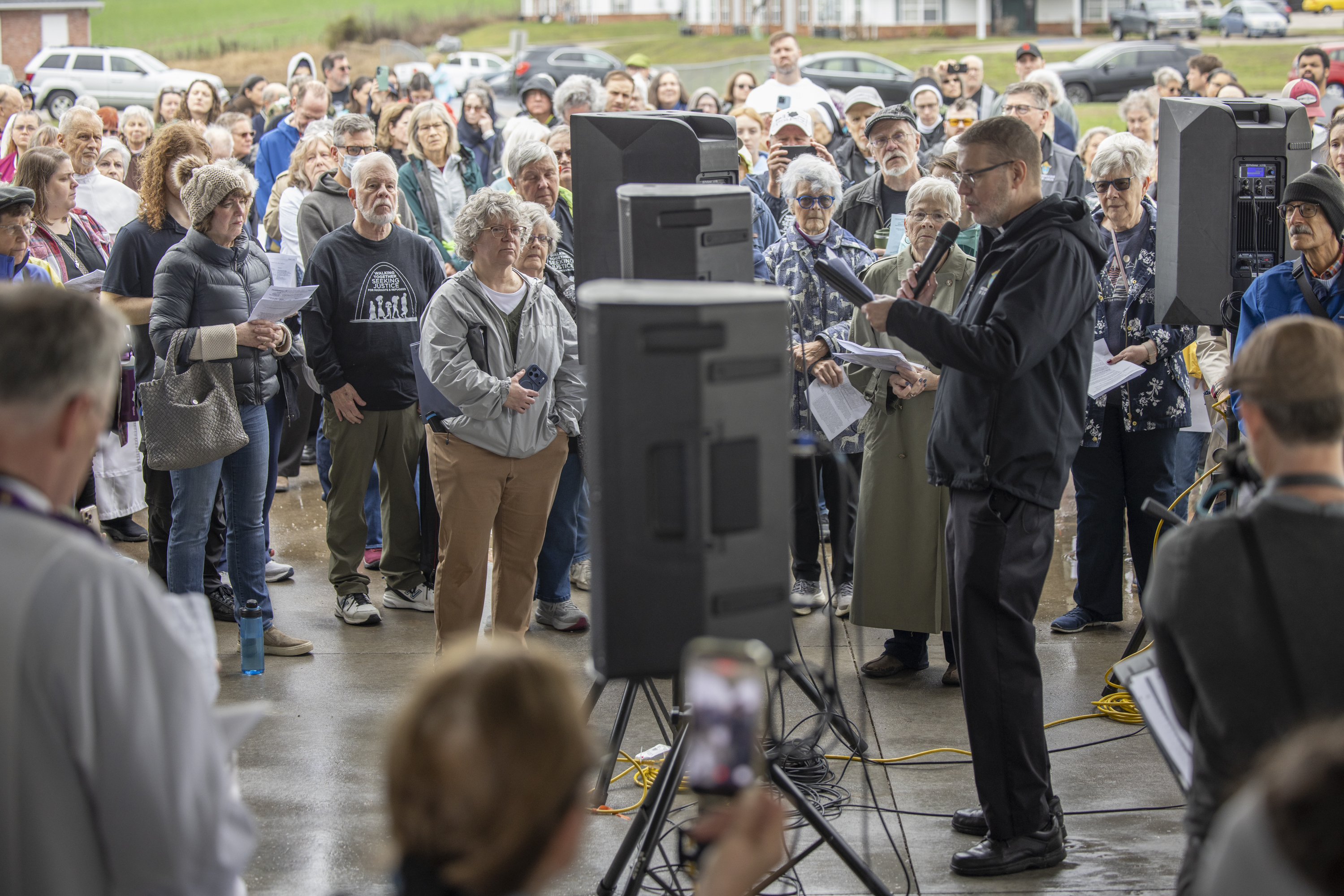
It is good for us to be together today. Archbishop Rozanski was not able to be with us, but he sends his blessing, and he is praying for us. We are blessed indeed to have an Archbishop who has spoken out many times on the issue of immigration. My name is Father Scott Jones, and I am one of the episcopal vicars, and I’m here to speak on his behalf.
A couple of months ago, I was in a meeting that focused on immigration, and one of the Hispanic parish representatives at the meeting broke down crying. I’ll never forget her words that came out with her sobs. She said, “I was born at Barnes Hospital, and I am a U.S. citizen. But because I am brown and have an accent, I have to carry my passport with me everywhere, and so does my daughter. So many of the people in my parish community are at risk; some have been detained. No one knows the nightmare we are living through right now, the fear, the hatred that is directed towards us, even from our fellow Catholics. That’s what hurts the most…knowing that some of our fellow Catholics don’t care what is happening to us, knowing that some of them even support what is happening to us.” She then spoke directly to the priests in the room: “Please, we need to know that the Catholic community stands with us, that you know what is happening to us, that you see what is happening to us, and that you care and are willing to speak up.”
Her words have stuck with me. I’ve thought about them a lot. We are here today, Catholics, Protestants, priests, religious, ministers, people of other religions…we are here today to share that we do know what is happening, we see it, and that we do care, and that we are willing to speak up. You are not forgotten. Whether you are detained, or at risk of detention, or have loved ones who are at risk, you matter. And that care and concern we express today isn’t just for undocumented persons. We also care deeply about law enforcement officials and those who work in detention centers. We care about those who mistakenly support everything that is happening to our immigrant brothers and sisters. The love of Christ doesn’t discriminate. That’s what makes it love.
As Christians, we interpret everything, the present moment, the past, we interpret everything through the lens of the Gospel. We even have a term for it: salvation history. The times we are living in are part of salvation history, which means that God is present and no matter how much the sin of racism or xenophobia seems to dominate what goes on around us, and perhaps even what goes on within us — because we all carry sinful attitudes — God is present, and He is calling us to something wonderful: salvation. Salvation isn’t just a word. Salvation is grounded in love; it is defined by love — God’s love for us, the love God has for every person, the love God goes so far as to demand of us — not just to love him, but to love others, including those who disagree with us. That’s why today isn’t about judging anyone or saying hateful things that drive the wedge in deeper. There has been enough of that. Today is an invitation, first to us, that we set aside any judgment or animosity we have towards anyone, including those who disagree with us on the issue of immigration. If we accept that invitation to love, then we can become the means by which God invites others to lay aside their own animosity or, more likely, their fear. There is so much fear in our country right now, and fear is used to divide us. Fear is being used to scapegoat groups of people, be it immigrants or people of different political beliefs. Our fear is being used to encourage us to hate each other, to regard one another as enemies. The salvation of God invites us to let go of fear and to see one another as brothers and sisters.
Because salvation history is so much a part of how we view the world, we cannot be silent when it comes to injustice. There are times when people have asked me where the Church stands on the issue of immigration, especially immigration enforcement. This isn’t a gray issue; it is black and white. Pope Leo, the U.S. bishops, and Archbishop Rozanski have all said multiple times that countries have the right to regulate immigration. No one disputes that. But they have also repeatedly acknowledged that our current system of immigration enforcement is morally flawed…meaning sinful. They have made it clear that we oppose the indiscriminate mass deportation of undocumented persons, that mass round-ups accomplish nothing and generate a culture of fear that inevitably leads to violence. They have said repeatedly that there needs to be fair and just pathways to achieving legal status, and means of welcoming those who are fleeing injustice from other countries. They have spoken out against separating families or detaining persons who have not committed crimes and who are going about normal daily activities, such as taking their kids to school. They have spoken out against use of dehumanizing language, whether it is towards undocumented persons or towards law enforcement. Whether we are talking about Pope Leo, or the U.S. Bishops, or Archbishop Rozanski, at the heart of their teaching is the Gospel of Jesus: that we treat every person with the compassion and dignity that we would show to Jesus himself, because it is Jesus himself who asks that of us.
None of this is unachievable. It is possible. We’ve been down this road before as a country. In the mid-19th century, there was tremendous prejudice against Catholic immigrants in the United States, including widespread violence. Politicians, political cartoons, speakers on the lecture circuits mocked Irish-Catholics and Catholics from southern and eastern Europe. The Know Nothing Party was the largest third party in U.S. history, and in the 1850s, they swept state legislatures in the Midwest and Northeast. Members of the Know-Nothing party promised never to vote for a foreigner or a Roman Catholic. At the time, it seemed impossible that the prejudice would come to an end, that we would ever get past that divisive moment as a nation…but we did. And we will get through this moment as well, if we don’t lose hope.
Today, we pray for our undocumented brothers and sisters. We pray for their families. We also pray for anyone who is living with fear, be it fear for immigrant communities, or fear of immigrant communities. There are many wounds that need to be healed, but the healing power of Jesus will do just that- — heal — and the day will come when we will see how God was walking us through this particular moment of salvation history, bringing us not only closer to him, but to each other as well. May our hearts be open to healing, and may we become agents of God’s healing in the world.