
Altar relics are a sign of spiritual continuity with early Church, communion with saints in heaven
On the feast of All Saints, Catholics celebrate the holy men and women who have come before us and now intercede for us in heaven.
Many also take the opportunity to display and venerate saints’ relics and give thanks for their faithful witness, pointing us toward God.
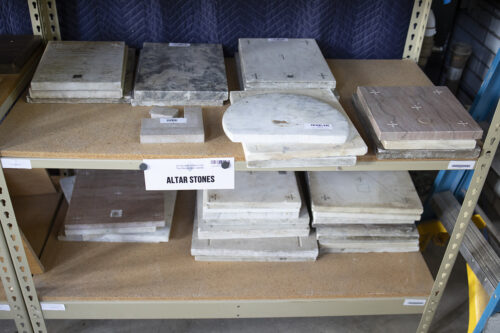
The Reclamation Center of the Archdiocese of St. Louis in Shrewsbury houses altar stones from decommissioned altars.
Lesser known, perhaps, are the saints inside church altars.
The tradition of placing relics within an altar has deep roots in Christian history, said Father Nick Smith, director of the archdiocesan Office of Sacred Worship and rector of the Basilica of St. Louis, King of France (Old Cathedral). In the book of Revelation, John says: “I saw underneath the altar the souls of those who had been slaughtered because of the witness they bore to the word of God” (Revelation 6:9).
“This imagery reflects the early Christian understanding of the altar as intimately connected to the sacrifice and witness of the martyrs,” Father Smith said.
In the Catholic Church, relics are customarily placed within the principal altar used for the celebration of the Eucharist. They are often sealed inside an altar stone — a piece of stone that can be inserted into a cutout on the top of an altar — but can also be placed in reliquaries below the altar.
The General Instruction of the Roman Missal affirms this tradition, stating: “The practice of placing relics of Saints, even those who are not Martyrs, beneath the altar to be dedicated is fittingly retained. However, care should be taken to ensure the authenticity of such relics” (GIRM 302).
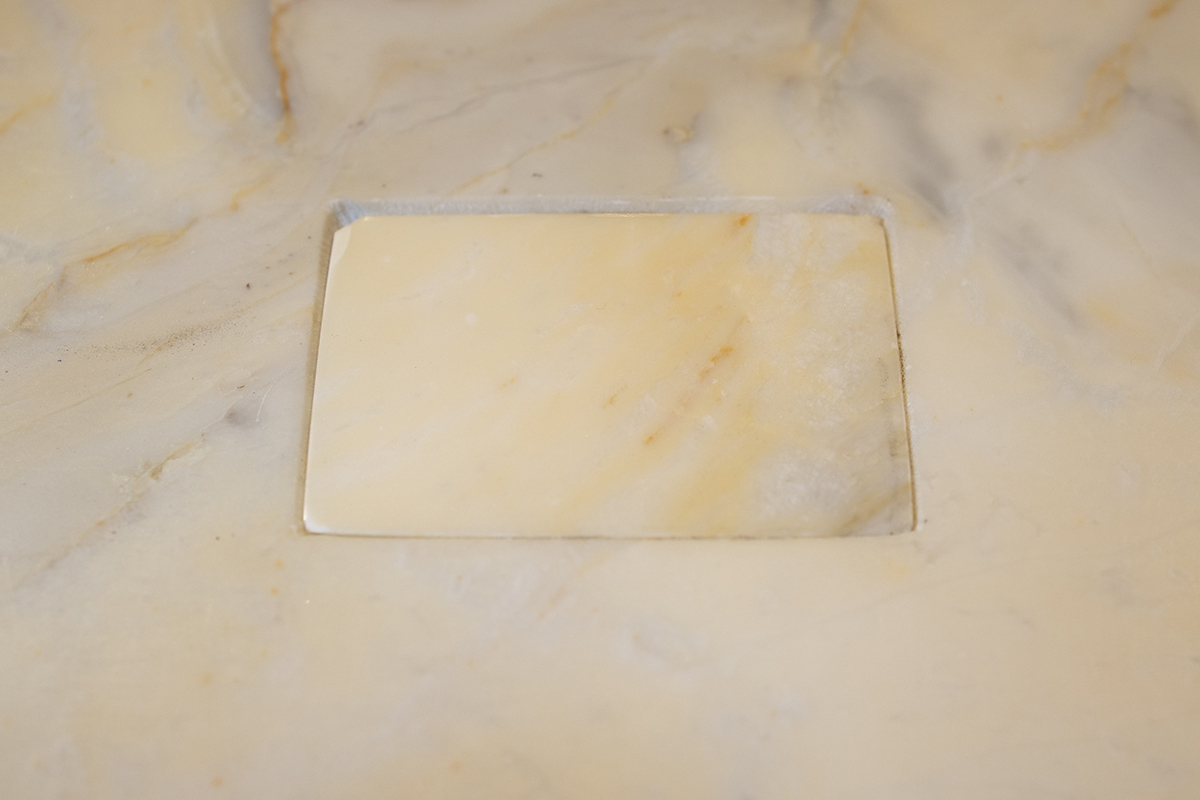
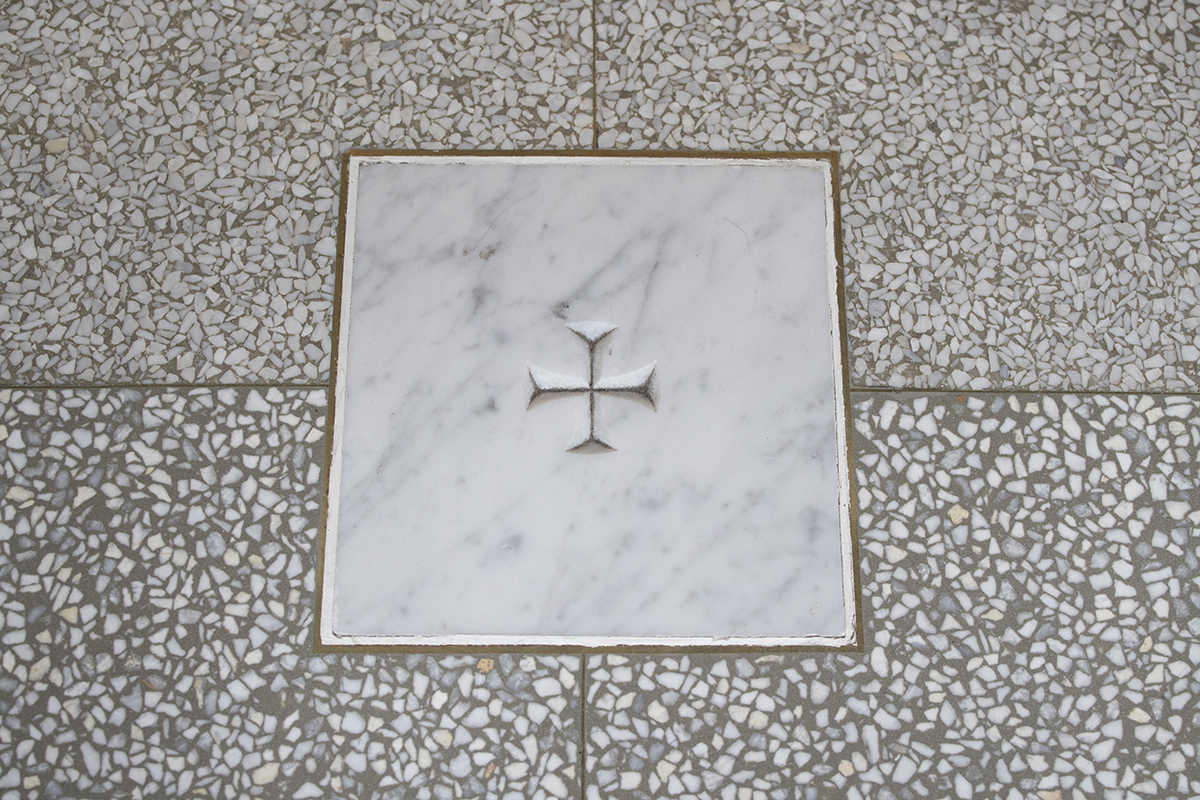
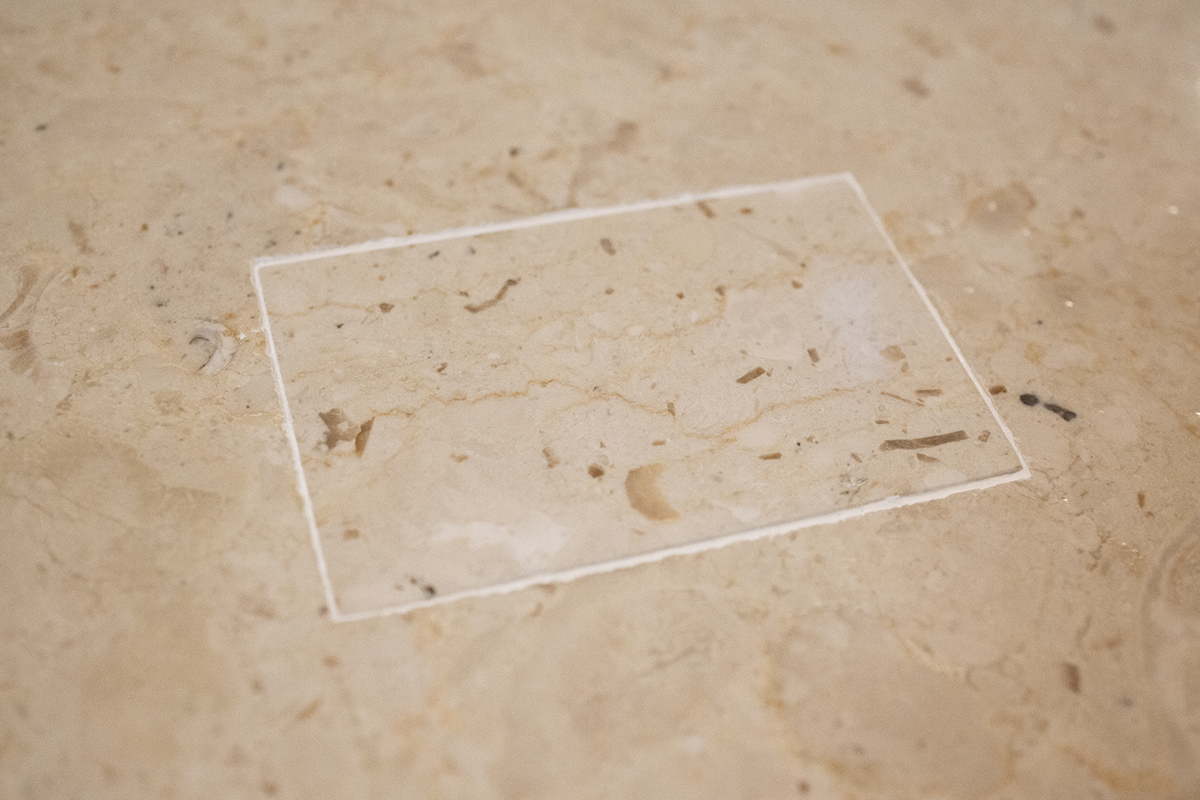

The practice began in the early Church, when Christians would gather to celebrate the Eucharist over the tombs of martyrs in the catacombs. As Christianity spread and churches were constructed, this tradition continued by transferring relics from the tombs to the altars of the newly built churches.
“Celebrating Mass on an altar containing the relics of the saints — especially martyr saints — is a powerful sign of spiritual continuity and faith,” Father Smith said. “Their willingness to shed blood for Christ becomes profoundly linked with the eucharistic sacrifice, the very mystery that gave them strength and courage. It is a reminder that the Church is built upon the witness of the saints, and that every celebration of the Eucharist is an encounter with their enduring legacy of faith, hope and love.”
In the Archdiocese of St. Louis, relics are housed in the Office of Sacred Worship, which assists churches seeking altar relics. Altar stones removed from decommissioned altars are housed in the Reclamation Center.
Who’s in the altar?
The Cathedral Basilica of Saint Louis’ altar includes relics of three early-Church martyrs: St. Benignus of Dijon, St. Jucundus of Rheims and St. Illuminatus of Ravenna. After Vatican II, a relic of 20th-century pope St. Pius X was added, cathedral basilica rector Msgr. Henry Breier said.
The altar at St. Ambrose Church in St. Louis also contains relics of three early martyrs: St. Liberatus, St. Irenaeus and St. Clement I, sealed inside an altar stone placed in the main altar. The saints’ earthly bodies remind us that these holy men and women were real people who lived real lives on earth, just like us, St. Ambrose pastor Father Jack Siefert said.
“These brave men and women who were martyrs, they remind us of what we should be for Christ, and that is we give our life, our souls, our everything to Jesus,” Father Siefert said. “So they are just heroes for me of how I should behave as a human being for Christ.”
The new Chapel of the Risen Christ in Resurrection Cemetery was completed and consecrated this summer. Catholic Cemeteries’ staff worked with the Office of Sacred Worship to select 11 relics for the chapel’s altar: St. John Henry Newman, St. Rita, St. Maria Goretti, St. John Vianney, St. Pius X, St. Vincent de Paul, St. Therese of Lisieux, St. Rose Philippine Duchesne, St. Denis, St. Stanislaus Kostka and St. Gertrude.
“We wanted to get saints that were meaningful, saints that maybe had a connection either to the country or to us in St. Louis, and then connected to the people involved” in the chapel project, said Matt DeWitt, Catholic Cemeteries’ managing director of administration services.
St. Vincent de Paul and St. Rose Philippine Duchesne are patrons of the archdiocese; St. Gertrude’s prayer for the souls in purgatory has a clear connection to their work, DeWitt said. Availability of relics also played a role.
Archbishop Mark S. Rivituso celebrated solemn evening prayer the night before the Chapel of the Risen Christ was consecrated, during which the relics were put on display. Then, during the Mass of Consecration, the relics were processed to altar, where they were entombed in a sarcophagus beneath and later sealed by a mason.
“We’re so far removed from what occurred 2,000 years ago, and yet so close all at the same time,” DeWitt said. “The cemeteries and catacombs were the first places of worship, so for us, that’s pretty meaningful.”
When Father Matthew Stewart, SJ, was looking for relics for the new Chapel of the Beloved Disciple at St. Louis University High School, he first went to the Jesuits’ U.S. Central and Southern Province archives. From there, he obtained a relic of St. Ignatius of Loyola, the founder of the Jesuits, as well as relics of three young Jesuits: St. Aloysius Gonzaga, St. Stanislaus Kostka and St. John Berchmans, all young men who died prior to their ordination.
“So as a high school for boys, these were all Jesuit boy saints — we thought those were key,” Father Stewart said.
He then went to the Office of Sacred Worship seeking a relic of St. John the Beloved Disciple, the patron saint of the new chapel. He figured it was a long shot.
“But about 15 minutes later, (Father Smith) calls me up and says, ‘You’ll never believe it — the very first relic I pulled out was of St. John the Beloved,’” Father Stewart said.
The relics are housed in a metal box sealed with a ribbon and wax, placed inside the floor directly underneath the altar and covered by a white stone.
Being able to celebrate Mass over the relics of saints gone before us is “a beautiful and powerful and moving tradition for us to continue,” Father Stewart said.
“At Mass, we pray with the Church on earth and the Church in heaven. And to be that close to these saints, physically but also spiritually, is really significant and important,” he said. “With John, the apostle — to think that there’s a piece of someone who is the apostle who laid his head on the Lord’s chest at the Last Supper is pretty cool, as we commemorate the Last Supper at Mass every time. It’s really moving. It’s a detail that is not lost on me as I preside at Mass.”
What is a relic?
Relics are physical objects that have a direct association with a saint or with Jesus.

First-class relics are the body or fragments of the body of a saint, as well as the cross on which Jesus was crucified.
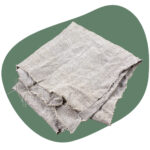
Second-class relics are items that a saint touched or owned, such as clothing, or pieces of those items.
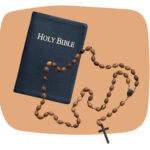
Third-class relics are items that a saint has touched or items that have been touched to another relic.
Relic veneration on All Saints Day
The Cathedral Basilica of Saint Louis will have its collection of more than 140 relics on display for veneration and prayer in the All Saints Chapel following 8 a.m. Mass on Saturday, Nov. 1. In addition to the relics housed in reliquaries, the cathedral basilica also has a number of relics of St. John Paul II from his 1999 visit, including the altar he used for Mass and a prie-dieu he knelt on as he prayed in the Blessed Mother’s Chapel.
The Basilica of St. Louis, King of France (Old Cathedral) will also have relics available for veneration on All Saints Day, Nov. 1. The relic collection will be displayed at the side altar of St. Louis.
St. Therese relics to visit St. Louis in November
Relics of St. Thérèse of Lisieux will be in the Archdiocese of St. Louis from Nov. 10-13. Her relics are in the U.S. for the second time — the first was in 1999-2000 — and will make 40 stops in 11 states from Oct. 1-Dec. 8. This year marks 100 years since the Little Flower’s canonization.
Monday, Nov. 10, at St. Agnes Home in Kirkwood: Veneration of relics from 8 a.m.-6 p.m.; Mass at 9 a.m.
Tuesday, Nov. 11 and Wednesday, Nov. 12 at the Carmel of St. Joseph in Ladue: Veneration of relics from 6:30 a.m.-8:30 p.m.; Mass at 7 p.m.
Thursday, Nov. 13 at Little Flower Church in Richmond Heights: Venration of relics from 10 a.m.-6:15 p.m.; Mass at 6:30 p.m.